Tag Archives: County Durham

Leading Stoker Andrew Blakey

Leading Stoker Andrew Blakey

Andrew Dryden Blakey was born on 14th October 1873 in Jarrow, County Durham. One of twelve children, his parents were John and Jane Blakey. John was a joiner by trade, and the family were brought up at 71 Hedley Street, South Shields.

When he completed his schooling, Andrew was set on broadening his horizons. On 21st January 1899 he enlisted in the Royal Navy as a Stoker. Full details of his time in the navy have been lost to time, but by the time he reached the end of his contract, he had spent thirteen years at sea, and had risen to the rank of Leading Stoker.

On 4th February 1902, Andrew married Eleanor Slater, a labourer’s daughter from South Shields. The have five children, and, while her husband was at sea, she would take rooms with her uncle.

Leading Stoker Blakey was stood down to reserve status on 30th July 1913. His service records at that point show that he was 5ft 3.5ins (1.61m) tall, with blue eyes and a fair complexion. He was also noted as having a number of tattoos: clasped hands and a star on his right forearm, and his initials on the left.

When war broke out, Leading Stoker Blakey was called into action once more. After an initial assignment on board the battleship HMS Duncan, his time was split between HMS Pembroke and HMS Wildfire, the Kent shore bases at Chatham and Sheerness respectively.

Andrew’s health was becoming impacted by this point, however, and, in the spring of 1917, he was admitted to the Royal Naval Hospital in Chatham with carcinoma of the colon. The condition would ultimately take his life: he died on 4th May 1917, at the age of 43 years old.

The body of Andrew Dryden Blakey was laid to rest in the naval section of Woodlands Cemetery, Gillingham, Kent, not far from the Chatham Dockyard, he had for so long called home.


Stoker 1st Class William Fawkes

Stoker 1st Class William Fawkes

William Fawkes was born on 31st July 1883 in South Shields, Country Durham. One of seven children, his parents were called William and Ann. William Sr was a steam crane operator in the local docks, and the 1891 census found the family living with Ann’s widowed husband Ralph in an apartment on Bedford Street.

Ralph died not long after the census was taken, and it seems that William and Ann took over the tenancy. The 1901 return found the family living at 8 Bedford Street, this noted as being a private home. William Jr had finished school and was employed as a labourer to a blacksmith; three of his sibling were also gainfully employed, the family managing to scratch together enough of a living to pay the rent.

By the start of 1903, William Jr was starting to get itchy feet, and sought out a career on the ocean wave. On 5th January he enlisted in the Royal Navy as a Stoker 2nd Class, and was sent to HMS Pembroke, the Royal Naval Dockyard in Chatham, Kent, for his training. His service records confirm that he was 5ft 3.5ins (1.61m) tall, with bark hair, brown eyes and a fair complexion. He was also noted as having his initials – WH – tattooed on the back of his right hand.

Stoker Fawkes completed his training in October 1903, and was sent to the battleship HMS Sans Pareil as his first posting. He only remained on board for a couple of months, before a move to another battleship, HMS Resolution. In June 1904, he was transferred again, to HMS Swiftsure, a third battleship that he would call home for the next three years.

During his time on board Swiftsure, William was promoted, gaining the rank of Stoker 1st Class for his work. Over the next decade, he served on a further seven ships, returning to his base in Kent between voyages.

In the spring of 1904, William married Mary Hornby. The daughter of a publican, she had continued to support her mother and siblings after his death in 1897. With William at sea, the 1911 census found her living in a one-roomed apartment on Commercial Road in South Shields, together with her mother, Euphemia, and her son, James. He was born a couple of years before she married William and bore her maiden name: it is unclear whether James was her husband’s son.

By the summer of 1914, war had been declared, and Stoker 1st Class Fawkes had been assigned to another battleship, HMS Formidable. She was part of the Channel Fleet, her role to patrol the seas of the southern coast of Britain.

Early on the morning of 1st January 1915, while off the Dorset coast, she was torpedoed by the German submarine U-24. Other ships in her convoy came to her aid, but it would prove fruitless. After a couple of hours she sank. 120 members of the crew were saved, but more than 540 officer and crew – including Stoker 1st Class Fawkes – were lost. He was 31 years of age.

William Fawkes’ body was one of those recovered and identified. It seems that Mary was unable to cover the cost of a funeral. Her husband was, instead, laid to rest in a communal grave in Lyme Regis Cemetery, in the hills above the Dorset town where he had been brought ashore.


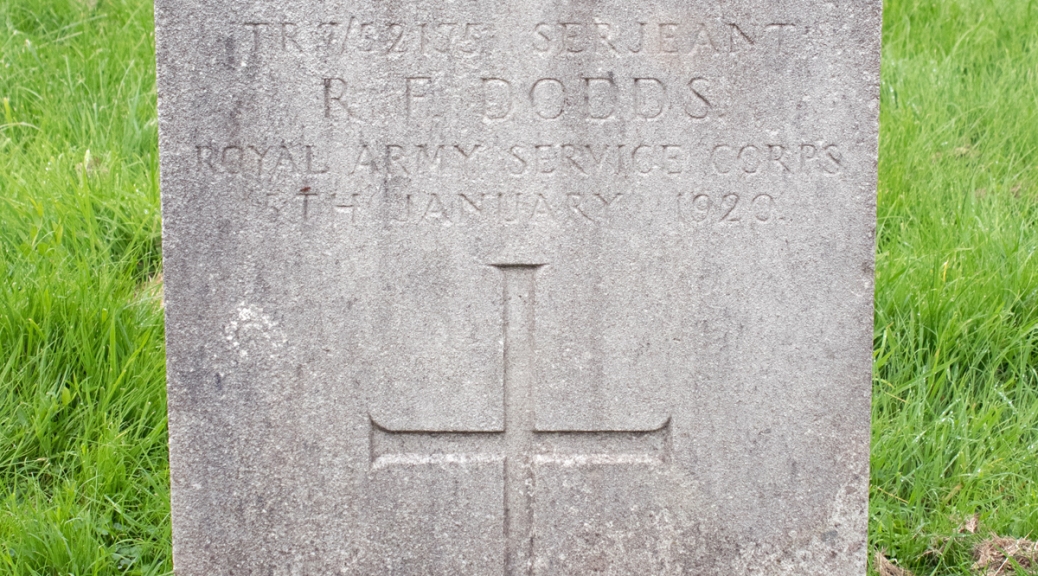
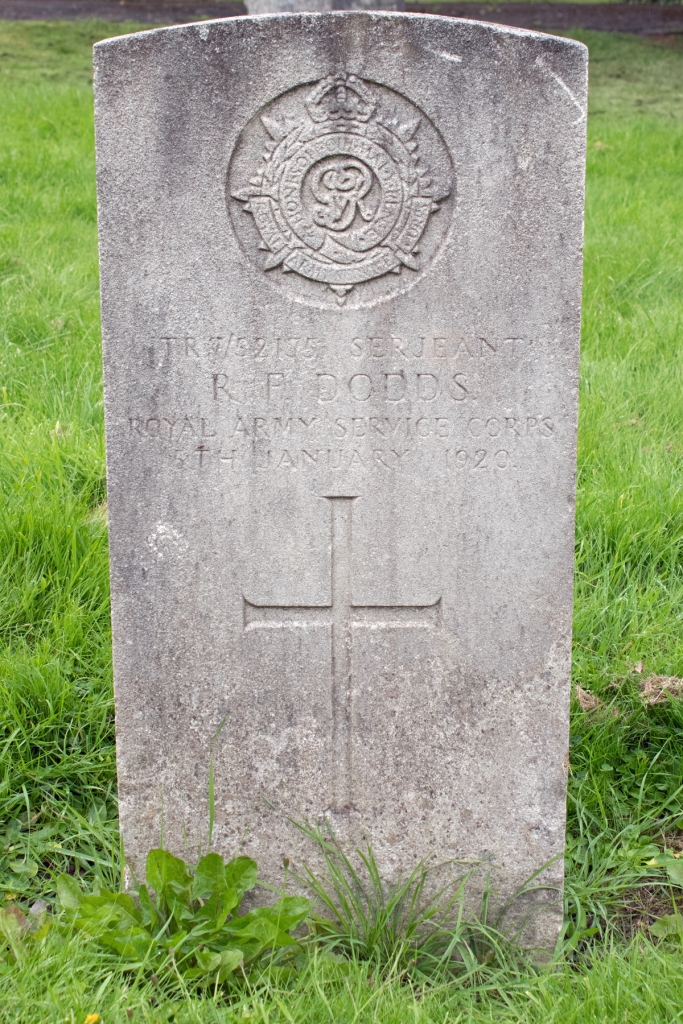
Serjeant Robert Dodds

Serjeant Robert Dodds

Robert Frederic Dodds was born in 1874 in Darlington, Country Durham. The third of nine children, his parents were Robert and Elizabeth Dodds. Robert Sr was a carter and furniture remover and, when he finished his schooling, Robert Jr joined his father in his work.

Robert Sr died in 1898, at the age of 61. Whether this was a catalyst for his son to move on is unclear, but by the following year, Robert Jr was working as a labourer in Weston-super-Mare, Somerset. On 16th September 1899, he married Elizabeth Counsell, a fisherman’s daughter from the town.

It seems that Robert was keen to build a life for his new wife: the next census, taken in 1901, found the couple living in Cardiff, Glamorgan, where he was employed as a stone mason. The Dodds remained in Wales for the next decade, having three children – Lily, William and Rosie – there. By the spring of 1911, however, they were back in Somerset, living in a three-roomed cottage in Castle Street. Elizabeth had had a fourth child just a month before the census, with a second son, Bertie, adding to the family.

When war came to Britain, Robert stepped up to play his part. He initially joined the Royal Army Veterinary Corps as a Private, and found himself in France on 6th March 1915. Elizabeth, meanwhile, remained at home in Somerset, seeking support from her family. With four children to look after, her workload was to increase again when, just a week after Robert arrived on the Western Front, she gave birth to their fifth child, the patriotically named Frederick Gordon Kitchener Dodds.

Robert remained in the Royal Army Veterinary Corps for the next four years, rising to the rank of Serjeant. Details of his time in the service are unclear, but he survived the war and, on 11th July 1919, he transferred to the Royal Army Service Corps.

Little further information is available about Robert’s life. By the winter of 1919/1920, he was based in Midlothian, Scotland. He was admitted to the 2nd Scottish General Hospital, Edinburgh, although his condition is unclear. Whatever it was, it was to be fatal: he passed away on 6th January 1920, at the age of 45 years old.

Robert Frederic Dodds’ body was taken back to Somerset for burial. He was laid to rest in Highbridge Cemetery.


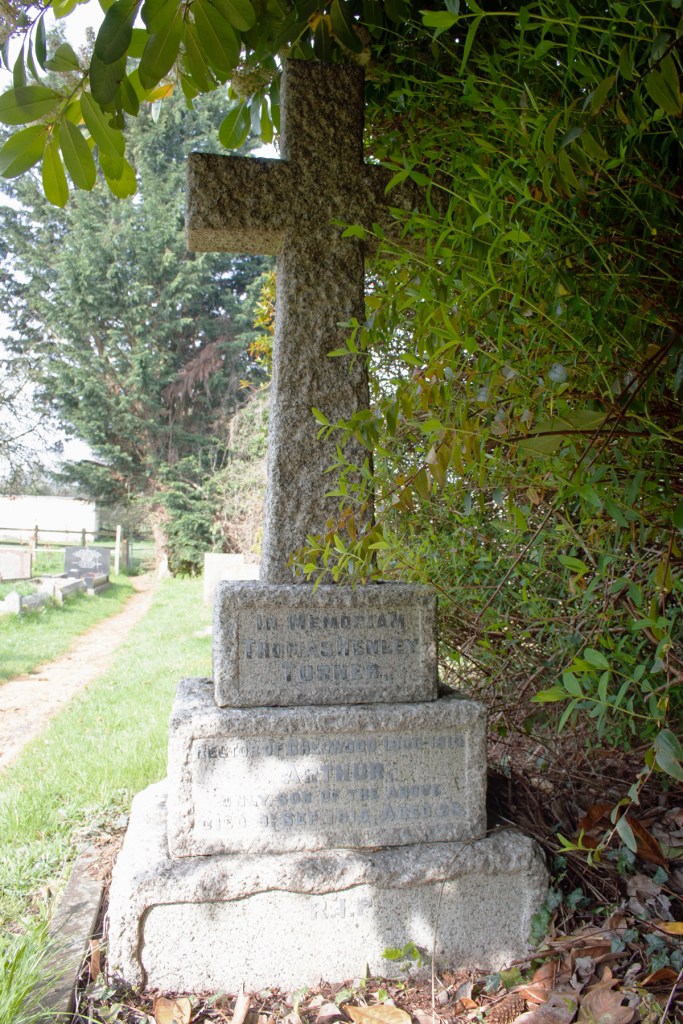
Private Arthur Turner

Private Arthur Turner

Arthur Turner was born in East Brent, Somerset, in the spring of 1892. The younger of two children to Thomas and Lucinda Turner, his older sister had passed away while Lucinda was pregnant with him. Thomas was a vicar for the Church of England, and baptised both children, although the records suggest that he did not lead his daughter’s funeral service.

In 1900, the Turners had moved on to a new parish, setting up home in the rectory in Chelwood, to the south of Bristol. They settled in well, and Thomas remained vicar of St Leonard’s Church there until the summer of 1914, when he passed away after a short illness, at the age of 64.

Conflict had not long darkened Europe by this point, and Arthur felt compelled to play his part. Full details of his military service are not available, but records suggest that he had enlisted in the Gloucestershire Regiment by March 1915.

Assigned to the 12th (Service) Battalion, Private Turner was sent north for training. Billeted in a camp in Wensleydale, North Yorkshire, Arthur would have moved south to Salisbury Plain with his troop, had he not fallen ill. He was admitted to a hospital in Darlington, in neighbouring County Durham, suffering from typhoid. The condition was to get the better of him, and he passed away on 9th September 1915. He was just 23 years of age.

Arthur Turner was brought back to Somerset for burial. He was laid to rest in the family plot in St Leonard’s Churchyard, Chelwood, alongside his father, Thomas.


Whatever her late husband’s calling, Lucinda’s own faith must have been strong. Having lost her eldest child young, she then stood witness to the burials of her husband and son within eighteen months.

The 1921 census recorded Lucinda living with her sister, Charlotte, in Bromley, Kent. Eighteen years later, the 1939 Register found her back in Somerset, where she was living in Clutton, providing support and companionship to Letty Collinson, a retired kindergarten mistress.

Lucinda passed away in March 1942, at the age of 88 years old. She was brought back to Chelwood, and buried alongside her husband and son, the family reunited at last.


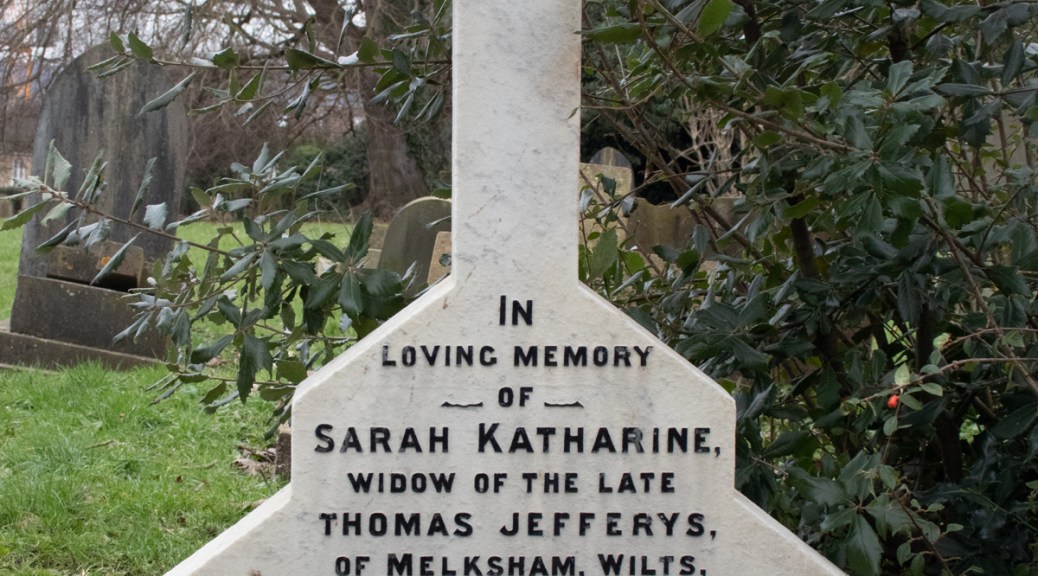
Reverend Charles Jefferys

Reverend Charles Jefferys

Charles Thomas Claude Jefferys was born on 23rd August 1880 in the small Carmarthenshire town of Laugharne. One of five children, his parents were naturalist Charles Jefferys and his wife Adeline.

Charles’ Jr’s life was to be one of education, and his father’s standing allowed for the best. He studied at Ellesmere College, Shropshire, then attended Durham University and Durham Theological College. By the 1901 census he was passing that education on to others: he was listed as a schoolmaster at Stow Wood College in Hampshire.

By 1908 Charles had returned to Wales, and was living in Monmouth. On 2nd January he married Eva Pride, an estate agent’s daughter from Tetbury, Gloucestershire. The marriage certificate confirms that, by this point, Charles was a clerk in holy orders, on his way to his true calling.

The 1911 census showed what a transient life the church could lead to: Charles and Eva were listed as living in a house in Oswaldkirk, North Yorshire. Their two young children, George and Charles, born in 1909 and 1910 respectively, were living with Eva’s sister, back in Tetbury.

When war came to Europe, Reverend Jefferys must have felt compelled to play his part. He joined the Army Chaplains’ Department, and by May 1916, he found himself in France. His role – providing pastoral care to the troops – would have led him to some of the darkest places of the Front Line. He remained there for the next couple of years, only returning to the family home – now in Chelsea, London – towards the end of the conflict.

Reverend Jefferys had contracted pneumonia, and he had returned from the continent to recuperate. Sadly, the condition was to prove too much, and he succumbed to it on 20th November 1918, at the age of 38.

Charles Thomas Claude Jefferys was taken to Somerset for burial – there were close family connections in the Bath area. He was laid to rest in the family plot, alongside his paternal grandmother in the city’s St James’ Cemetery.


Further tragedy was to strike in June 1925 when Eva also passed away. Details of her death are unclear, but this left George and Charles as orphans in their early teens.


Stoker George Bell

Stoker George Bell

George Joseph Bell was born on 9th October 1890 in South Shields, County Durham. He was one of four children – all boys – to George and Eleanor Bell. George Sr was from Chatham in Kent and worked as a boilermaker for a shipbuilder.

Both of George Jr’s parents died when he and his siblings were in their teens. Times were definitely harsh for them: George’s older brother Robert was a coal teemer – unloading the carts at the Tyneside docks. His younger brother, Matthew, was a pit pony driver for the Bolden Colliery. George himself was a pressed glass manufacturer.

The 1911 census recorded Robert, George and Matthew boarding with the Easter family; renting a room in a three-bedroomed house on Commercial Road, South Shields, within spitting distance of the docks and river.

George was, by this point, courting a young lady a few doors down from him. Harriet Shield was the daughter of one of the dock labourers; the couple married at St Hilda’s Parish Church on 30th November 1912.

War was coming to Europe, and on 18th December 1914, George enlisted to play his part. His service records show that he stood 5ft 5ins (1.65m) tall, had blue eyes and a fresh complexion. He was also noted as having tattoos of a heart and his initials on his left forearm.

George joined the Royal Naval Reserve – this suggests that he had previously had some sea-going experience, although there is no specific evidence of this. He was given the role of Stoker, and was sent to HMS Pembroke – the Royal Naval Dockyard in Chatham, Kent – for training.

Stoker Bell’s first posting – and where he spent to most of 1915 – was on board the seaplane tender HMS Engadine. He returned to Chatham that November, before being assigned to the minesweeper HMS Gentian two months later.

After five months patrolling the North Sea, Stoker Bell returned to HMS Pembroke in June 1917. The Dockyard was a busy place that summer, and temporary accommodation was needed quickly. Chatham Drill Hall was brought into service, and George found himself billeted there.

On the 3rd September 1917, the German Air Force carried out its first night air raid: Chatham was heavily bombed and the Drill Hall received a direct hit; Stoker Bell was among those killed instantly. He was just 27 years of age.

George Joseph Bell was laid to rest alongside the other victims of the Chatham Air Raid, in the Woodlands Cemetery, Gillingham.


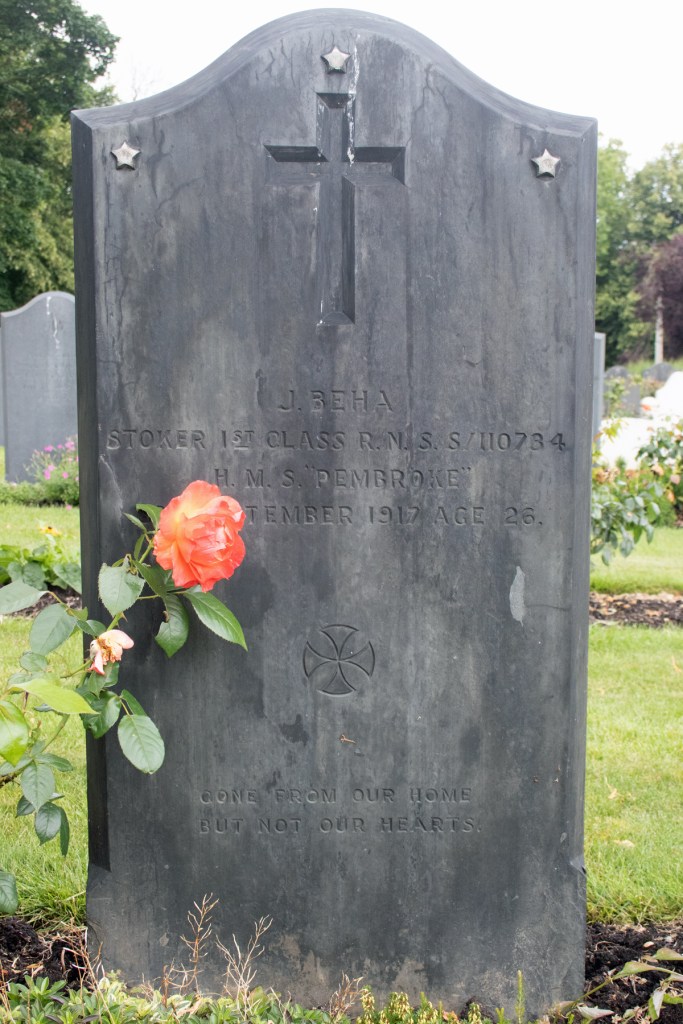
Stoker 1st Class Joseph Beha

Stoker 1st Class Joseph Beha

Joseph Beha was born on 16th June 1891, in the Yorkshire town of Whitby. He was the middle of five children to Joseph and Alice Beha, and had a half-sister, through his mother’s previous relationship.

Joseph Sr was a labourer in the local shipyard, and the family had moved to Hartlepool by the time his son had reached 10 years old. The sea had a definite draw for Joseph Jr, and by his twentieth birthday he had enlisted in the Royal Navy as a Stoker 2nd Class.

The service records show Joseph Jr stood 5ft 3.5ins (1.61m) tall, had brown eyes, dark hair and a fresh complexion. His land base was HMS Pembroke, the alternative name for the Royal Naval Dockyard at Chatham, Kent, and it was here that he received his initial six months’ training.

Stoker Beha’s first sea posting was HMS Falmouth, a light cruiser, on board which he served for more than eighteen months, gaining a promotion to Stoker 1st Class in the process. Over the next few years, he was posted to two further ships and, by the time the First World War broke out, was serving on the armoured cruiser HMS Lancaster.

While his record suggests he was of generally good character, Joseph’s time was totally without blemish. He served time in the cells on three separate occasions – for five days in 1913, fourteen days in 1915 and ten days in 1917 – although no evidence of his misdemeanours remains.

The summer of 1917, found Stoker Beha back on dry land in Chatham. HMS Pembroke was a particularly busy place at that point in the war and temporary accommodation was set up. Joseph found himself billeted at The Drill Hall, away from the main barracks.

On the night of 3rd September 1917, Chatham suddenly found itself in the firing line, as the German Air Force launched a bombing raid. One of the bombs landed squarely on the Drill Hall, and Stoker Beha was killed instantly. He was just 26 years old.

Ninety-eight servicemen perished during the Chatham Air Raid that night. They were buried in a mass funeral at the Woodlands Cemetery in nearby Gillingham. This, too, is where Joseph Beha was laid to rest.


Trimmer Cuthbert Kean

Trimmer Cuthbert Kean

Cuthbert Kean was born on 2nd October 1862, the eldest of four children to John and Jane Kean. John was a tailor from Manchester, who brought his young family up in the town of Crook, County Durham.

Cuthbert followed in his father’s footsteps and, by the time of the 1891 census – when he was 26 years old – was lodging in central Edinburgh, and was working as a tailor.

There is little more information available on Cuthbert’s early years. When war broke out, he enlisted in the Royal Navy, joining up on 26th October 1914. His papers show that he stood 5ft 2ins (1.57m) tall, had a fair complexion and grey eyes.

By 1917, having turned 55, he was transferred to the Royal Naval Reserve, and worked as a Trimmer – an alternative title for a Stoker. He had served on a number of vessels, joining HMS Firefly towards the end of the war.

Early in 1919, Trimmer Kean was admitted to the Royal Naval Hospital in Chatham, Kent, suffering from a sarcoma of the neck. Sadly, he was to succumb to this, and he passed away on 4th March 1919. He was 58 years old. His records give his next of kin as his sister Mary, who was living in Durham.

Cuthbert Kean was laid to rest in the Woodlands Cemetery in Gillingham, Kent.


Chief Petty Officer Telegraphist William Field

Chief Petty Officer Telegraphist William Field

William John Field was born on 8th October 1885 in Boston, Lincolnshire. The eldest of four children, his parents were Charles and Ellen. Charles was a boatman for the coastguard; his job, by the time of the 1891 census, had taken the family to the village of Dawdon on the County Durham coastline.

Given his father’s job, it is not unsurprising that William was destined for a life at sea. As soon as he left school in the spring of 1901, he joined the Royal Navy and was sent to HMS Ganges, the shore-based training establishment in Suffolk. Being underage, he was initially assigned the role of Boy, moving, after a year, to HMS Pembroke, also known as the Naval Dockyard in Chatham, Kent.

By November 1902 Boy Field was moved to HMS Venerable, a ship that was to be his home for the next three years. During this time, William came of age, and was formally enrolled in the Royal Navy as a Signalman. He evidently worked hard on the Venerable, rising through the ranks to Qualified Signalman and Leading Signalman.

In June 1905, William was moved to HMS Leviathan, where he was again promoted, to Second Yeoman of Signals, before again being assigned to Chatham Naval Dockyard six months later.

While based in Kent, William met Nelly Watt, the daughter of a labourer at the dockyard. The couple married in 1906, and went on to have four children.

Over the next few years, the now Petty Officer Telegraphist Field spent an almost equal amount of time at sea and on shore. War was coming and when his initial term of service came to an end in October 1915, he immediately renewed his contract through to the end of the hostilities.

All of William’s time was now spent on land, primarily at HMS Pembroke, but also at HMS Actaeon in Portsmouth, HMS Victory VI at Crystal Palace, London and HMS Bacchante in Aberdeen.

While Chief Petty Officer Telegraphist Field’s naval service records are quite detailed, his passing is anything but. The war over, he moved back to Chatham Dockyard in January 1919. At some point he was admitted to the Royal Naval Hospital in the town, and died from ‘disease’ on 13th March that year. He was just 33 years of age.

William John Field was laid to rest in the Woodlands Cemetery in nearby Gillingham.


A sad aside to the story is that, at the time of he husband’s death, Nellie was pregnant with the couple’s fourth child. John William Field was born on 16th October 1919, destined never to know his father.


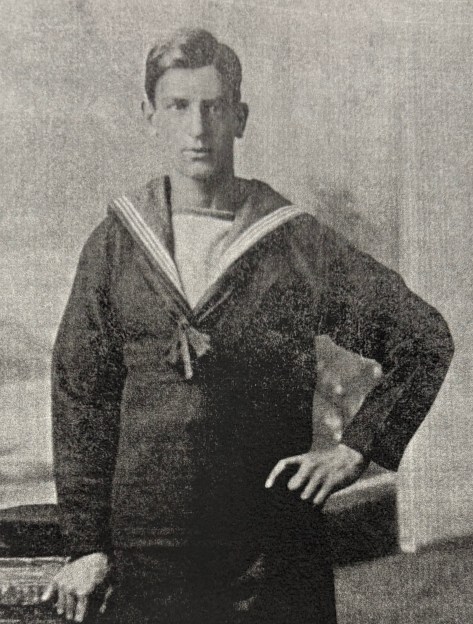
Able Seaman Michael Goulding

Able Seaman Michael Goulding

Michael Joseph O’Neill Goulding was born on 5th May 1884, the oldest of six children to Michael and Ellen Goulding (née O’Neill). Michael Sr worked for the inland revenue and his job took him around most parts of the British Isles.

Michael Jr had been born in Limerick – both of his parents came from Ireland – but his subsequent three siblings (Patrick, Margaret and William) had all been born in Scotland. His second youngest sibling, Lily, was born in County Durham, the youngest back in Scotland, while, by the time of the 1901 census, the whole family were living in Forest Gate, East London.

The census also shows that Michael Jr, having left school, was working at Customs House (presumably where his father was employed), as a boy copyist on tea accounts. The inland revenue at that time was a career for life; by the next census in 1911, the family had moved to Hertford, where Michael Sr was a customs and excise supervisor, and Michael Jr was an assistant clerk at the same place of employment.

War was on its way, but Michael seems not to have enlisted immediately. While specific dates for his joining up are not available, it appears that he was still working for the Inland Revenue when he got married in Shoreditch, in April 1917. His wife was called Bridget Mary Gough (known as Bryde), and she had also been born in Ireland. The couple went on to have a daughter, Ellen (or Eileen), the following year.

By this time, Michael had definitely enlisted. He joined the Royal Naval Volunteer Reserve, and was based at HMS Pembroke, the shore-based establishment in Chatham, Kent. This was the location for the Navy’s main accounting base, so it is likely that he was employed for financial, rather than his military, skills.

Able Seaman Goulding served through to the end of the war and beyond, and it was while he was based in Kent that he became unwell. Admitted to the Royal Naval Hospital in Chatham, he succumbed to a combination of bronchitis and pneumonia on 22nd February 1919. He was 34 years of age.

Michael Joseph O’Neill Goulding was laid to rest in the Woodlands Cemetery in nearby Gillingham. His family were still in Hertford, while his widow and daughter moved back to Ireland.


Michael Joseph O’Neill Goulding
(courtesy of ancestry.co.uk)