Tag Archives: Essex

Leading Mechanic Charles Harris

Leading Mechanic Charles Harris

Charles William Harris was born in Wingham, near Canterbury, Kent, on 19th July 1879. The fourth of eleven children, his parents were Charles and Kate Harris. Charles Sr was a carpenter and builder, and his son was to follow in his stead.

By the time of the 1901 census, however, Charles Jr had stepped out on his own. He had moved to London, and was boarding with the Hurley family, in rooms at 408 Bethnal Green Road, Middlesex.

On 1th June 1902, Charles Jr, now a plumber, married Esther Danton. An engine driver’s daughter from Kent, she was four years her new husband’s senior. The couple set up home at 5 Leatherdale Street in Mile End, and had two children: daughter Lilian was born in 1905, with son George following three years later.

When war broke out, Charles was called upon to play his part. He enlisted in the Royal Naval Air Service as an Air Mechanic, and was quickly promoted to Leading Mechanic. His service records show that, when he joined up on 15th June 1916, he was 5ft 7.5ins (1.71m) tall, with light brown hair, blue eyes and a fresh complexion.

Leading Mechanic Harris would be based out of HMS President, the umbrella name for the Royal Navy’s London bases. He spent time working at Wormwood Scrubs, and, in February 1917, was moved to Kingsnorth, Kent.

What happened next is summed up in a simple statement on Charles’ service papers: “26th May 1917 Accidentally killed by explosion of gas holder.” There is no further information, and nothing in the media about the incident. Leading Mechanic Harris was 37 years of age.

The body of Charles William Harris was taken to the Woodlands Cemetery, Gillingham, Kent. He was laid to rest in the naval section of the burial ground.


Tragedy was to strike again just two years later, when Charles and Esther’s daughter also passed away:

Much sympathy and respect were shown at Holy Trinity Church, Springfield, when the funeral of Lily Harris, the fourteen-year-old daughter of Mrs and the late Mr CW Harris took place. Deceased’s father, who was chauffeur to the Bishop of Chelmsford, lost his life in the war while serving with the RNAS, and this fact added to the regret felt by the parishioners at the further sad loss sustained by his widow, who is now left with only one little boy. The funeral procession included a large number of the scholars of the Springfield Day and Sunday Schools, with Mr R Coward of the day school, and practically every child carried a floral tribute. There was also a large attendance of neighbours and friends, including children, assembled at the church. The Bishop of Chelmsford officiated… [and] gave a touching address to the church, speaking particularly to the children; and his lordship also performed the last sad rites at the graveside.

[Essex Newsman: Saturday 29th November 1919]

There is no evidence of any connection between Charles and the Bishop of Chelmsford: as far as the records show, he was never a chauffeur, working as a builder, plumber and gas fitter before enlisting.


Midshipman Randolph Lemon

Midshipman Randolph Lemon

Randolph Charles Lemon was born on 23rd September 1900. An only child, his parents were Charles and Edith. Charles was a schoolmaster from Hampton Wick, Middlesex, by he and Edith raised their son at 176 Union Road, Leytonstone, Essex.

There is little information available about Randolph’s life. When war broke out he stepped up to play his part, but the only documentation about his time at sea confirms that he served as a Midshipman in the Royal Naval Reserve. Randolph was assigned to the TSS Hurunui, owned by the New Zealand Shipping Company, in April 1916. By the spring of 1918, however, he had transferred to the destroyer HMS Exe.

That March Exe was sailing with HMS Kale south down the eastern coast of Britain, from Hull to Portsmouth. On 27th March 1918, both ships inadvertently steered six miles out of a clear channel and into a British-laid minefield. Both ships hit mines and the Kale was sunk, with the loss of 41 lives. The Exe floundered and, while the full impact is unclear, Midshipman Lemon was killed in the incident. He was just 17 years of age.

The Exe made it to the Royal Naval Dockyard in Chatham, Kent. Randolph Charles Lemon’s body was laid to rest in the naval section of Woodlands Cemetery, Gillingham, Kent.


The loss of their only child at such a young age must have been for his parents to bear. The 1921 census found Charles and Elizabeth had moved to Ilford, Essex, where Charles was now teaching.

Charles died in 1939, at the age of 65, Elizabeth passing away in February 1967, aged 90. Both were buried with their son: a family reunited after nearly five decades.


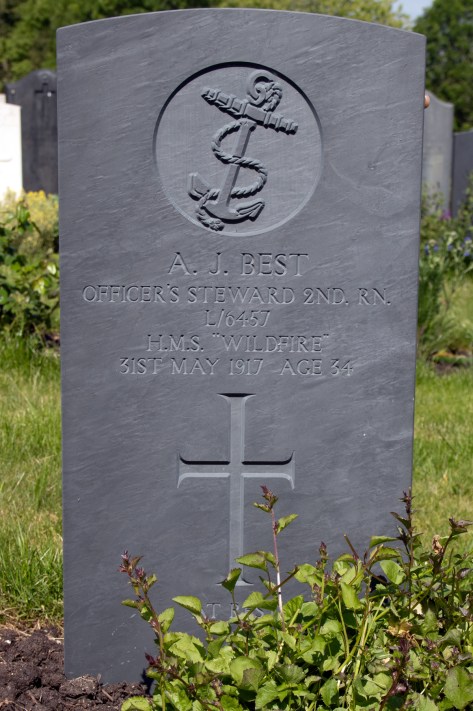
Officer’s Steward 2nd Class Alfred Best

Officer’s Steward 2nd Class Alfred Best

Alfred Henry John Best was born on 17th November 1883. The second of ten children, his parents were William and Alice Best. William was an engine driver and both he and Alice were from Ipswich, Suffolk. Alfred was born in Dovercourt Essex, but by the time of the 1901 census the family had settled in the village of Ramsey, near Harwich.

When he finished his schooling, Alfred was set on a life of adventure. Living so close to the sea, a life on the ocean drew him in, and he found employment on the steamships as a steward. Absent from the 1901 census, the following return, taken in 1911, found him back at home with the family, and employed as a ship’s steward.

When war broke out, Alfred stepped up to serve his country. He enlisted in the Royal Navy as an Officer’s Steward 3rd Class, and was sent to HMS Pembroke, the Royal Naval Dockyard in Chatham, Kent. His service records give his year of birth as 1884, but show that he was 5ft 4.5ins (1.64m) tall, with light brown hair, blue eyes and a fresh complexion. He was also noted as having a mole under his right eye.

Within a matter of days, Alfred’s previous experience gained him a promotion to Officer’s Steward 2nd Class. He would spend the next couple of years on shore, his time being split between Pembroke and HMS Wildfire, a similar establishment just along the coast in Sheerness.

By the spring of 1917, Officer’s Steward Best was back in Chatham, and had been admitted to the town’s Royal Naval Hospital with tuberculosis. The condition would prove fatal, and he breathed his last on 31st May 1917: he was 33 years of age.

The body of Alfred Henry John Best was buried in the naval section of Woodlands Cemetery, Gillingham, Kent, not far from the base he had called home for some time.


Officer’s Steward 2nd Class Alfred Best
(from ancestry.co.uk)

Corporal Tom Morse

Serjeant Tom Morse

Thomas Morse was born in St Nicholas, Pembrokeshire, in the summer of 1885. One of thirteen children, his parents were Thomas and Mary Morse. Thomas Sr was an agricultural labourer, but when he completed his schooling, his son found work as a mason and, by the time of the 1911 census, he was boarding with his older sister Maria and her family.

When war broke out, Thomas Jr – who was better known as Tom – stepped up to play his part. Full details about his service have been lost to time, but it is clear that he enlisted in the Royal Army Service Corps. It is unclear whether he spent any time overseas, but towards the end of the war, he found himself based in Essex in the Mechanical Transport Division.

In the autumn of 1918, Tom, who had risen to the rank of Acting Corporal, fell ill. He came down with pneumonia, and was admitted to Colchester Hospital. The condition would prove fatal, and he passed away on 26th October 1918: he was 33 years of age.

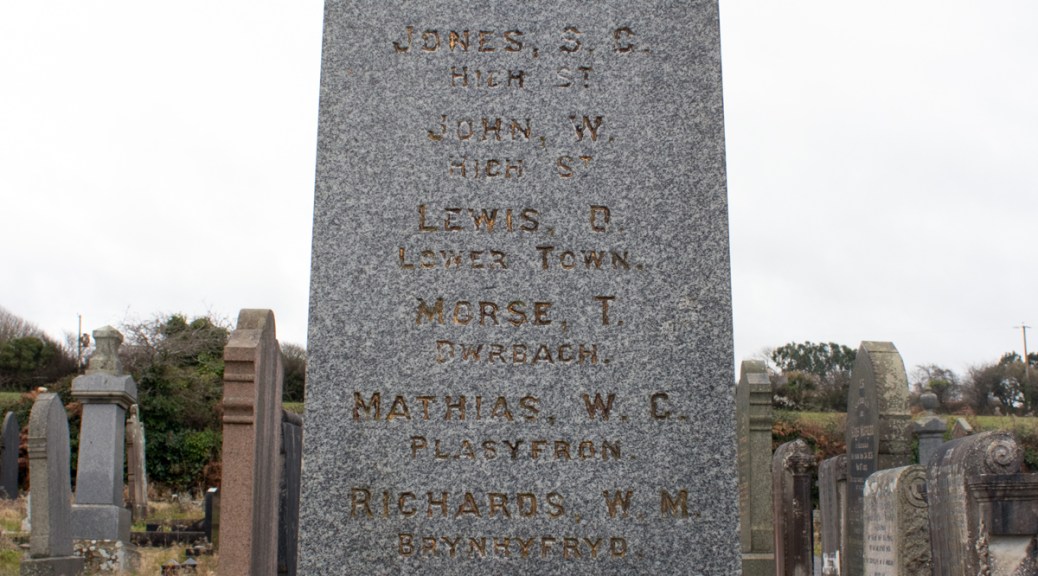
The body of Thomas “Tom” Morse was brought back to Pembrokeshire for burial. He was laid to rest in the Hermon Baptist Burial Ground in Fishguard.


Intriguingly, the Commonwealth War Graves Commission have Tom’s rank as Serjeant. What remains of his service papers, however, all suggest he was an Acting Corporal.

Equally intriguing are the details of Tom’s dependents. His entry on the Army Register of Soldiers’ Effects gives his father, Thomas Sr, as his beneficiary. His Dependents’ Pension Record, however, gives his mother, Mary, and Miss M Nicholas, who is listed as the guardian of his illegitimate child. There no further information on them.


Carpenter’s Mate George Land

Carpenter’s Mate George Land

George William Land was born early in 1891, and was the only child to George and Caroline Land. George Sr was a greengrocer from Dagenham, Essex, and the family were living in Ilford when his son was born.

Caroline seems to have died a few months after George Jr’s birth, and, by the time of the 1901 census, he was in the care of her parents. His father was still running the shop, and was supported by George Jr’s aunt.

The 1911 census found George Jr employed as a greengrocer, and it seems likely that he was working alongside his father by this point. He was living with his maternal and uncle, who was also employed in the same line of work.

When war was declared, it seems that George Jr wated to play his part. Full details of his service have been lost to time, but it seems that he joined the Merchant Navy and, by the summer of 1918, he was working as a Carpenter’s Mate on board the SS Mesaba. She was a cargo liner, requisitioned by the Admiralty for transport duties.

On 31st August 1918, the Mesaba left Liverpool, Lancashire, for Philadelphia. The following day, she was torpedoed by the German submarine U-118, and foundered. She sunk off the coast of County Wexford, with the loss of 20 souls, Carpenter’s Mate Land included. George Jr was 27 years of age.

The body of George William Land was laid to rest in St David’s Parish Cemetery, Pembrokeshire. It is unclear whether his body had been brought to Wales with the seventy survivors who had been rescued, or whether it had washed ashore there some time after the sinking.


Sapper Harold Chandler

Sapper Harold Chandler

Harold Frederic Chandler was born on 8th April 1886, and was the only child to Frederic and Rhoda. Frederic was a newspaper publisher, and the family lived in North London. The 1891 census found the Chandlers living at 1 Parolles Road, Islington; ten years later they were at 14 West View on Highgate Hill.

Those census returns included family members as part of the household. By the time of the 1911 census, however, when the were living in a substantial house at 22 Hillside Gardens, Highgate, there were no other family members with them, although they did have a boarder – banker’s clerk Alfred Schleicher – and domestic servant Esther Tebbutt living with them.

By this point, Harold was 24 years of age, and was employed as an architect’s assistant. War was coming, however, and he was called upon to play his part.

Full details of Harold’s service have been lost to time, but it is clear that he enlisted in the Royal Engineers as a Sapper, likely using the skills he had learnt in his civilian life.

The only documentation confirms Harold’s passing. Discharged from the army on 29th October 1919, he died just over a year later. He breathed his last on 17th December 1920, at the age of 34 years old. His death was registered in Edmonton, Essex, so it seems likely that he was there in some sort of convalescent capacity.

The body of Harold Frederic Chandler was taken back to Middlesex for burial, and he was laid to rest in Highgate Cemetery.


Blacksmith Robert Holdsworth

Blacksmith Robert Holdsworth

Robert William Holdsworth was born on 11th February 1880 in Pilmoor, Yorkshire. The third of nine children, his parents were John and Fanny. John was a railway signalman, and, by the time of the 1891 census, the family had moved to Kirby Wiske, near Thirsk.

When he completed his schooling, Robert found work as a blacksmith. Moving away from home, by 1901, he was boarding at the Albion Foundry on New Street in Pocklington. The job, however, was a stepping stone to bigger things, and, on 28th July 1902, he enlisted in the Royal Navy.

Blacksmith’s Mate Holdsworth’s service records show that he was 5ft 6ins (1.68m) tall. He had dark brown hair, brown eyes and a dark complexion. It was also noted that he had a scar on his right elbow.

Robert was initially sent to HMS Pembroke, the Royal Naval Dockyard in Chatham, Kent, for his training. He would spend the next year at the base, and was promoted to Blacksmith proper in April 1903. Over the twelve years of his initial contract, he would serve on board seven ships, returning to Chatham in between assignments. The 1911 census recorded him as being one of 283 crew aboard HMS Patrol, a scout vessel moored in Harwich Harbour, Essex.

In the summer of 1916, Robert married Minnie Eames. Born in Kensal Rise, London, by the time of the nuptials, her family had moved to Gillingham, Kent, where her father James worked as a night watchman. Minnie was working as a shop assistant by this point, and was living with her parents and older brother at 35 Wyles Street.

Back at work, Blacksmith Holdsworth had renewed his contract. His annual reviews noted both very good conduct and superior ability, and he had added another string to his bow – the role of Diver – in the spring of 1912. In April 1913 he was assigned to HMS Astraea, on board which he would spend the next three years. The cruiser patrolled the seas off the eastern coast of Africa, bombarding Dar-es-Salaam in the autumn of 1914.

By the summer of 1916, Blacksmith Holdsworth was back at HMS Pembroke, where he would remain for the rest of the year, barring a couple of months’ on board HMS Royal Arthur. On 2nd December Robert was feeling unwell, and was moved the Hospital Ship Garth Castles. He had suffered a cardiac arrest, but his transfer would prove too late: he died that afternoon, at the age of 36.

The body of Robert William Holdsworth was laid to rest in Woodlands Cemetery, Gillingham, not far from the naval base he had called home, and within walking distance of where his widow still lived.


Blacksmith Robert Holdsworth
(from ancestry.co.uk)

The epitaph on Robert’s headstone reads: In loving memory of Robert William Holdsworth, 1st Class Petty Officer (Blacksmith & Diver). There is no evidence in his service records for the PO rank, although this may have been an informal nod to his dual roles.


Able Seaman Isaac Veal

Able Seaman Isaac Veal

Isaac Veal was born on 18th November 1874, the seventh of eight children to Joseph and Frances Veal. When he was born, his parents were the publicans at the Waterloo Arms in Lyndhurst, Hampshire, and this is the town in which they would raise their family.

Frances died in 1890, and by the following year’s census, Joseph had stepped back from being a landlord, he was living with three of his children on a farm to the north of the town centre. Now employed as a domestic gardener, Isaac was working with him.

Isaac sought bigger and better things, however, and, on 21st December 1891, he enlisted in the Royal Navy. Intriguingly, though, he gave his date of birth as 10th July 1875. Below the age to formally sign up, he was given the rank of Boy 2nd Class, and was sent to HMS St Vincent in Devonport, Devon, for training. He remained on board for the next two years, rising to Boy 1st Class in March 1893.

On 26th August 1893, Isaac was promoted to Ordinary Seaman: this would normally mark a boy’s coming of age, but the date doesn’t match Isaac’s given date of birth, or his actual one. It is likely, therefore, that his true age had become known.

Ordinary Seaman Veal’s service documents confirm that he was 5ft 6ins (1.68m) tall, with auburn hair, brown eyes and a fair complexion. He signed up for a period of twelve years and, during that time, he would serve on a total of eleven ships. Isaac travelled the world, returning to HMS Victory, the Royal Naval Dockyard in Portsmouth, Hampshire, in between voyages.

On 11th March 1895, Isaac was promoted to the rank of Able Seaman, and his annual reviews generally marked him of very good character. From April 1901 he was assigned to the battleship HMS Revenge, and she would remain his home for more than four years. During his time assigned to her his contract came to an end and he immediately re-enlisted.

On 18th October 1909, Isaac married Ethel Maud Astridge, a caretaker’s daughter from Basingstoke, Hampshire. When they wed, Ethel – who was better known by her middle name – was working as a housemaid for a miller in North Stoneham. The couple would go on to have three children – Beatrice, Mary and Florence – and while her husband was away at sea, Ethel lived in their cottage on Queen’s Road in Lyndhurst.

Back at sea, Able Seaman Veal would continue to travel the world. During the second term of his contract with the navy, he was assigned to a further dozen ships. In August 1912, Isaac was assigned to HMS Dolphin, the shore base in Gosport, Hampshire, which was the home of the Royal Navy Submarine Service. Over the next five years he would split his time between Dolphin and HMS Maidstone. The submarine depot ship, which operated out of Harwich, Essex, would be his home for the majority of the First World War. Able Seaman Veal’s commitment to the navy was being recognised, as was his ability, which was recorded as superior in each of his annual reviews from 1911 onwards.

As the conflict entered its closing months, Isaac’s health was becoming impacted. In the spring of 1918, he was admitted to the sick quarters in Shotley – just across the river from Harwich – suffering from pernicious anaemia and rheumyalgia. The combination of conditions would prove fatal: Isaac passed away on 11th April 1918, at the age of 43 years old.

The body of Isaac Veal was taken back to Hampshire for burial. He was laid to rest in Lyndhurst Cemetery, just a few minutes’ walk from his family home. Conveyed to the cemetery in a motor ambulance van, he funeral was supported by a firing party from the local Bombing School Camp, tributes including “a token of respect from the men of the 8th and 9th Submarine Flotillas.” [Hampshire Advertiser – Saturday 20 April 1918]


After the death of her husband, Maud remained living in Myrtle Cottage, the family’s home for the rest of her life. The 1921 census recorded her as being an apartment House Keeper, while the 1939 Register noted that both she and her daughter Florence, were carrying out unpaid domestic duties.

This latter document identifies three boarders to Myrtle Cottage, including Maud’s younger sister Thirza.

Ethel Maud Veal died on 17th October 1949, at the age of 62. She was buried in the family plot in Lyndhurst Cemetery, reunited with her husband Isaac after more than 30 years.


Private Job Jefferies

Private Job Jefferies

Job Jefferies was born on 12th October 1889 in the city of Timaru, on New Zealand’s South Island. The sixth of ten children, his parents were William and Ada Jefferies.

There is little information available about Job’s early life, but by the time war broke out, he had moved to Kongahu, at the northern tip of South Island. He was working as a labourer, and was employed by the Public Works Department.

Job was quick to step up and serve his country. He enlisted in the New Zealand Infantry on 12th February 1915, and was assigned to the Canterbury Regiment. His service records confirm that he was 5ft 10.75ins (1.79m) tall, and weighed 170lbs (77.1kg).

Private Jefferies left New Zealand in the summer of 1915, and his service record makes for grim reading.

On 9th August 1915, Job’s unit arrived in the Dardanelles, and he was firmly entrenched in the fighting at Gallipoli. Wounded on 5th September, he was initially treated at a casualty clearing station, before being medically evacuated first to Malta, then to Britain. He was admitted to the No. 2 Western General Hospital in Manchester, Lancashire, and would spend the next seven months there.

On 12th May 1916, Private Jefferies was on the move, leaving his base in Hornchurch, Essex, for the Western Front. He re-joined his unit on 7th July, but just nine days later was wounded at the Somme. Medically evacuated to Britain again, he spent the next couple of months being moved between hospitals. Discharged back to base in Hornchurch, Essex at the end of September, he would spend the next four months recuperating once more.

By February 1917, it would seem that Private Jefferies had been moved to Sling Camp near Bulford, Wiltshire. While there, he fell ill, and was admitted to the No. 3 New Zealand General Hospital in nearby Codford. He was suffering from pneumonia, and this time his body could take no more. Job passed away on 7th February 1917: he was 27 years of age.

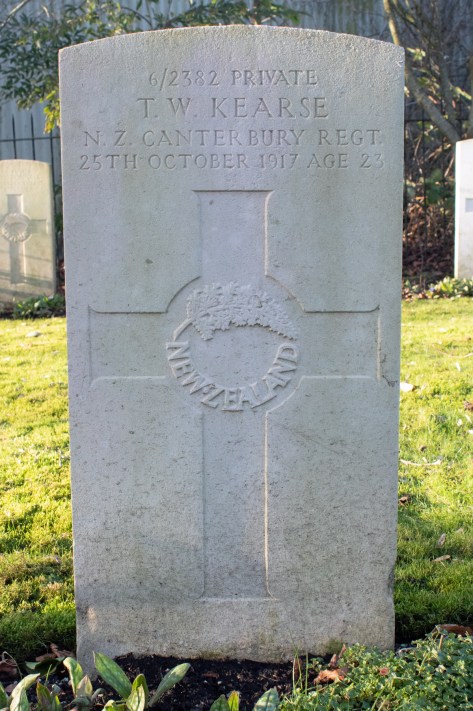
Job Jefferies was laid to rest alongside his fellow soldiers in the ANZAC extension to St Mary’s Churchyard, Codford.


Private Job Jefferies
(from findagrave.co.uk)

Bed Steward Henry Herring

Bed Steward Henry Herring

Henry George Herring – also known as Harry – was born on 10th November 1889. The second of six children, his parents were Thomas and Mary Herring. Thomas was a tailor from Tiverton, Devon, and the family lived at 131 West Exe South in the town.

Henry sought a life of adventure, and joined the Merchant Navy. Sadly, details of his service have been lost to time, so it is not possible to get a clear picture of his time at sea. Certainly he had moved out of the family home by the time of the 1911 census, though it is unclear whether he had enlisted by this point.

By the start of 1916, Henry was serving as a Bed Steward on board the SS Maloja, a passenger steamship that travelled between Britain and India. On 26th February she left Tilbury, Essex, bound for Bombay, with a crew of 301 and 122 passengers on board.

The following morning, Maloja was sailing through the Strait of Dover when she hit a mine. There was a large explosion and she faltered. The Canadian ship Empress of Fort William was only a short distance behind, and she steamed forward to assist, but she also struck a mine just 1km (0.6miles) away.

The Maloja’s lifeboats were readied to launch and passengers started to board, but the ships engine room had flooded, and she began to list. Three of the four lifeboats were unable to launch, and, as she was unable to stop, no rescue ships could come alongside.

The Maloja sank 24 minutes after hitting the mine. Many of the crew and passengers ended up in the water: most were rescued, but 44 bodies – including that of Bed Steward Herring – were recovered and around 100 people were unaccounted for.

Henry George Herring’s body was taken to shore: he was just 26 years old when he died. He was taken back to Devon for burial and laid to rest in Tiverton Cemetery, not far from where his grieving family still lived.