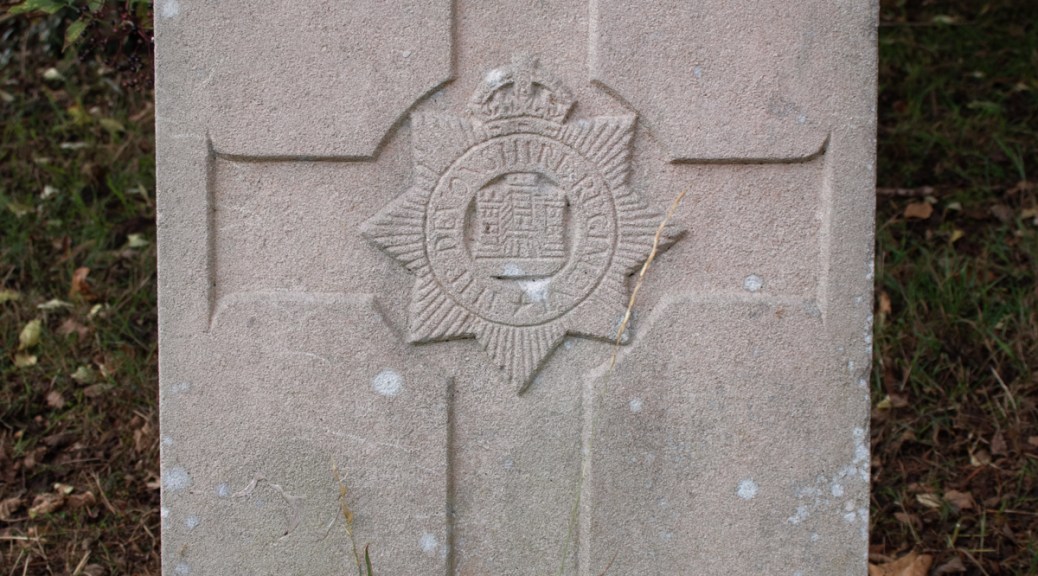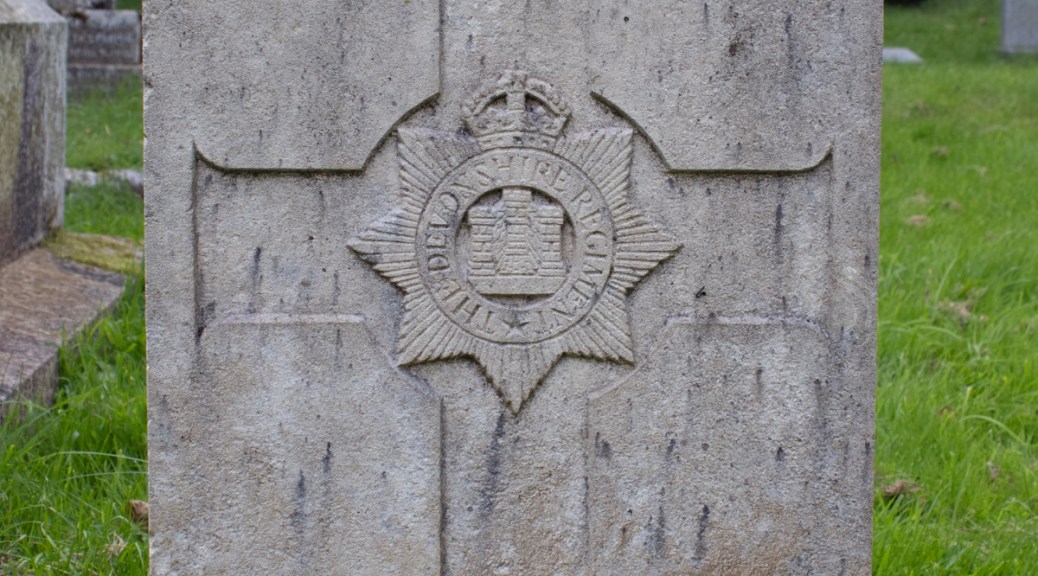
Bernard Gale King was born in the spring of 1881, the seventh of eleven children to Charles and Charity King. Charles was a bookseller from Huntingdonshire, but he and Charity had moved to Wolborough, Devon by the time Bernard was born.
The 1901 census found that the family had moved again and Charles had set up shop in the Tormoham area of Torquay. By this point Bernard and his older sister, Florrie, were helping their father with the business, which was located at 99 Union Street .
On 5th March 1904, Bernard married Lilian Potter at the Wesleyan Chapel in Brixham. Sadly, there is little information available for her, but she was a year older than her husband, and had been born in Exeter. The couple set up home on Rock Road, Torquay, and had three children: Frederick, William and Gladys.
By the time of the 1911 census, Bernard had moved away from selling books, and had become a photographer. Storm clouds were brewing over Europe, however, and things were to change.
When war broke out, Bernard stepped up to play his part. He enlisted on 11th December 1915, and joined the Devonshire Regiment. His service records show that the family had moved along the coast, and were living at 22 Winner Street in Paignton.
Private King was notes as being 5ft 7ins (1.7m) tall and weighing 119lbs (54kg). He had dark brown hair, blue eyes and a pale complexion. Initially assigned to the 4th Battalion, by October 1916, he had transferred to a home service unit, and remained on home soil during his time in the army.
In the spring of 1917, Bernard contracted tuberculosis. The contagious nature of the illness meant that he was deemed no longer fit for any service, and he was medically discharged on 7th April 1917.
At this point Bernard’s trail goes cold. He seemed to have returned home, but would ultimately succumb to the lung condition he had contracted in the army. He passed away on 21st October 1918: he was 37 years of age.
Bernard Gale King was laid to rest in Paignton Cemetery, overlooking the town in which his grieving family still lived.
Charles Douglas Howard Vanstone was born in Paignton, Devon, on 27th October 1888. The fourth of seven children, he was the second son to Frederick and Charlotte Vanstone. Frederick was an architect’s surveyor and civil engineer, and the family lived comfortably in the seaside town.
The 1891 census found them living at Sorrento, a villa on Esplanade Road, overlooking the sea. By the time of the next census, they had moved to Torbay Park, and lived in a 12-room property. The family’s three sons all followed in their father’s trade, and, according to the 1911 return, four of the Vanstones were recorded as being civil engineer architects and surveyors.
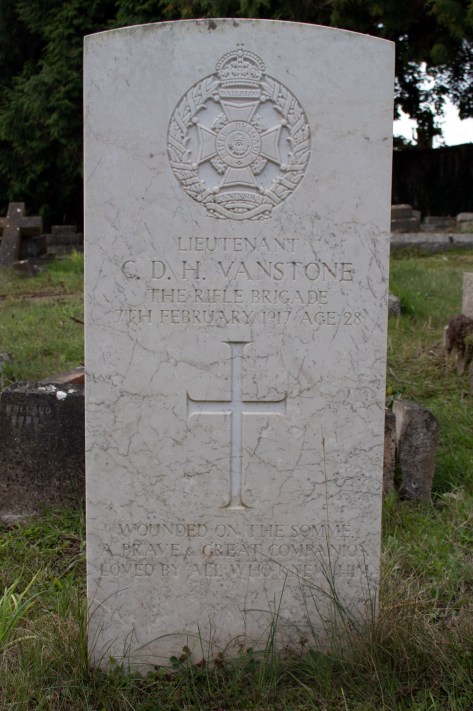
When war came to Europe, Charles stepped up to play his part. He received a commission in August 1915 and, as a Second Lieutenant, was assigned to the Rifle Brigade. Attached to the 15th (Reserve) Battalion, the records suggest that he was in France by 23rd March 1916.
Lieutenant Vanstone seems to have been part of a Trench Mortar unit at the Somme. Wounded during the battle, he was medically evacuated to Britain for treatment. Admitted to the Reading War Hospital in Berkshire, his injuries were to prove too severe. Charles passed away on 7th February 1917: he was 28 years of age.
Charles Douglas Howard Vanstone’s body was brought back to Devon for burial. He was laid to rest in his home town’s sweeping cemetery.
Charles’ death was the third loss for the Vanstone family in as many years. His older sister, Constance, had died in 1914, while his younger brother, Stanley, a Lieutenant in the 20th Royal Fusiliers, died of wounds he received on the Western Front in October 1915. Just 25 years of age, he is buried in Merville Communal Cemetery, France.
Thomas John Gladstone Legg was born in Dunster, Somerset, on 30th July 1898. The fourth of six children, his parents were John and Louisa Legg. John was a baker, and the family lived on West Street in the village.
By 1911, the Leggs had moved south, settling in Winsford, on the outskirts of Exmoor. Thomas was still in school, but his two older brothers were helping their father with the bakery business, and they had taken in a boarder – road worker John Jeffrey – to help bring in a bit of additional income.
When war broke out, Thomas stepped up to play his part. There is little information available about his military service, but it is clear that he had enlisted in the Devonshire Regiment by the spring of 1918.
Private Legg was assigned to the 15th Battalion, although he soon transferred to the 474th Agricultural Company of the Labour Corps.
The profound sympathy of parishioners goes out to Mr and Mrs J Legg… who have sustained a double bereavement. On October 22nd their daughter, Miss Ivy Marion Legg, aged 23, succumbed to pneumonia. Their son, Pte J Legg, came home from training to attend his sister’s funeral, and he was attacked by pneumonia and died in a few days. Amid general tokens of respect and sympathy, the interments were made in Highbray Churchyard. Both father and mother have been seriously ill, but are now recovering. There are still several critical cases of complications following influenza in the parish.
[North Devon Journal: Thursday 14th November 1918]
Thomas passed away on 2nd November 1918: he was 20 years of age. He was laid to rest alongside his sister in All Saints’ Churchyard, High Bray.
Reginald William Brown was born in South Molton, Devon, the summer of 1873. The second of four children – all boys – his parents were William and Mary Brown. William died when Reginald was just a child, and the 1881 census found Mary supporting her children by working as a mangler.
Details of Reginald’s early life are sparse. In the autumn of 1898 he married Elizabeth Mayne and the couple set up home at 13 Cook’s Cross. The couple went on to have six children, and Reginald supported his family with work as a gardener.
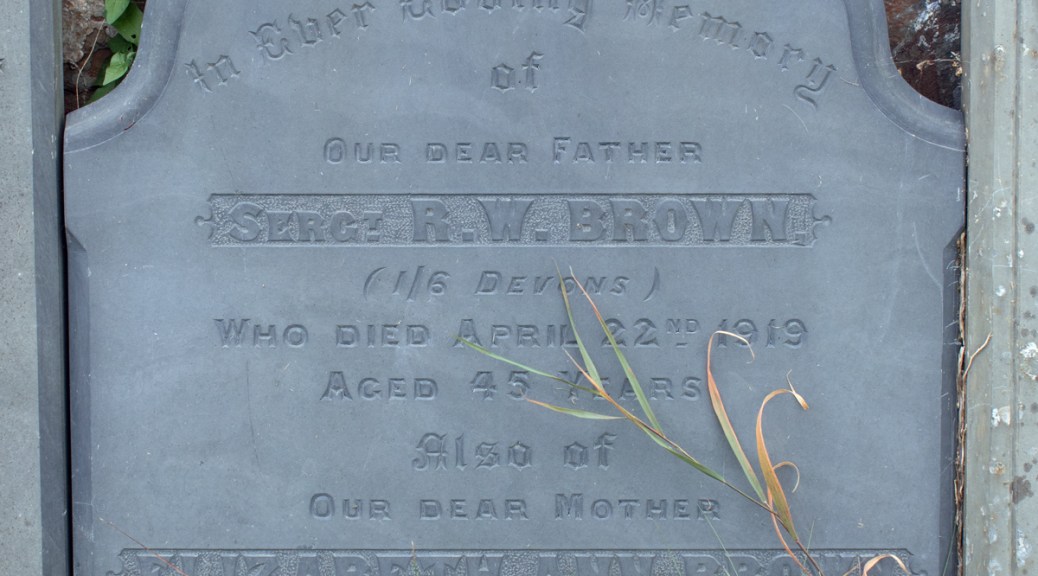
Alongside his gardening work, Reginald volunteered for army service. Again, full details are unclear, but he was attached to the Devonshire Regiment from 1908. Initially for a year’s contract, he seemed to renew this on-and-off for the next six years.
When war broke out, Reginald was formally called into service. HIs time in the army resulted in him being given the rank of Sergeant, and by October 1914, his unit – the 4th Battalion – was sent to India.
Reginald spent the next couple of years overseas, before being posted back to Britain in the spring of 1916. That November he spent six weeks admitted to the Manor County of London War Hospital in Epsom, Surrey, suffering from bronchitis. This was the result of malaria, and he would continue to suffer from lung complaints for the next few years.
In September 1917, Elizabeth passed away, and Reginald was left, at a distance at least, to raise his children. By now, his health was being severely impacted, and in April 1919, he was medically discharged from army service.
Reginald returned home, but he would quickly succumb to illness. He passed away at 43 South Street, South Molton, on 22nd April 1919. He was 45 years of age.
Reginald William Brown was laid to rest in South Molton Cemetery. His was a family plot, and he was reunited with his beloved Elizabeth.
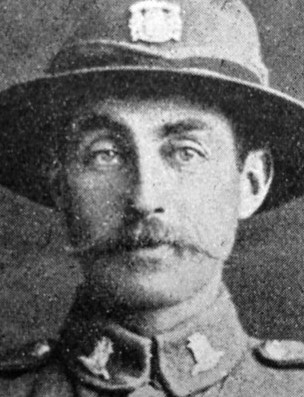
Charles Tombs was born on 26th November 1875 in Sefton, New Zealand. The seventh of eight children, his parents were Job and Elizabeth Tombs.
There is little information available about Charles’ early life. He found work as a chainman, working as a labourer in a sawmill.
On 11th December 1899, Charles married Eliza Pound, the daughter of immigrants from Somerset. The couple settled in Wairau, and went on to have six children: John, Charles, Arthur, William, Ronald and Alice.
(The Tombs and Pounds seemed to have been closely connected: Charles’ younger brother John, went on to marry Eliza’s younger sister, Elizabeth.)
Sadly, Eliza died in 1910, leaving Charles to raise four children (John and Alice having died when just babes-in-arms), alone. A later document gives Charles’ next-of-kin as Mrs R Register, who was, in fact, his younger sister, Mary (who had married Robert Register in 1907).
War was coming, and Charles would be called upon to serve his long-distant King and Empire. On 26th July 1916, he stepped up, and enlisted in the New Zealand Canterbury Regiment. His service records show that, at 40 years of age, he was 5ft 5ins (1.65m) tall, and weighed 119lbs (54kg). He had brown hair, blue eyes and a dark complexion.
Private Tombs’ unit departed from New Zealand on 15th November 1916, making the journey to Britain on the RMS Tahiti. The journey took nearly three months, and Charles arrived in Devonport, Devon, on 29th January 1917.
The ANZAC camp near Codford, Wiltshire, was to be Private Tombs ultimate destination, and he arrived there a couple of days after landing in Britain. After a lengthy journey, his health had been impacted, as had many of the men he had travelled with.
Suffering from bronchitis, Charles was admitted to the No. 3 New Zealand General Hospital on the outskirts of the camp. The condition was to prove his undoing, and he passed away on 17th February 1917. He was 41 years of age.
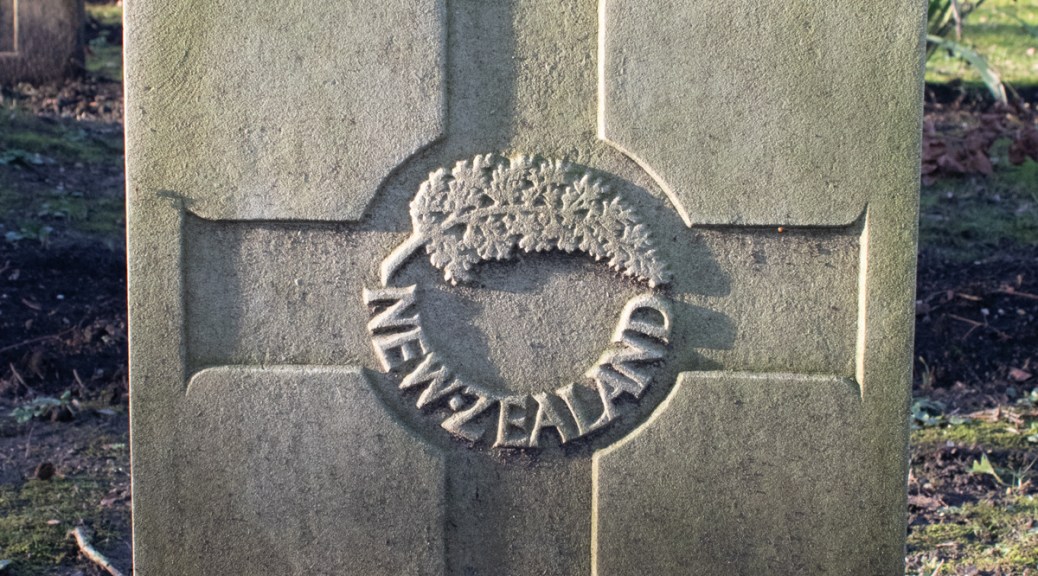
Charles Tombs was laid to rest in the ANZAC extension to St Mary’s Churchyard in Codford, Wiltshire.
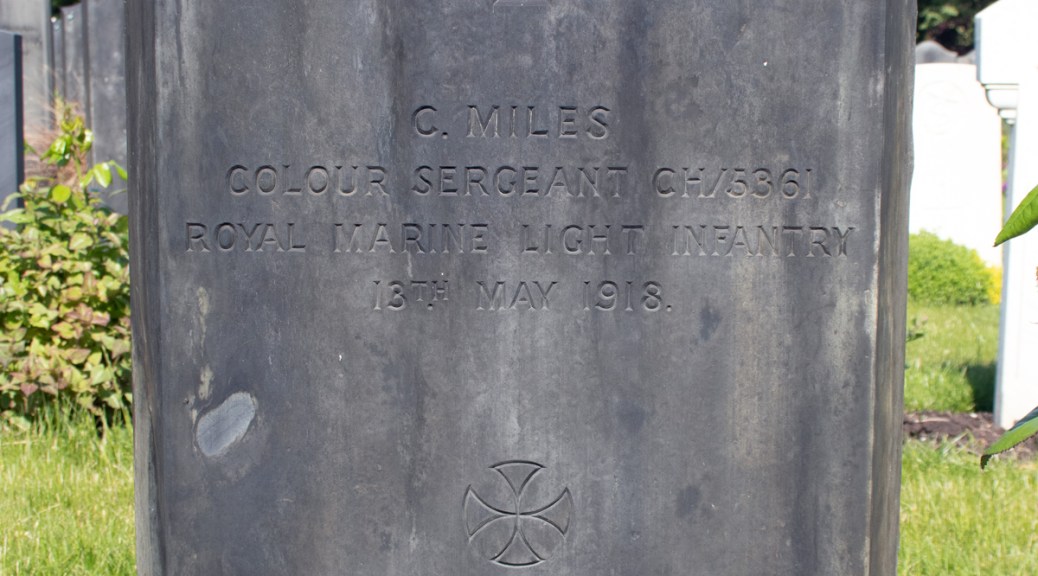
The early life of Charles Miles, whose body lies at rest in the Woodlands Cemetery in Gillingham, Kent, is a challenge to unpick, and the starting point is the last document relating to him.
His military Pension Ledger confirms that he died on 13th May 1918, from empyema, a bacterial infection affecting the lungs. The document cites his next-of-kin as Miss Hilda Miles, of 15 St John’s Road in Gillingham. She is noted as being the guardian of two children – Ada, born in 1905, and George, born the following year – because their mother, Charles’ wife, had passed away on 30th May 1912.
An online search for Ada and George gives an entry in the 1911 census. This finds them as the youngest two of six children to Charles and Elizabeth Miles. The document also gives a clue about their future guardian, Hilda: she is their older sister.
The Miles family were living at 45 Commercial Street in Whitechapel, East London. Charles, at 39, was recorded as a Royal Marines Pensioner and schoolkeeper. His wife, Elizabeth, was assisting with this role, and the couple had two other surviving children, Charles Jr and Walter.
While it is still difficult to piece together Charles’ childhood, his Royal Marine service records do shed a little light onto it. Born in Hampstead on 23rd November 1871, he was working as an ironmonger’s assistant when he enlisted. He joined up on 23rd August 1889, the document showing that he was 5ft 6ins (1.68m) tall, with brown hair, grey eyes and a fresh complexion. He also had a tattoo on his right forearm.
Private Miles had joined up in London but, as with most Royal Marine recruits, he was sent to the base in Walmer, Kent, for his initial training. In the spring of 1890 he moved to the Royal Naval Dockyard in Chatham, Kent, and this would become his regular port for the remainder of his service.
Charles’ service proved to be a committed one. Over the next decade he would serve on five ships, and would rise through the ranks. In October 1894 he was promoted to Lance Corporal, making full Corporal less than a year later. On 1st January 1899 he was promoted to Sergeant, and by the start of 1908, he held the rank of Colour Sergeant. Formally stood down to reserve status on 22nd November 1910, he was noted as having a very good character.
Away from the service, there is no record for Charles and Elizabeth’s marriage. She had been born in Sheerness, Kent, and was a year younger than her husband. It is likely that they were married by 1897, as this is when their oldest child was born. The 1901 census recorded them living on Manor Street in Gillingham, but, once Charles had been stood down, the school keeper’s position in the East End came up.
When war broke out, Charles was called upon to play his part once more. He returned to Chatham, leaving his younger children in Hilda’s care. By September 1914 he had moved to HMS Victory, the Royal Naval Dockyard in Portsmouth, Hampshire, and he would remain there for the next eighteen months. His shore base and naval experience suggest that, at 43 years of age, his was more of a training or mentoring role, although there is nothing in his records to confirm this.
In February 1916, Colour Sergeant Miles returned once more to Chatham, and the naval base there would be his home for the next few years. He was admitted to the Royal Naval Hospital in the spring of 1918, and passed away from the infection on 13th May 1918. He was 46 years old.
Charles Miles was laid to rest in Woodlands Cemetery, Gillingham.
After their father’s death, the Miles siblings found their own way in life.
By the time of the 1921 census, Ada, now 16 years old, was working as a domestic servant for Henry Chapman, a ship’s surveyor, and his family. They were living at 73 Milton Street in Fleetwood, a short stroll from the Lancashire coast.
Hilda, into whose care Charles had given his youngest children, was now 22 years of age. She had married William Swift, a pattern maker for the Admiralty, in the summer of 1918. They would not have any children, and the 1921 census found the couple living at 15 Milner Road, Gillingham. She too was just a short walk from the shoreline, but was also within walking distance from the cemetery in which her father had been buried.
Walter Marsh was born on 17th April 1891 in Beckenham, Kent. The fifth of thirteen children, his parents were Harry and Louisa Marsh. Harry was a bricklayer from Doncaster, Yorkshire, while his wife was from Enfield, Middlesex. By the time their first child was born, however, they had moved to Kent, and the 1901 census found the family living in a small terrace at 77 Birkbeck Road.
In such a large family, it would have been a challenge to find your place. It seems that Walter wasn’t able to make his mark on the world within the constrains of his siblings and so, on 11th August 1910, he enlisted in the Royal Marine Light Infantry. His service records confirm that he was 5ft 6ins (1.68m) tall, with brown hair, blue eyes and a dark complexion. He was also noted as having a scar on his back, and passed his swimming exam when he was tested on 4th November.
Private Marsh’s initial training was undertaken in Deal, Kent, but over the following eight years, his main base was to be the Royal Naval Dockyard in Chatham. In six separate postings, he would spend more than three-and-a-half years at sea, including a year on the battleship HMS Russell and the submarine depot ship HMS Cyclops.
In January 1915 Walter was promoted to the rank of Corporal, and it was around this time that he got married. In the summer of that year, he tied the knot with Gertrude Crozier, a domestic servant, and daughter of a Chatham flour mill labourer.
Corporal Marsh would continue in the Royal Marine Light Infantry until January 1918. Medically discharged, he was seen to no longer be fit for military service, although it is unclear what condition or injury led to the end of his eight year career.
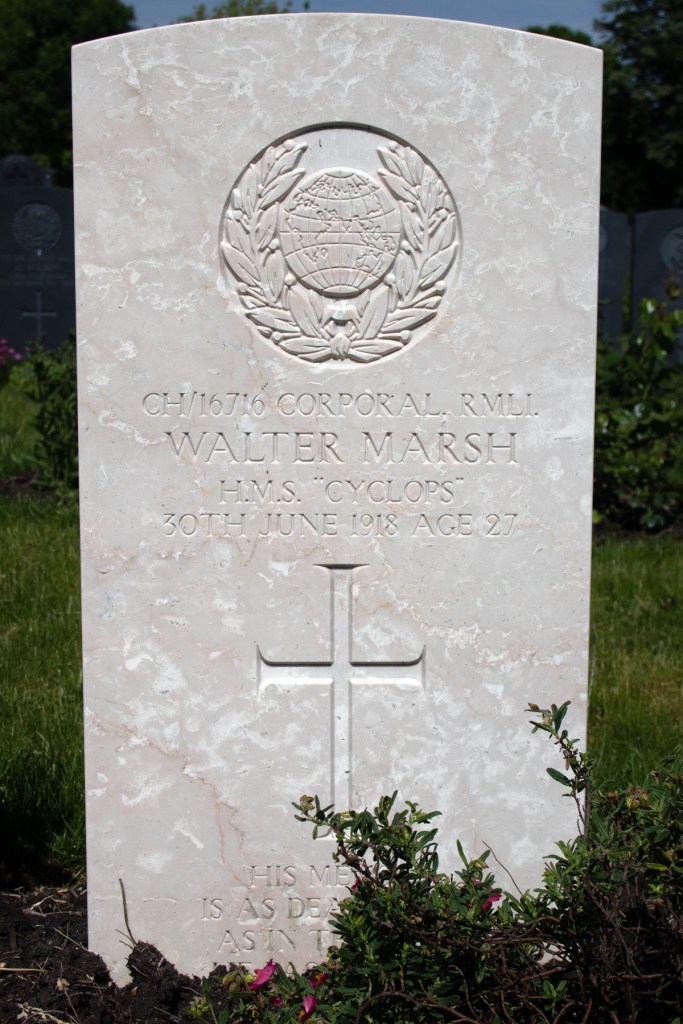
As this point, Walter’s trail goes cold, and the next record relates to his passing. He died in Chatham on 30th June 1918, at the age of 27 years old. Gertrude had given birth to their first child, a daughter named after her mother, just six months before.
The body of Walter Marsh was laid to rest in the naval section of Woodlands Cemetery, Gillingham, Kent, not far from the base that had become a home from home.
After the loss of her husband, Gertrude would go on to marry again, wedding Royal Navy Petty Officer Frederick Harris on 1st January 1920. The couple went on to have a child of their own, daughter Florence, towards the end of that year.
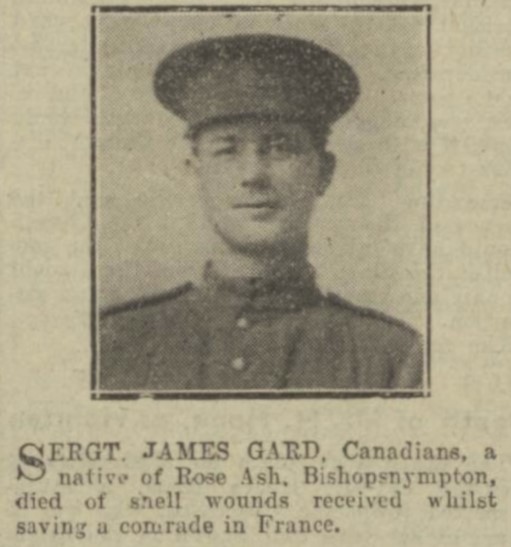
James Gard was born on 8th March 1889 in the Devon village of Rose Ash. One of fourteen children, he was the fourth of six sons to George and Mary Gard. George was a poultry dealer, but when both he and Mary died within two months of each other in 1897, their children were suddenly left as orphans.
The 1901 census found 12-year-old James visiting the Cole family, farmers who lived a few miles away in Bishops Nympton. James’ older brother Philip had plans, however, and in 1907, the two of them set out for a new life in Canada.
Boarding the SS Saxonia in Liverpool, they arrived in Boston with 50s (approx. £390 in today’s money) between them. Their final destination was to be Winnipeg in Manitoba, but the soon moved further north, setting up neighbouring homes in the town of Fisher Branch.
Both siblings found farming work, but when war broke out in Europe, James stepped up to play his part. On 24th February 1916 he enlisted in the Canadian Expeditionary Force, and was assigned to the Canadian Infantry. His service records show that he was 6ft (1.83m) tall and weighed 155lbs (70.3kg). He had dark brown hair, blue eyes and a ruddy complexion.
Private Gard set sail for Britain within a matter of weeks, arriving in Shorncliffe, Kent, on 12th May 1916. His unit – the 44th Battalion – moved to their base in Bramshott, Hampshire, and this is where he would receive his training.
James’ unit was involved in the fighting at the Somme and Ancre, and his commitment was rewarded when, on 20th January 1917, he was promoted to the rank of Sergeant. Just days later, however, he was badly injured.
A high explosive shell exploded near Sergeant Gard that day, bursting both of his eardrums. Initially treated on site, he was medically evacuated to Britain for treatment, and was admitted to the Military Hospital in Tooting, Surrey. He developed mastoiditis in both ears, and this, combined with septicaemia, lead to his ultimate death. He passed away on 1st April 1917, at the age of 28 years of age.
The body of James Gard was taken back to Devon for burial. He was laid to rest in the graveyard of St Peter’s Church in his home village, Rose Ash.
Albert Chapple was born early in 1895, and was the son of Elizabeth Chapple. She was just 16 years of age when he was born, and her parents, John and Sarah, unofficially adopted him as their own. John was a church sexton from the village of Knowstone, Devon, and this is where the Chapple family were raised.
Elizabeth married William Dart, a fishmonger from Dawlish, in 1909, and by the time of the census two years later, they had set up home in Beach Street, close to the town’s railway station.
Albert, meanwhile, was still living with his grandparents back in Knowstone. John, now 66 years of age, was employed as an agricultural labourer, while his grandson was working as a cattle boy on the same farm.
When war broke out, Albert was called upon to play his part. Sadly, full details of his military service have been lost, but it is clear that he had enlisted by June 1916. He enlisted in the Royal Army Medical Corps as a Private, with his entry in the British Army of Soldiers’ Effects suggesting that his unit was attached to the 2nd/1st Wessex Field Artillery.
Private Chapple’s pension record confirms that he had been admitted to the 2nd Western General Hospital in Exeter, Devon. He passed away on 10th December 1916, following an operation, although the document gives no clue as to why he had needed surgery. He was just 21 years of age.
Albert Chapple’s body was taken back to Knowstone for burial. He was laid to rest in the graveyard of St Peter’s Hospital in the village.
The next census return, taken in 1921, found Elizabeth and William still plying their trade in fish in Dawlish. By this point, they had had a son, Edmund, who was five years old. Elizabeth’s sister, Rosie, was living with them, and assisting in the business.
Christopher Templar Spratt was born on 23rd August 1889 in Streatham, Surrey. The youngest of three children, his parents were James and Elizabeth. James was an electrician by trade, and the 1891 census recorded the family as living at 58 Limes Road, between Selhurst and West Croydon.
The Spratts seem to have been a divided family. By the time of the 1901 census, James appears to have emigrated to Australia, presumably to earn money in the burgeoning country. Elizabeth and their younger two children were visiting Worthing, West Sussex.
At this point, and the decision seems to have been made for them to move to Sussex permanently, as the 1911 census found her and Christopher living at 87 Westcourt Road, Worthing. Elizabeth was noted as living on her own means; Christopher was working as a solicitor’s clerk, and they had a boarder, governess Nettie Buckler, to help bring in some additional money.
In January 1912, Christopher married Edith Green, a dressmaker from just along the coast in Goring-by-Sea. The couple moved in with Elizabeth, and went on to have two children: Florence, who was born that June; and Christopher Jr, who was born in November 1916.
By this point, war was raging across Europe, and Christopher stepped up to serve his King and Country. He had enlisted the Royal Naval Volunteer Reserve on 9th December 1915, but was not formally mobilised until the following June. Given the rank of Ordinary Seaman, Christopher’s service records note that he was 5ft 9ins (1.75m) tall, with dark brown hair, grey eyes and a fair complexion. He was also noted as having a mole on his left thigh.
Christopher was assigned to the Nelson Battalion of the Royal Naval Division, and sent to Dorset for training. While details of his service as more haphazard than usual, it seems that he served time overseas, and was promoted to Able Seaman on 1st October 1916. He became unwell in February 1917, as was admitted to the 18th General Hospital in Dannes-Camiers, on the French coast.
Suffering from cellulitis, Able Seaman Spratt was medically evacuated to Britain for treatment, and ended up as a patient in the 2nd Western General Hospital in Manchester. The condition was to prove fatal: he passed away on 12th February 1917, at the age of 27 years old.
The body of Christopher Templar Spratt was brought back to Sussex for burial. He was laid to rest in the churchyard of St Mary’s in Goring-by-Sea.
Elizabeth went on to re-marry and, by the time of the 1921 census, was living in East Preston, Sussex, with her new husband, Edward Neal, Christopher Jr and her new daughter, Enid. There is no evidence of Elizabeth’s older daughter, Christopher, although there is a Florence Spratt recorded as a patient in White Oak Schools (Homes for Ophthalmic Children) in Swanley, Kent.
Christopher Jr went on to marry Phyllis Bennett in the autumn of 1946. They remained in the Worthing area until his death in March 1993: he was laid to rest alongside the father he would not have remembered, in St Mary’s Churchyard. When Phyllis died seven years later, she was buried alongside her husband and father-in-law.