Category Archives: Suffolk

Able Seaman Jesse Baber

Able Seaman Jesse Baber

Jesse Baber was born on 28th February 1889 and was the youngest of thirteen children to John and Jane Baber. John was a farm labourer from Westcombe in Somerset, and it was in this village that he and Jane raised their family.

Jesse chose not to follow his father and siblings into farm work and instead, on 6th October 1906, he enlisted in the Royal Navy. As he was underage for full service at the time, he was given the rank of Boy 2nd Class and sent to HMS Ganges, a training establishment on the outskirts of Ipswich, Suffolk. His service records confirm that he was 5ft 5.5ins (1.66m) tall at the time of joining. He was also noted as having dark brown hair, grey eyes and a fresh complexion, with a mole on his right cheek being highlighted as a distinguishing mark.

Boy Baber spent six months at HMS Ganges, and was promoted to Boy 1st Class for his commitment. He was then transferred to HMS London, a dreadnaught battleship for a further six months. During his time on board, Jesse came of age, and was formally enrolled in the Royal Navy with the rank of Ordinary Seaman.

Over the next eight years, Jesse served on eleven different vessels, sailing between his British base of HMS Vivid in Devonport and the East Indies. His service seems to have generally been very good – he was promoted to Able Seaman in February 1909 – although he did spend five days in the brig in July 1912 for reasons unrecorded.

When war broke out, the ships that Able Seaman Baber served on patrolled the waters of the Mediterranean. In the summer of 1916, while on board HMS Dartmouth, he contracted malaria. Jesse was admitted to a hospital in Malta, where he remained for six weeks, and was then sent on leave home to recover.

He arrived at Castle Cary [in Somerset] on the evening of the 23rd August, on a visit to his sister, in a very serious condition, being practically in a state of collapse. Medical attention was immediately obtained, but his condition was hopeless, and he lay in an unconscious condition until Friday September 1st, when he expired, death being due to meningitis, following malaria.

[Shepton Mallet Journal: Friday 15th September 1916]

Jesse Baber was 27 years old when he passed away. He was laid to rest in the quiet graveyard of St Mary’s Church in Batcombe, not far from where his mother, who was now 74 years old, was living.


Private Edward Savage

Private Edward Savage

In the graveyard of St Augustine of Hippo Church in Penarth, Glamorgan, lies the Commonwealth War Grave for Private Edward Savage. The headstone confirms that he had died on 25th December 1915 and that he was in the Loyal North Lancashire Regiment.

The Commonwealth War Grave Commission website suggests that he was the son of Edward and Rachel Savage and that he was born in Beccles, Suffolk. Sadly, there are no available census documents to shed any further light on that early life.

The same website suggests that he served in Burma, and in the South African campaign, which would have placed him there in the late 1890s and early 1900s.

It is also noted that Edward was the husband of Emily Savage and that they were living in Fleetwood, Lancashire. Edward’s later pension ledger suggests this was an Emily Shannon, who is, in fact, noted as the guardian of his illegitimate child. Further information, however, is not available.

From a military perspective, it is likely that Private Savage was either still service at the point that the First World War broke out, or that he was called into service – or volunteered his services – shortly after its declaration. He was assigned to No. 5 Supply Company of the 3rd/4th Loyal North Lancashire Regiment and, by the autumn of 1915, he found himself based at Penarth Head Fort near Cardiff.

Edward’s death seems to have been a less than auspicious one, as a local newspaper reported at the time.

The district coroner held an inquest at Penarth on Tuesday touching the death of Private Edward Savage, who was found dead at the billets of the A Company of the Loyal North Lancashire Regiment on Sunday morning. Surgeon-Major Charles Parsons, the local medical officer, stated that the deceased had apparently fallen down some stone steps, causing a fracture of the base of the skull. The jury returned a verdict of “Accidental Death.”

Western Mail: Wednesday 29th December 1915

Private Edward Savage had died on Christmas Day, 25th December 1915. He was 54 years of age. He was laid to rest in the graveyard of St Augustine of Hippo Church in Penarth.


Edwards shares his grave with another member of the Loyal North Lancashire Regiment, Serjeant Frank Carter. Read his story here.

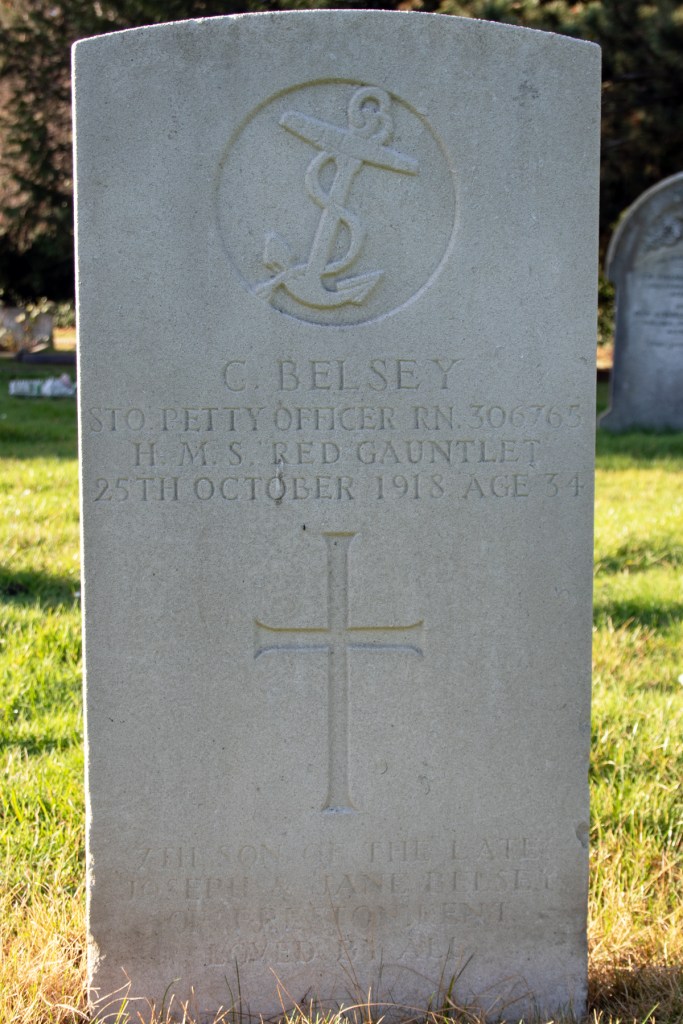
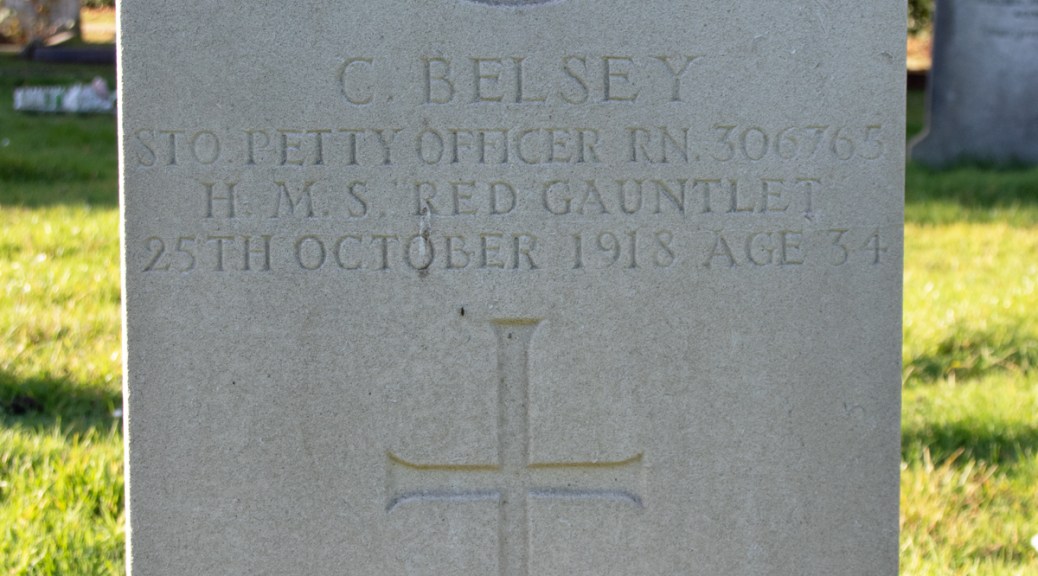
Stoker Petty Officer Christian Belsey

Stoker Petty Officer Christian Belsey

Christian Belsey was born on 12th February 1884 in the village of Preston, Kent. He was one of fourteen children to Joseph and Jane Belsey. Joseph was a farm labourer, and Christian followed suit on leaving school.

He wanted bigger and better things, however, and after his older brother Charles had sought out a life in the Royal Navy, he followed suit. Christian enlisted on 28th June 1904; his service records show that he was 6ft (1.83m) tall, had brown hair, brown eyes and a fresh complexion.

Stoker 2nd Class Belsey was based out of HMS Pembroke, the Royal aval Dockyard in Chatham, Kent, and this is where he returned to in between voyages. His first posting was on board the destroyer HMS Acheron, on board which he spent six months.

Over the twelve years of his initial service he was assigned to six different ships, rising through the ranks to Stoker 1st Class (in 1906), Leading Stoker (1911) and Stoker Petty Officer (1912).

When war broke out in August 1914, Christian was back in Chatham; he was soon assigned to HMS Laertes, a destroyer based out of Harwich, which patrolled the North Sea. She was involved in the attempt to head off the German attack on Yarmouth and Lowestoft in April 1916, during which, two of Christian’s colleagues, Stoker Ernest Clarke and Stoker Petty Officer Stephen Pritchard, were awarded the Distinguished Service Medal for their bravery under fire.

After three years on board Laertes, Christian was transferred to HMS Redgauntlet. He served on board for eighteen months until, in October 1918, he fell ill.

Admitted to a hospital in Samford, near Ipswich, Suffolk, Stoker Petty Officer Belsey was suffering from pneumonia. Sadly, the lung condition was to get the better of him, and he passed away on 25th October 1918, at the age of 34 years old,

Christian Belsey was brought back to Kent for burial. He was laid to rest in Faversham Borough Cemetery.


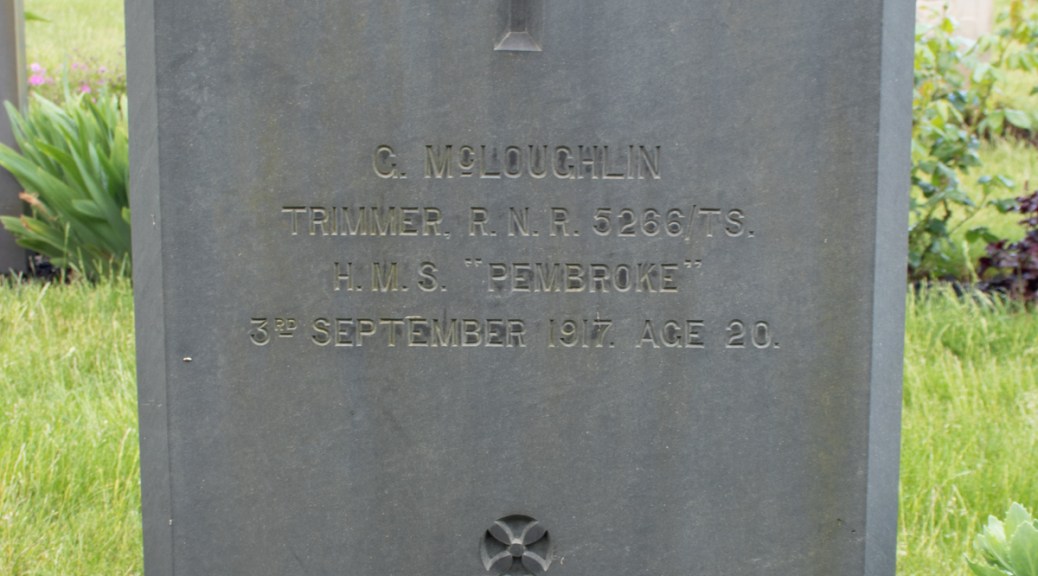
Trimmer Gilbert McLoughlin

Trimmer Gilbert McLoughlin

Gilbert McLoughlin was born in Grimsby, Lincolnshire, on 19th August 1896, one of eight children to Charles and Isabella McLoughlin. Being a fishing port, it is likely that Charles was involved in the industry, and it is no surprise that Gilbert and his siblings followed suit.

When war came to Europe, his skills at sea led to him being brought into the Royal Naval Reserve, and indeed Gilbert joined up on 20th March 1916. His service records show that he stood 5ft 2.5ins (1.59m) tall, had brown eyes and a sallow complexion, and had tattoos on his left arm.

Trimmer McLoughlin was based at HMS Pekin, a shore establishment in Grimsby, from which he would have served on ships patrolling the Lincolnshire coast. He remained posted in his home town until the end of 1916, at which point he moved down the coast to HMS Ganges, the naval base in Ipswich.

Gilbert made a further move in July 1917, when he was posted to HMS Pembroke, the Royal Naval Dockyard in Chatham, Kent. The base was particularly crowded that summer, and he was billeted in temporary accommodation set up in the barracks’ Drill Hall.

On the night of 3rd September, Chatham came under attack from a German air raid, and the Drill Hall received a direct hit. Trimmer McLoughlin was among those to be killed that night. He was just 20 years of age.

Gilbert McLoughlin was laid to rest in the Woodlands Cemetery in Gillingham, Kent, alongside the other victims of the Chatham Air Raid.


Gilbert’s older brother Joseph McLoughlin was also a victim of the First World War. As the conflict began, he continued his work as a trawlerman, although the role of his ship – the Kilmarnock – now also included elements of mine location.

On the afternoon of the 22nd September 1914, the Kilmarnock left Grimsby on a routine trip. She was around thirty miles offshore when the captain spotted floating mines ahead.

The skipper put out a buoy to mark the position, and intended returning to port to report the matter to the Admiralty authorities, but seeing some naval vessels in the distance he made towards them instead with the object of reporting.

Whilst doing so an explosion occurred amidships, and the vessel was blown into two parts, which sank immediately.

The skipper was blown to pieces on the bridge and the chief engineer badly injured.

The naval vessels, attracted by the explosion, hurried to the spot, picked up the wounded engineer, mate, and one member of the crew.

Boston Guardian: Saturday 26th September 1914

Joseph was one of the six crewmen to be killed in the incident. He was just 19 years of age.


Leading Telegraphist Ernest Webber

Leading Telegraphist Ernest Webber

Ernest Webber was born on 19th April 1897 in Newton Abbot, Devon, although there is little further documented about his early life

The 1911 census records Ernest as being at the Scattered Home in Newton Abbot. This was, in fact, the Greenaway Home for Boys, part of the town’s Union Workhouse. It was run by a Mrs Louise Foote, had 22 ‘inmates’ and was located on the Highweek Road.

The following year, however, Ernest found a way to better himself, enlisting in the Royal Navy. His service records confirm that he joined up on 9th October 1912 and gave a physical description of him: he was 5ft 5ins (1.65m) tall, had fair hair, blue eyes and a fresh complexion. He was also noted as having a scar on his left index finger.

As he was below the age for full service, he was given the rank of Boy, and was sent to HMS Ganges, the naval base in Ipswich, Suffolk, and HMS Impregnable, a training ship, for his initial instruction. Some talent seems to have been unearthed as he was soon promoted to Boy Telegraphist.

In August 1913, Ernest was assigned to the battleship HMS Conqueror. He spent nearly two years on board and, during that time, came of age. Now formally inducted into the service, he was given the rank of Ordinary Telegraphist, before being promoted again – to the full role of Telegraphist – in April 1915.

Two months later Telegraphist Webber was transferred to HMS Phaeton; over the next year, he spent time on two further vessels, before being assigned to HMS Victorious in April 1916. With this assignment came a further promotion: Ernest was now a Leading Telegraphist.

In the summer of 1917, Ernest moved again, this time to HMS Vivid, the Royal Naval Dockyard in Devonport. At this point, however, he had fallen ill, and was medically discharged from duty on 5th September 1917, having contracted tuberculosis.

At this point, Ernest’s trail goes cold. He returned to Newton Abbot, but the events of the next year are lost to time. All that can be confirmed is that he passed away, presumably of his lung condition, on 11th December 1918. He was just 21 years of age.

Ernest Webber was laid to rest in the graveyard of All Saints Church in Highweek, near Newton Abbot.


Stoker James Pye

Stoker James Pye

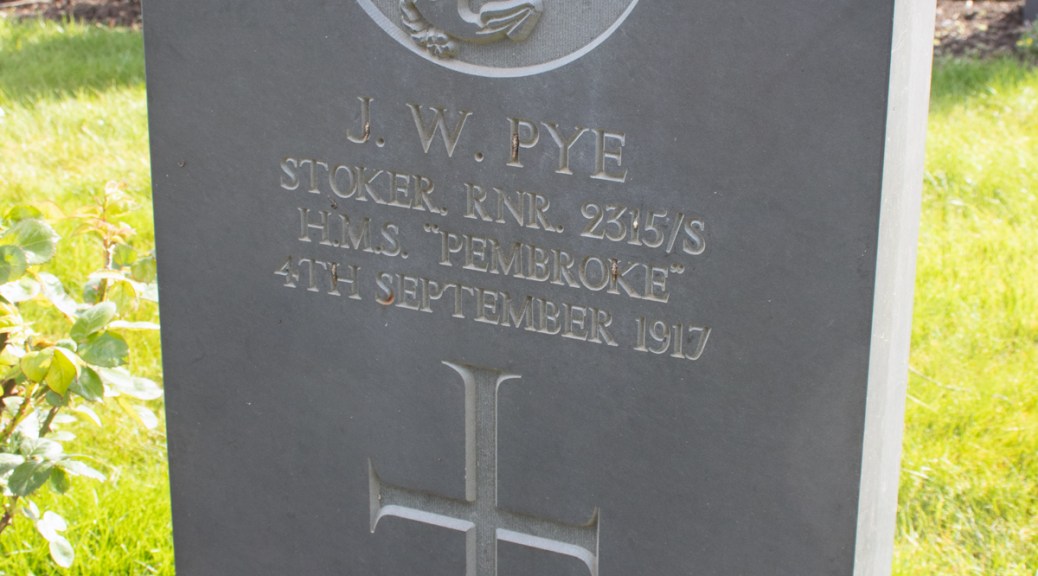
James William Pye was born on 14th August 1892, the oldest of ten children to James and Florence Pye. James Sr was a carter from Lowestoft, Suffolk, and this is where and he and Florence raised their family.

James Jr sought bigger and better things, and a career: he does not appear on the 1911 census, but, on 8th February 1912, he enlisted in the Royal Naval Reserve as a Stoker. His service records confirm that he was 5ft 7ins tall, had a fresh complexion and blue eyes. He was, by this point, living in Bungay, but no further information is given.

James was officially mobilised on 18th August 1914, and was sent to HMS Pembroke, the Royal Naval Dockyard in Chatham, for training. The following year Stoker Pye was assigned to the armoured cruiser HMS Shannon. He spent nearly two years on board, before returning to Chatham.

The summer of 1917 was a particularly crowded time at HMS Pembroke; additional space for the crews was needed, and the barracks’ Drill Hall was given over to accommodation. This is where James found himself billeted for his 25th birthday.

On the night of 3rd September, Chatham came under attack from a German air raid, and the Drill Hall received a direct hit. Stoker Pye was badly injured and admitted to the Chatham Naval Hospital; he succumbed to his injuries the following day.

James William Pye was laid to rest in the Woodlands Cemetery in Gillingham, Kent, alongside the other victims of the Chatham Air Raid.


Stoker 1st Class Horace Godden

Stoker 1st Class Horace Godden

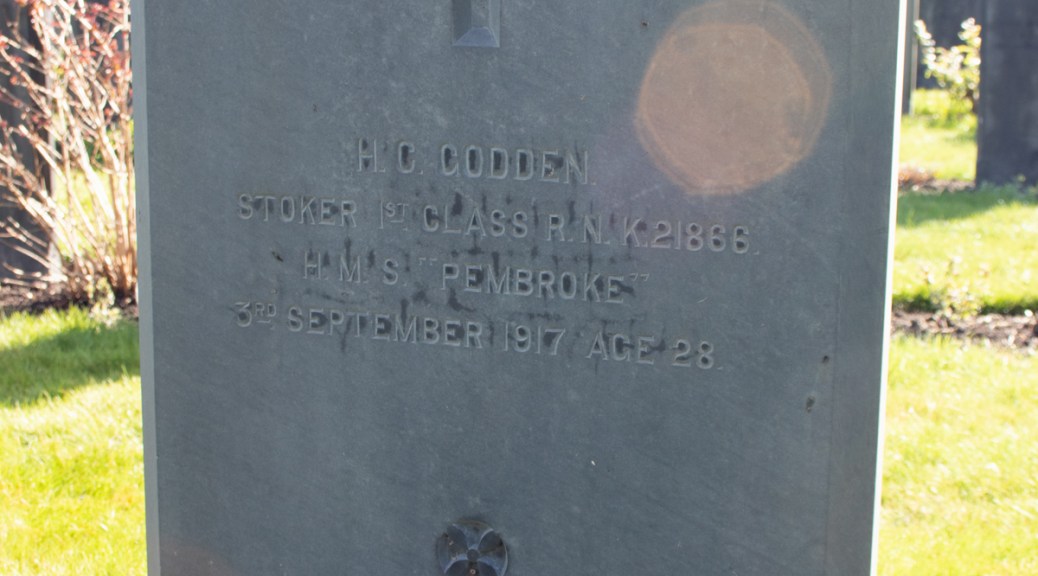
Horace Cecil Godden was born on 8th February 1889 in the Suffolk village of Boxford. He was one of eleven children to Charles and Sarah Ann Godden. Charles was a butcher and pig trader, and butchering was a trade that Horace also got into on leaving school.

He was after bigger and better things, however, and on 23rd January 1914, he enlisted in the Royal Navy. as a Stoker 2nd Class. His service records show that he stood 5ft 3ins (1.59m) tall, had brown hair, brown eyes and a fresh complexion. Horace was also noted as having a scar on the back of his left hand.

Stoker Godden was initially sent to HMS Pembroke – the Royal Naval Dockyard in Chatham, Kent – for training. His first sea-going assignment was on board the gunboat HMS Jason and, during his first year with the navy, he served on three ships in total.

Horace was promoted to Stoker 1st Class in December 1914, and served on board another two ships before returning to Chatham in November 1915. His time was not without incident, however, and he spent time in the brig on two separate occasions – for 7 days in May 1915, and for two weeks that October – although his crimes are not recorded.

In March 1916, Stoker 1st Class Godden returned to sea once more, this time on board the sloop HMS Cadmus. He came back to Chatham the following February, and then remained at the HMS Pembroke.

That summer, the Royal Naval Dockyard was packed to capacity, and Horace was billeted in temporary accommodation put in place at Chatham Drill Hall. On the night of the 3rd September 1917, during a German air raid, the Hall received a direct hit and Stoker 1st Class Godden was among those to be killed. He was just 27 years of age.

Horace Cecil Godden was laid to rest, along with the other victims of the Chatham Air Raid, in the Woodlands Cemetery in Gillingham, Kent.


Leading Seaman Edward Mudford

Leading Seaman Edward Mudford

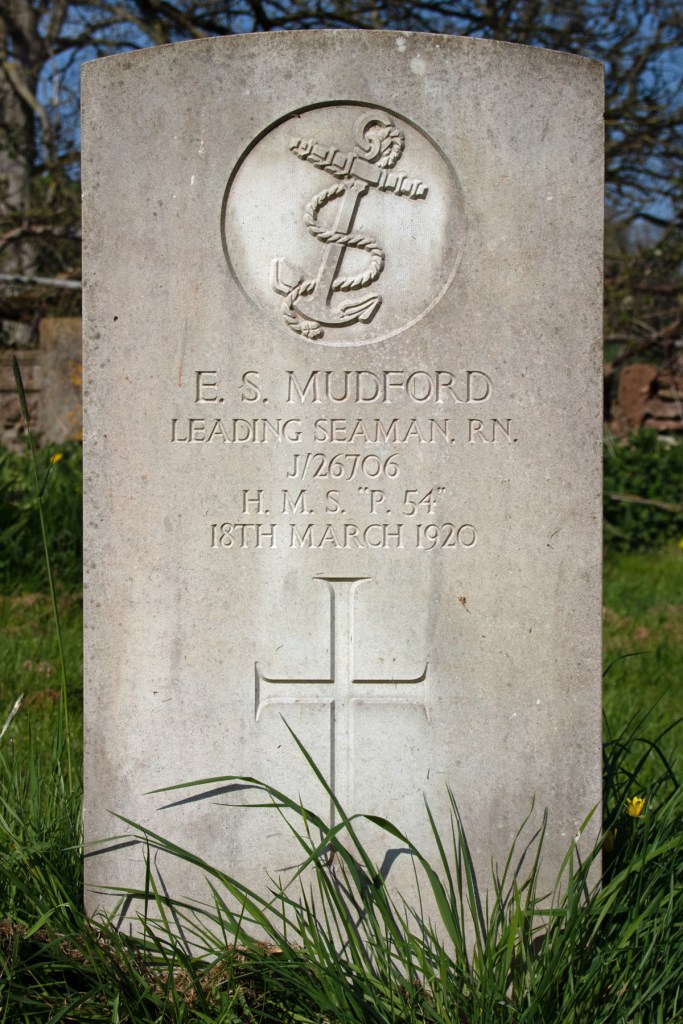
Edward Short Mudford was born on 29th March 1898 in the Somerset village of Stratton-on-the-Fosse. He was one of nine children to Joseph and Mary Mudford.

Information about his early life is confusing: the 1901 census gives his name as Edwin, rather than Edward; his father appears to have died by this point, leaving Mary to raise the family alone. The 1911 census records Edward and a younger sister living in the Union Workhouse in Shepton Mallet, while Mary has apparently remarried and was living in Radstock with two of Edward’s siblings and a daughter from her second marriage, although her new husband is noticeable in his absence from the document.

From this shaky start, however, Edward sought a new life for himself. On 21st August 1913 he enlists in the Royal Navy. His service records show that he stood just 5ft 1ins (1.55m) tall, had fair hair, hazel eyes and a fresh complexion. Being under age at the time, he was given the rank of Boy 2nd Class.

Edward was initially sent to HMS Ganges, the naval training establishment outside Ipswich, Suffolk. Promoted to Boy 1st Class in February 1914, he was soon given his first posting, on the cruiser HMS Crescent.

After another short spell at HMS Vivid, the Naval Dockyard in Plymouth, Boy Mudford found himself on board HMS Thunderer. Edward spent nearly four years aboard the battleship, coming of age and gaining the rank of Ordinary Seaman, while also being promoted to Able Seaman in March 1916.

Edward returned to Plymouth in February 1918, and spent the next couple of years between there, Portsmouth and Woolwich Dockyards. He was again promoted, given the rank of Leading Seaman in September 1918.

Life at sea and in barracks took its toll, however, and, in in the spring of 1920, Leading Seaman Mudford contracted influenza and pneumonia. Sadly the conditions proved too much to bear: he passed away on 20th March 1920, a week shy of his 22nd birthday.

Brought back to Somerset, where, presumably some of his family still lived, Edward Short Mudford was laid to rest in the graveyard of St John the Baptist Church in Chilcompton.


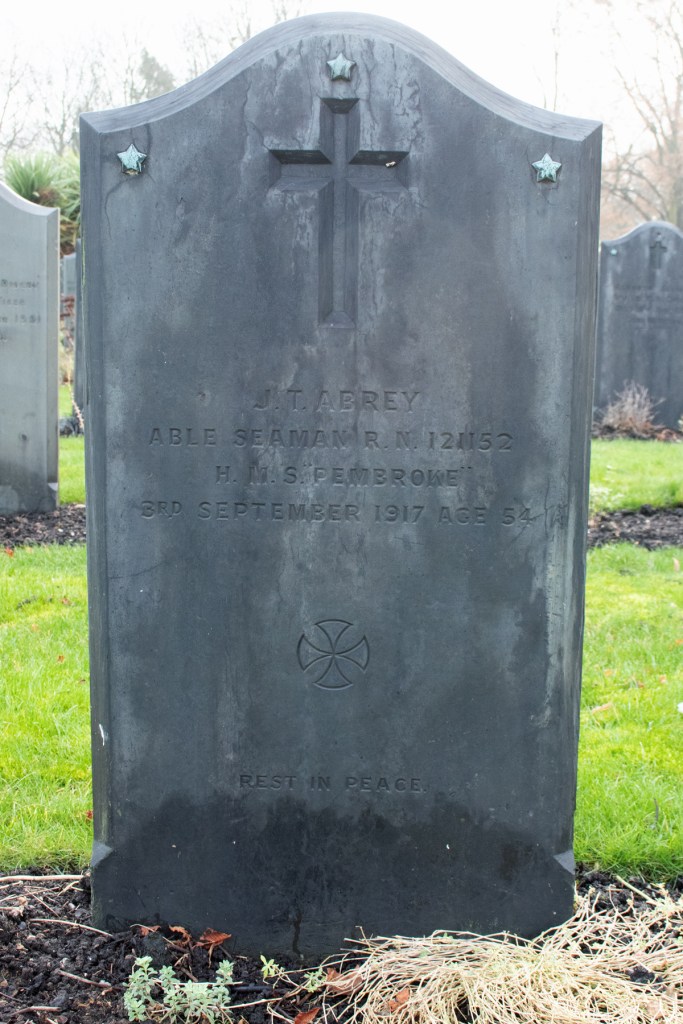
Able Seaman John Abrey

Able Seaman John Abrey

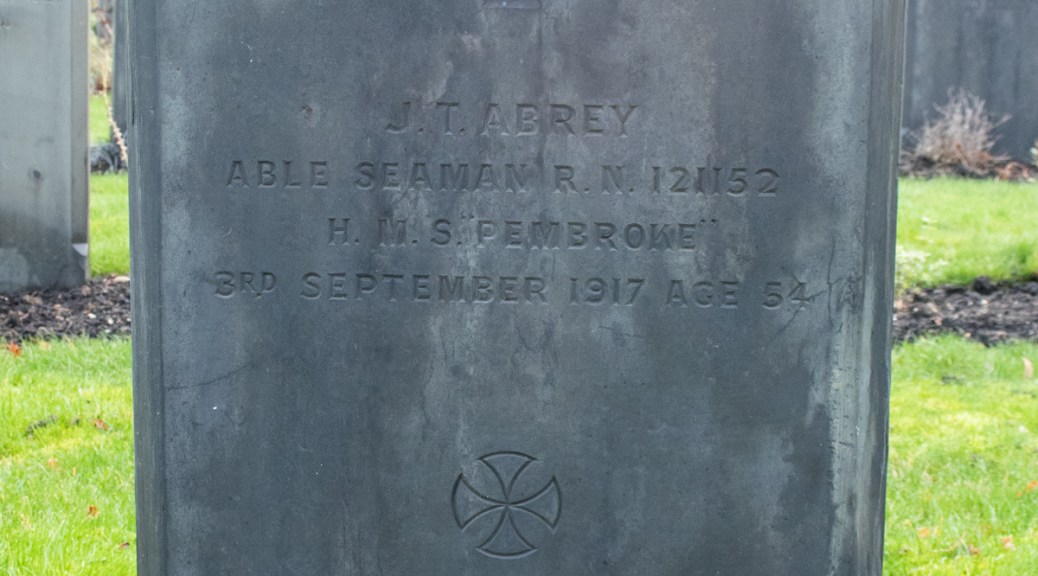
John Thomas Abrey was born in Earl’s Court on 12th August 1867, the middle of five children to John and Anne Abrey. John Sr was a carpenter and labourer from Suffolk, and Anne was from Suffolk. By the time they married, however, the couple had settled in London.

When he left school, John Jr found work as a printer, but he was after bigger and better things and, on 4th October 1882, he joined the Royal Navy. He was only 15 at this point, and so was given the rank of Boy 2nd Class. His service document record that he was 5ft 2ins (1.57m) tall, had brown hair, brown eyes and a sallow complexion.

John received his training at HMS Ganges, the shore-based establishment near Ipswich, Suffolk, and gained promotion to Boy 1st Class. He then spent six months on the training ship HMS Impregnable, before being given his first posting on HMS Minotaur. He served aboard for just over a year, during which he turned 18, and so was formally inducted in the Royal Navy, and was given the rank of Ordinary Seaman.

At this point, John signed up for a period of ten years and, over that time, he served on board seven further ships, and was promoted to the rank of Able Seaman.

On 25th May 1890, John married Christiana Ann Hamshaw at All Saints Battle Bridge in Islington. Christiana had been married and widowed twice, and had two teenaged daughters. The couple settled down – as much as a sailor can – and had two children of their own, John and William.

In August 1895, having completed ten years’ naval service, Able Seaman Abrey was stood down to the Royal Naval Reserve. Over the next few years, he maintained this service, while finding work as a labourer.

When war broke out, John was recalled to active duty and, over the next three years, served on a number of vessels. Between each assignment, however, he returned to HMS Pembroke, the Royal Naval Dockyard in Chatham, Kent, which had become his base. It was here that he was barracked in the summer of 1917.

It was a particularly busy for the base, and temporary accommodation was set up in the Drill Hall; this is where John was billeted.

On the night of 3rd September 1917, Chatham suddenly found itself in the firing line as a wave of German aircraft bombed the town. The Drill Hall received a direct hit, and Able Seaman Abrey was amongst those to be instantly killed. He had celebrated his 50th birthday the month before.

John Thomas Abrey was laid to rest in the Woodlands Cemetery in Gillingham along with the other servicemen who had perished during the Chatham Air Raid that night.


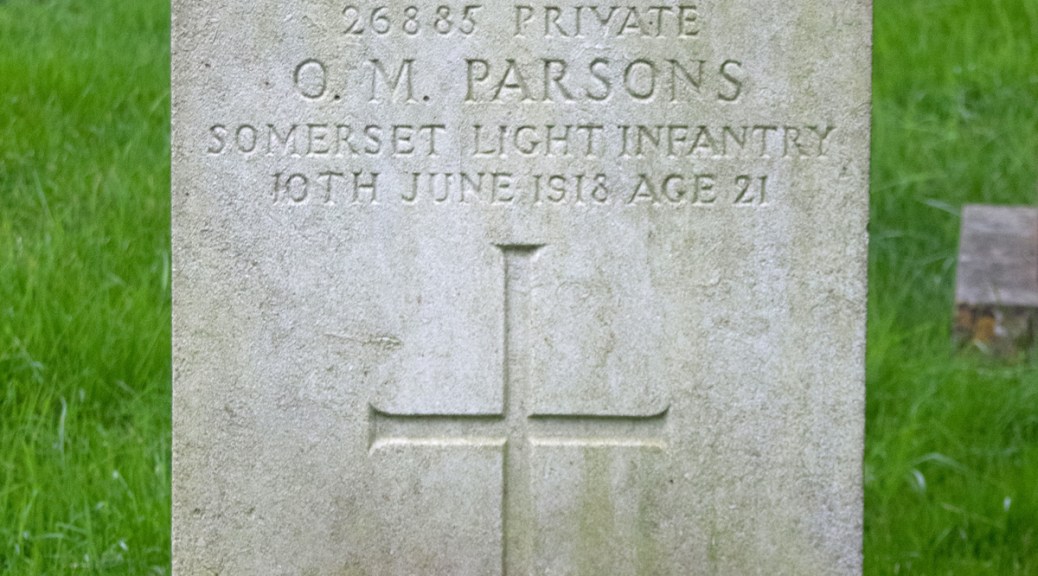
Private Oliver Parsons

Private Oliver Parsons

Oliver Metford Parsons was born in North Newton, Somerset, on 3rd January 1897. His parents were Thomas and Lily Parsons, and he was one of four children.

Thomas was a carter and labourer on a farm, and this is the trade his son took up when he left school. The 1911 census recorded Oliver as living with the market gardener Edmund Durridge and his family – who lived in the same village – and working as a labourer for them.

Lily had passed away in 1907, so this move may have had something to do with a change in family circumstances – the 1911 census recorded Thomas living in the village with Hannah Parsons, having been married for just a year.

When war came to Europe, Oliver was keen to play his part for King and Country. While full service records are not available, documents confirm that he enlisted in the Somerset Light Infantry in the spring of 1917. Private Parsons was assigned to the 7th (Service) Battalion and soon found himself on the Front Line.

While it is not possible to pinpoint exactly where Oliver fought, his battalion fought at the Third Battle of Ypres and, in April 1918 moved to Amiens.

It was in June 1918 that Private Parsons was caught up in a gas attack. He was injured and medically evacuated to England for treatment, where he was admitted to the Ipswich Hospital in Suffolk. Sadly, his injuries proved too severe, and he passed away at the hospital on 10th June 1918. He was just 21 years of age.

Oliver Metford Parsons’ body was brought back to his Somerset home. He was laid to rest in the graveyard of St Peter’s Church in North Newton.


Private Oliver Parsons
(from ancestry.com)