Category Archives: Surrey

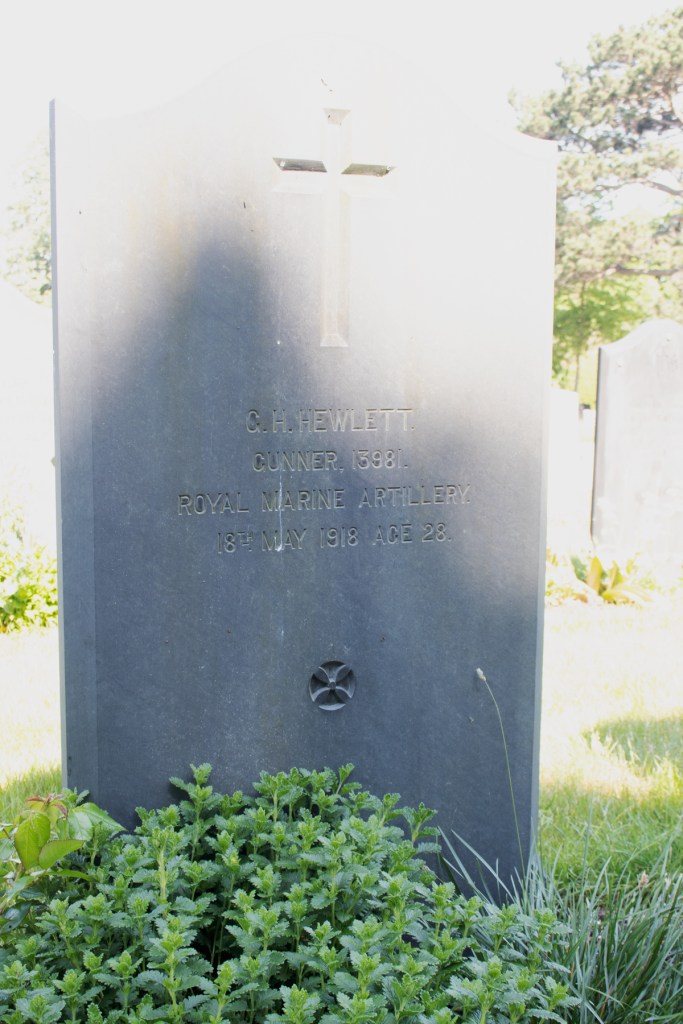
Gunner George Hewlett

Gunner George Hewlett

George Henry Hewlett was born on 11th July 1892, the oldest of four children to Henry and Louisa Hewlett. Henry was a painter from Hampshire, who travelled for work. George and his youngest sibling were born in Romsey, while his two brothers were born in Swindon, Wiltshire. By the time of the 1901 census, when George was eight years old, the family had settled in Hammersmith, London.

The next census, in 1911, recorded the family as living in Caterham, Surrey. By this time, George and his father were working as gardeners, while his brothers were working as grocers. Louisa, meanwhile, was employed as a live-in housekeeper for a spinster and her mother just around the corner.

War was coming and George was determined to do his bit. Full details are not available, but he enlisted in the Royal Marine Light Infantry, taking on the role of Gunner. In May 1918 he was on board HMS Iris, a Mersey ferry requisitioned by the Royal Navy for support in the planned raid on Zeebrugge.

On 23 April 1918, HMS Iris was towed across the English Channel to Zeebrugge by HMS Vindictive; she was carrying a couple of platoons of the 4th Battalion of the Royal Marines as a raiding party. When the Vindictive neared the Zeebrugge she cast the ferry aside. Iris tried to pull up to the breakwater under heavy fire in order to off-load the raiding parties which were on board. She sustained heavy fire and a shell burst through the deck into an area where the marines were preparing to land. Forty-nine men were killed, including Gunner Hewlett. George was 28 years of age.

George Henry Hewett’s body was brought back to England. He was laid to rest in the Woodlands Cemetery in Gillingham, Kent, not far from the dockyard at which he was based.


George’s two brothers also fought in the First World War.

John William Hewlett, who was two years younger than George, joined the 1st Royal Marine Battalion of the Royal Naval Division as a Private. He fought on the Western Front, and was killed in fighting on 22nd October 1916. He was 21 years of age. John was laid to rest at the Mesnil-Matinsart Cemetery near the town of Albert in Northern France.

Joseph Herbert Hewlett was born three years after George. When war was declared, he enlisted in the Buffs (East Kent Regiment), joining the 4th Battalion as a Private. Dispatched to India, he was initially based in Bombay, but was injured in fighting. He was sent back to England, and treated at the Military Hospital at Netley, near Southampton. Sadly, his wounds proved too severe – he passed away on 4th April 1915, aged just 20 years old.

In the space of three years, Henry and Louisa Hewlett had lost all three of their sons to the war. After George’s death, a local newspaper reported this was their “sad and proud record”. [Dover Express: Friday 31st May 1918]


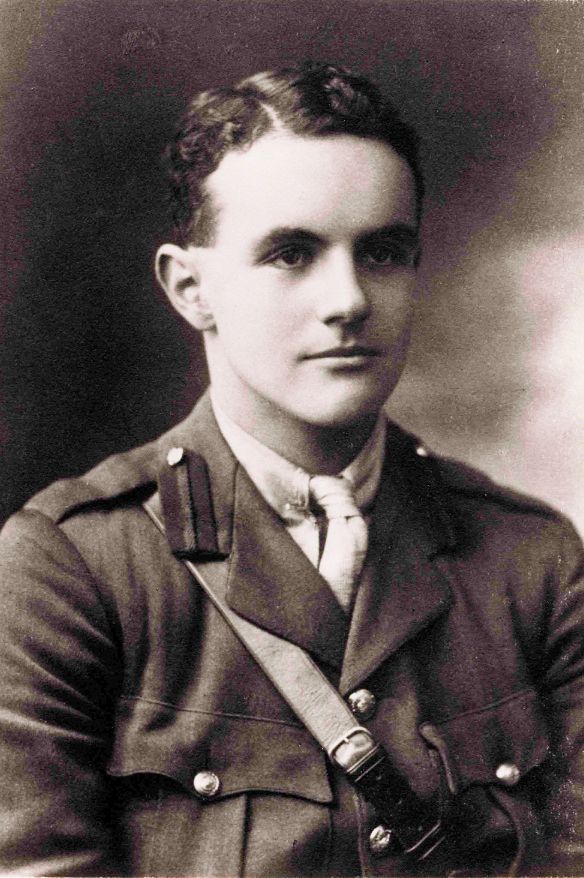
Lieutenant Basil Scott-Holmes

Lieutenant Basil Scott-Holmes

Basil Scott-Holmes was born on 2nd February 1884 in the Somerset village of Wookey. The oldest of two children, his father was Liverpool-born Thomas Scott-Holmes and his wife, Katherine. When Basil was born, Thomas was the vicar of St Matthew’s Church, Wookey, but by 1901, he had risen to the role of clergyman – and subsequently Chancellor – at Wells Cathedral.

Basil’s pedigree stood him in good stead. Initially educated in Llandaff, South Wales, he subsequently attended Sherborne School in Dorset. Sent up to Cambridge, he studied history at Sidney Sussex College.

After leaving university, Basil spent time in Europe learning German and French. He was then assigned the role of Assistant Commissioner in North Nigeria but, after a year there he was invalided home taking up a teaching role at the Bristol Grammar School in 1912.

In July 1913, Basil married Barbara Willey, a surgeon’s daughter from Reigate, Surrey. The marriage record shows that Basil was registrar for an architectural association by this point; the couple went on to have two children, daughters Annette and Prudence.

When the war broke out, he was obviously keen to do his bit. In September 1914 he enlisted in the Royal Army Service Corps, before gaining a commission in the King’s Royal Rifle Corps a couple of months later. In the spring of 1916, Lieutenant Scott-Holmes had been seconded to the Machine Gun Corps, although it is unclear whether he served abroad during any of his time in the army.

On the evening of 24th October 1916, Lieutenant Scott-Holmes was riding in a motorcycle sidecar through central London, on the way back to camp. A local newspaper picked up the story:

…they stopped when going through Wandsworth to re-light the near light, and in the dark a motor omnibus ran into them, and Lieutenant [Scott-Holmes], who was strapped in the side-car, was, with the car, flung across the road. He died as he was being taken to Wandsworth Hospital. At the subsequent inquest, a verdict of “accidental death” was returned.

Central Somerset Gazette: Friday 3rd November 1916

Basil Scott-Holmes was just 32 years old. His body was brought back to Somerset; he was laid to rest in the cemetery at Wells Cathedral.


Larger memorial image loading...
Basil Scott-Holmes
(from ancestry.co.uk)

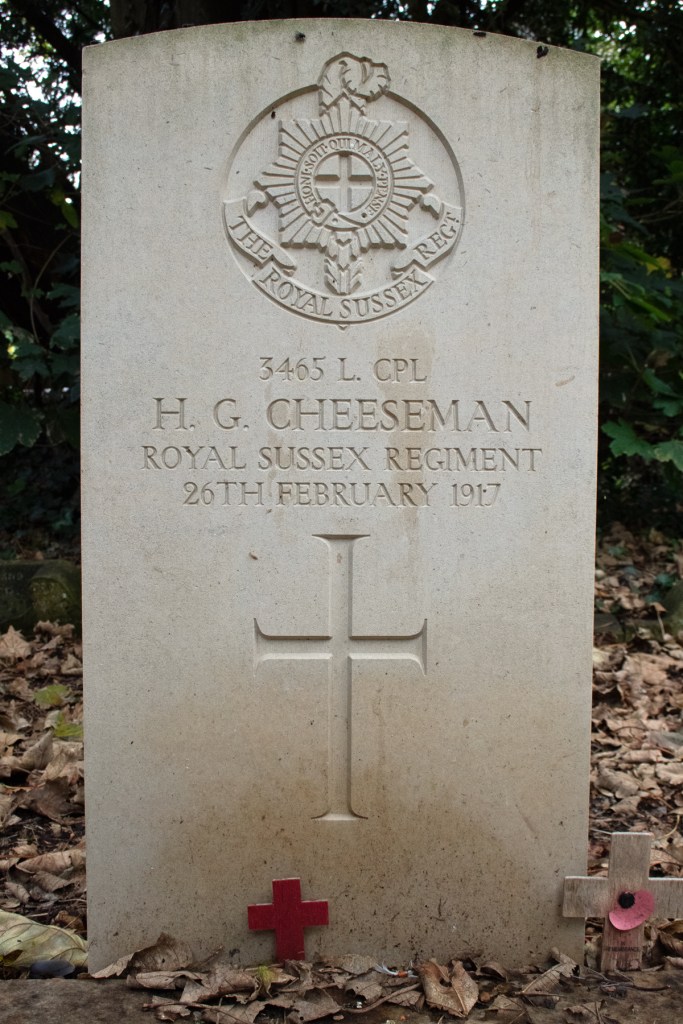
Lance Corporal Harry Cheeseman

Lance Corporal Harry Cheeseman

Harry George Cheeseman was born in the summer of 1893, one of eleven children to Charles and Sarah Cheeseman. Charles was an innkeeper, and ran the now-closed Red Lion Inn in Angmering, West Sussex for more than twenty years.

Harry did not follow in his father’s footsteps when he left school. Instead, he moved in with his older sister and her family in Horsham, where he worked as a roundsman on his brother-in-law’s dairy farm.

When war broke out, Harry was eager to enlist. He joined the Royal Sussex Regiment on 16th September 1914, and was assigned as a Private to the 9th (Service) Battalion.

Initially formed in Chichester, Private Cheeseman found himself moved to Portslade, then Shoreham, then Woking in Surrey, before eventually being sent to France at the beginning of September 1915. By this point, he had proved his worth and had been promoted to Lance Corporal.

Harry’s bravery shone through; in November 1915, while battle was raging, he brought an injured colleague into a field hospital and was about to rescue another when he himself was injured. His wound – a gun shot wound to the spine – was initially treated on site, but he was soon evacuated back to England.

Lance Corporal Cheeseman’s injuries proved to be life-changing. A later newspaper report stated that he had been “physically helpless” [Worthing Gazette: Wednesday 5th March 1917], so paralysis seems likely. Awarded the British and Victory Medals and the 1914 Star, he was medically discharged from the army in May 1916.

Harry returned home, but never really recovered from his injuries. He died on 26th February 1917, at the tender age of 23 years old. His funeral “which was of a most impressive character, was witnessed by five hundred people” [Worthing Gazette: Wednesday 5th March 1917], and he was laid to rest in the graveyard of St Margaret’s Church in his home town.


Private Charles Hide

Private Charles Hide

Charles Arthur Hide was born on 14th July 1897 and was the son of Ellen Edith Hide. The 1901 census found Charles living with his mother and her parents in the West Sussex village of Clapham. When Ellen’s father James died in 1909, local hurdle maker Alfred Daniels took her, Charles and her mother in as lodgers. Ellen subsequently married Alfred in 1916.

Charles, by this time, had left school and found employment with the railways. He started work on 22nd April 1913, earning 14s per week (around £55 a week in today’s money) as a porter at the station in Hove.

When war broke out, however, Charles felt the need to do his duty. He resigned from his job on 13th November 1914, and enlisted in the Royal Sussex Regiment as a Private. Charles was not alone in this: the employment records for Hove Station show that a number of other porters also handed in their notice around the same time.

Assigned to the 11th (Service) Battalion (also known as the 1st South Downs), Private Hide was initially based near Bexhill. His troop was then moved on, first to Maidstone in Kent, then to Aldershot, Hampshire. Whilst the battalion as a whole were shipped to France in 1916, there is no evidence that Charles went with them, and it seems that he may have served his time on home soil. Wherever he was based, he was awarded the Victory and British Medals for his time in the army.

At this point, details of Private Hide’s life become sketchy. He is only mentioned in one further document – the Army Register of Soldiers’ Effects – which confirms that he passed away at a military hospital in Epsom, Surrey, on 26th March 1917, although no cause is given. He was just 19 years of age.

Charles Arthur Hide’s body was brought back to Sussex for burial. He lies at rest in the quiet graveyard of St Mary the Virgin Church in his home village of Clapham.


Private Leonard Patch

Private Leonard Patch

Leonard David Patch was born on 22nd October 1892, the oldest of four children to David and Fanny Patch from Norton-sub-Hamdon in Somerset. David was a stone mason, but when his eldest son left school, he found work as a carpenter.

When war came to Europe, Leonard was one of the first from the village to volunteer. Given the small size of Norton-sub-Hamdon, it seems likely that he would have done so with friends; many of the Pals Battalions were formed like this.

Leonard joined the Somerset Light Infantry as a Private, and was assigned to the 7th Battalion. He was sent to Woking, Surrey, for training and it was while he was billeted there that he contracted measles. Moved to the Military Isolation Hospital in Aldershot, he developed pneumonia, and passed away from the lung condition on 25th February 1915. He was just 22 years of age, and had seen no military action.

Private Patch’s body was brought back to his home village, where he was laid to rest in the graveyard of St Mary’s Church, where he had been baptised two decades before.


Of Leonard’s brothers, two saw active service.

John Henry Patch, the second oldest of the siblings, served in the Royal Engineers, enlisting just ten months after his brother had died. He survived the war, married Linda Turner in Yeovil and went on to have a son, Norman. John passed away in February 1969, a few days after his 75th birthday.

Edward Lionel Patch – the third brother – served with the Devonshire Regiment. He too survived the war, marrying Honor Brown in 1923; they also had a son, called David. Edward passed away in Yeovil in 1966, aged 70 years old.

The youngest of the four brothers, Clarence William Patch, was born in 1899 and was lucky enough not to have seen military service. He married Emily Brown in 1924 and the couple had a daughter, Emmie. Sadly, she passed away as a babe-in-arms, and Emily was to follow soon after. In 1931, Clarence married again, this time to Emily Dyer; they went on to have a son, Douglas Leonard. Clarence passed away in 1945 at the age of just 46 years old.


Bandsman Hubert Campbell

Bandsman Hubert Campbell

Hubert Stephen Buck was born on 18th October 1887, in Stepney, East London. His father, Edgar Buck, started to use his grandmother’s maiden name – Campbell – from the 1880s, and, by 1901, the family had formally changed their name.

At the time of his marriage to Hubert’s mother Alexandra Stephen in 1885, Edgar was working as a ostrich feather manufacturer. The couple went on to have six children, all boys, of which Hubert was the second oldest.

By the time of the 1901 census, Edgar and Alexandra has moved the family south of the river, from Mile End to Lambeth. By now, Hubert’s father was working as a musician, but there is little further information about his trade.

The next census – from 1911 – found the family living in Lewisham. Edgar was now listed as a band leader, while Hubert, who was the oldest child still living at home, gave his profession as musician, presumably in his father’s band.

War was imminent and, while Hubert was definitely involved, there is little specific information about his military service. He enlisted in the Irish Guards, and was assigned the role of Bandsman.

In August 1917, Hubert married Alice Johnson in Sutton, Surrey. He listed his profession as Musician in HM Irish Guards, so must have enlisted before that point. Interestingly, the same document identifies Edgar’s profession as Bandmaster in the 1st City of London Regiment, so it seems he also enlisted.

The marriage certificate shows Alice was two years older then her new husband, and that she was the daughter of warehouseman Alfred Johnson, who had, by that point, passed away.

Bandsman Campbell survived the war, but there is no indication as to whether he served abroad, or was part of a territorial force. He and Alice moved to Worthing in West Sussex, but there is no confirmation on when the move took place. The 1921 census, taken in June of that year, records the couple as living at 151 Lyndhurst Road in Worthing, where he was noted as being a totally disabled pensioner. There is little further information about him, other than the fact that he died on 4th August 1921, at the age of 35.

Hubert Stephen Campbell was laid to rest in the Broadwater Cemetery in Worthing.


While Hubert’s trail went cold, there is further information on Alice. An advert in the Worthing Gazette offers musical training by her:

Musical Training on Modern Methods

Pianoforte (Matthay), Voice Production, Singing, Theory, Harmony, Aural Culture, Musical Appreciation, and Art of Teaching.

Thorough preparation for all Examinations, Elementary to Diploma Grades, Special Courses for Teachers for the study of the Matthay system and the Art of Teaching.

MADAME ALICE CAMPBELL (Member of the Musical Councils of the London and East London Musical Festivals. Registered Teacher: Teachers’ Registration Council.

Worthing Gazette: Wednesday 31st August 1921

Digging a little deeper, and there are similar advertisements in the newspaper from late 1917, through to at least the 1930s, by which time, Alice was running the Worthing School of Music.

The advert suggests a couple of points. It certainly suggests that a love of music is what brought Hubert and Alice together in the first place. There was a definite musical connection in the household, initially driven by Hubert’s father, and continued with his widow.

Given that the advert above is dated a matter of weeks after Hubert’s death, it also seems likely that his passing was not unexpected. There is nothing in the local media relating to his death, and, with regular students to teach, Alice obviously felt is unnecessary to take any significant time away from her work in grief. It is supposition on my part, but it would suggest that Hubert died from a chronic condition, possibly one of the lung diseases that were rife across Europe in the aftermath of the Great War.

The last advert for the Worthing School of Music ran on 12th September 1934. Beyond that date – when Alice would have been 49 – there is no further clear record of her or the school.


Private Arthur Westby

Private Arthur Westby

Arthur William George Westby was born in the spring of 1895, the only child to Arthur Henry Westby and his wife, Emma. Arthur Sr was a Corporal in the Scots Guards, but, beyond the fact that his son was born in Clapham, South London, there is little further information about Arthur Jr’s early life.

His father’s military career must have taken him across the country – the 1901 census lists Emma and Arthur Jr living in Bolton, Lancashire, even though there seem to be no connections with the county for them.

The records for Arthur Jr go quiet until 1920. At this point, documents hint at his military service during the Great War.

The death notices in the Sussex newspapers confirm his passing:

On November 19th 1920, at The Cedars, 13 Browning Road, Worthing, Arthur WG Westby (late MT, RASC), beloved husband of Ethel Westby, and only son of Ex-RQM Sergeant and Mrs Westby, 34 Wenban Road, Worthing. Patiently suffered to the end, result of Active Service.

Worthing Gazette: Wednesday 24th November 1920

There is no further information available about Ethel, and no marriage records to confirm a date for their wedding.

From a military perspective, Arthur enlisted in the Royal Army Service Corps, and was attached to the Motor Transport division. Again, there is nothing to evidence when he enlisted or for how long he served. It seems that Private Westby was injured in the line of duty, and was medically discharged in April 1918. The injury appears to have been life-changing, and it affected him until the end of his life.

Arthur William George Westby passed away in Worthing on 19th November 1920, aged just 25 years old. The specific cause of his death is unknown. He was laid to rest in the Broadwater Cemetery in the town, close to his parents and widow.


Private Arthur Rousell

Private Arthur Rousell

Arthur Edward Rousell was born in the summer of 1898, one of five children to Henry and Lucy Rousell. Henry was a police constable in Worle, near Weston-super-Mare, and this is where he initially raised his family. By the time of the 1911 census – when Arthur was a schoolboy of 12 years old – the family had moved to the village of Huish Episcopi, on the outskirts of Langport.

Details of Arthur’s military career are sketchy. Initially enlisting with the Royal Lancashire Regiment, he was soon transferred over to the 1st Battalion of the Lincolnshire Regiment. He certainly saw action abroad, and was caught up on the Western Front.

Private Rousell was injured on 27th May 1918, this the first day of the Battle of Aisne. His battalion was certainly involved in the battle, but whether this was where he was injured, and what his injuries actually were, cannot be confirmed.

Evacuated back to England for treatment, Private Rousell was admitted to the South African Hospital in Richmond. Whether he was there for a long time, is not recorded, but he was certainly there in nine months after he was wounded.

It seems that his injuries left him susceptible; his pension record confirms that he died of sickness, and it seems likely that this was one of the lung conditions – pneumonia, influenza – that was prevalent following the cessation of hostilities.

Private Arthur Edward Rousell died on 22nd February 1919, at the age of 20 years old. His body was brought back to Huish Episcopi, and he lies at rest in the family grave in the graveyard of St Mary’s Church.


UPDATE : 19th April 2022

An article on Arthur’s passing sheds more light onto his life:

We regret to record the death of Pte. AE Rousell, of the 1st Lancs. Regt., eldest son of PC and Mrs HJ Rousell of Newtown, which occurred at Richmond Hospital on Saturday morning. Deceased, who was 20 years of age, had been seriously ill a week with influenza, death being due to septic pneumonia, which followed.

The late Pte. Rousell, was a member of the staff of “The Langport and Somerton Herald” where he served his apprenticeship, when war broke out, and joined up early in 1917, his regiment being the King’s Own Yorkshire Light Infantry. After a period of training he proceeded to the front and took part in several engagements. He was gassed, and in the winter of that year was invalided home with trench feet. On recovery he was transferred to the Lancs. Regt., and again proceeded to the front.

On May 27th last he was severely wounded in the right leg by shrapnel, the bones being badly splintered. He was sent to a military hospital in this country and had been in hospital ever since. He had made a fairly good recovery and his parents were expecting him home shortly, when on Thursday last week a wire was received, informing them of his serious illness. Mrs Rousell at once proceeded to Richmond and was able to see her son before he passed away.

Deep sympathy is extended to the relations in their sad bereavement.

Langport & Somerton Herald: Saturday 1st March 1919

Private William Flower

Private William Flower

William Alister Flower was born in 1887, one of five children to Joseph and Annie Flower. Joseph was a platelayer for the local railway, and brought the family up in Weston-super-Mare, in his home county of Somerset.

When he left school, William worked as an errand boy for a local greengrocer; he stuck with it, and, by the time of the 1911 census, he was employed as a van driver for the grocer.

War was on the horizon and, while William enlisted in the army, it is difficult to get a complete handle on his military service. There are a number of servicemen with similar names, but the documentation that is available is not easy to directly connect them with the gravestone in the Weston-super-Mare cemetery.

What is clear is that William enlisted as a Private in the Army Service Corps at some point before May 1918. He was assigned to the Motor Transport division (this was likely on the back of his van-driving experience). His time seems to have been spent on home soil, although he was awarded both the Victory and British Medals for his service.

At some point, he had married a woman called Mabel. Exact details again are unclear – ancestry.com confirms the marriage of a William Flower and Mabel Richardson in December 1909, but as this took place in Northamptonshire, it is unlikely to be the Somerset Flowers researched here.

Details of Private Flower’s passing are also scarce. He died on 8th November 1918, in the Military Hospital in Croydon, Surrey, but the is no information as to the cause of his death. He was just 31 years old.

William Alister Flower’s body was brought back to Somerset; he lies at rest in the family grave, in the Milton Cemetery of his home town.


While I was researching William Flower, I was taken by the note of the accidental death of the first name on the family grave.

Edward Thomas Flower was two years William’s senior who, after leaving school, had gone on to be an errand boy for a local butcher.

Edward had decided to follow in his father’s footsteps and join the railways, leaving his home town in 1905 to work in Cornwall. After initially working as an engine cleaner, he progressed to be a fireman, helping to stoke the engine with coal. The local newspaper of the time picked up the story of the accident.

At the moment of the accident, a goods train was standing in the Redruth station, shunting having been temporarily suspended to admit the passage of the down motor rail car.

It appears that the flap of one of the cattle trucks in the goods train… had been allowed to remain down, and the folding doors above it had been insecurely fastened, with the result that as the motor rail car ran into the station the doors of the truck suddenly flew open outward and one of them struck deceased on the side of the face and head, inflicting terrible injuries.

There was a very extensive fracture of the skull, the whole of the left side of the face was driven in and there was also a formidable wound at the back of the head, death occurring within a few moments.

It appears that the rail motor was not proceeding at a greater rate than some five or six miles an hour, according to the statement made at the inquest by the driver, and the latter noticed that when the doors of the goods truck swung open they struck one of the handles on the fore part of the car. He applied the brake immediately, but did not know that Flower had been struck until afterwards.

Weston Mercury: Saturday 7th October 1905

The inquest found that there had been some neglect on the part of the porter and guard in not ensuring that the goods truck’s doors had been secured, and it seems that this was something that had been highlighted previously.

Edward had shortly been due to marry, leaving a fiancée, as well as a family, bereft. He was just 20 years old.

His body was brought back to Weston-super-Mare, and was the first to be buried in the family grave.


Lance Corporal Ernest Hawkins

Lance Corporal Ernest Hawkins

Ernest Frederick Hawkins was born in Street, Somerset, in 1884. He was the youngest of six children to Charles Hawkins and his wife Elizabeth. Both of Ernest’s parents were shoemakers in the Clark’s Factory in the town, and this was the trade Elizabeth continued in after her husband’s death in 1887.

Ernest’s life has some mysteries about it and there is a sense that he spent time trying to escape from something. In August 1904, he enlisted in the army, joining the Scottish Rifles (also known as the Cameronians). He did this under an assumed name, preferring to be called James Fisher.

“James” gave his next of kin as his parents, listing them as George and Annie in South Acton (even though these were not his actual parents’ names, and that his father had passed away 17 years previously).

His enlistment papers give an interesting insight into the young man. He was listed as 22 years old, 5ft 4ins (1.62m) tall, with brown eyes, black hair and a sallow complexion. His arms were adorned with a number of tattoos, including Buffalo Bill on his upper right arm and a ship surrounded by flags on his upper left.

Private Fisher served for a year on home soil, before being shipped out to India. He returned to the UK in October 1907, and transferred to the Army Reserve.

Ernest returned to Somerset, and it was here that he met Sarah Jane Manning. The couple married in a registry office in Bristol, and went on to have two children, Hubert and Iris.

War broke out, and Private Fisher was remobilised. By August 1914 he was promoted to Lance Corporal, and sent to France as part of the British Expeditionary Force. Here he became caught up in a number of the key battles of the conflict.

On 24th July 1916, during the British attacks on High Wood at the Somme, he was wounded in the right arm, and invalided back to England for treatment. Admitted to the War Hospital in Guildford, Surrey, it was confirmed that he had received a gun-shot wound to his right arm, which had resulted in a compound fracture of the humerus, radius and ulna. Sadly for Ernest, the only option was a full amputation of his right arm.

After some time to recover, Ernest was transferred to the Pavilion Military Hospital in Brighton where he was fitted for an artificial limb. He spent three months in the Brighton facility, before being moved to the Queen Mary’s Convalescent Home in Roehampton to recuperate. He was eventually discharged – from the hospital and the army – on 10th March 1917, and returned to his wife and family in Somerset.

There is little further documented information about Ernest. He and Sarah went on to have a further child – Leslie – in 1917. Sadly, where Ernest had been a toddler when his father had died, Leslie was consigned to be a babe-in-arms when Ernest passed away.

Ernest Frederick Hawkins – also known as James Fisher – died in Swindon on 2nd July 1918, at the age of 34. He lies at rest in St Mary’s Cemetery in his adopted home town of Taunton, Somerset.


Ernest’s gravestone also commemorates his brother Frank Hawkins. Frank was nine years older than Ernest, and, like his younger brother, had decided that the military life was for him.

Frank enlisted in the Royal Navy in November 1894 and was assigned a Boy 2nd Class on HMS Impregnable – the training ship based in Chatham, Kent. Over the period of his twelve years’ service, Frank rose through the ranks to Able Seaman. When his term was up, he joined the Royal Fleet Reserve for a further five years.

When war came, Able Seaman Hawkins was immediately called back into action. He was assigned to HMS Goliath, serving off German East Africa and the Dardanelles. On the night of the 12th May 1915, the ship was guarding the water off Gallipoli, when it was struck by three Ottoman torpedoes. The resulting explosions caused the ship to sink quickly, and 570 souls – out of a total complement of 750 crew – were lost.

Able Seaman Hawkins was one of those lost, and was subsequently commemorated on his brother’s gravestone.