Tag Archives: 1917

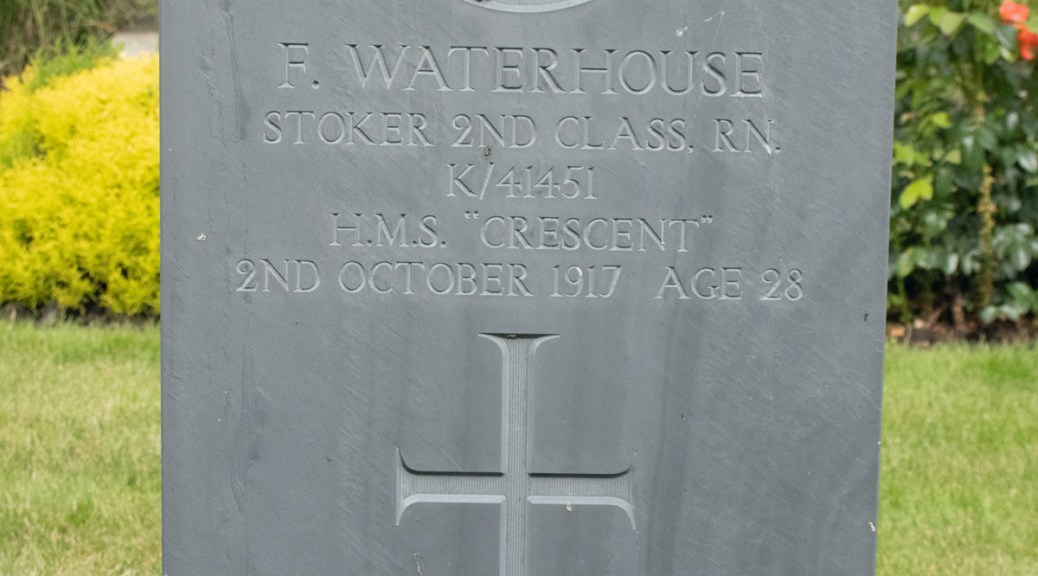
Stoker 2nd Class Frank Waterhouse

Stoker 2nd Class Frank Waterhouse

Frank Waterhouse was born in Keighley, Yorkshire, on 14th September 1889. The second of four children, including two younger sibling who both died before their first birthdays, his parents were Waddington and Jane Waterhouse.

Waddington was an engineer for a worsted mill in nearby Bingley, and when Frank finished his schooling, he found employment as a fireman for the same mill. By the time of the 1911 census father, son, Frank’s sister Fanny and her husband Arthur were all employed at the factory.

In the spring of 1915, Frank married Alice Greenbank. She worked at a mill in Haworth and the couple set up home together. They would not go on to have any children.

War was raging across Europe by this point, and Frank stepped up to play his part. He enlisted in the Royal Navy and his trade made him ideal for an initial role of Stoker 2nd Class. He was sent to HMS Pembroke, the Royal Naval Dockyard in Chatham, Kent, for his training and his service record confirms the man he had become. He was 5ft 7ins (1.7m) tall, with brown hair, brown eyes and a fresh complexion.

Stoker 2nd Class Waterhouse was sent to HMS Pembroke, the Royal Naval Dockyard in Chatham, Kent, for his training. At the beginning of May 1917, he was assigned to the cruiser HMS Crescent, and spent the next four months aboard.

During this time, Frank fell ill. When Crescent docked back at HMS Pembroke at the end of September, he was disembarked, and taken to the Royal Naval Hospital in Chatham. He was suffering from endocarditis, and the heart condition would prove fatal. He passed away the day after he was admitted – on the 2nd October 1917 – at the age of 28 years old.

Hundreds of miles from home, it is likely that Frank’s family would not have been able to foot the bill for bringing his body back home. Instead, Frank Waterhouse was laid to rest in the naval section of Woodlands Cemetery in Gillingham, Kent, not far from the base at which he had been based.


Petty Officer 1st Class Edward Grant

Petty Officer 1st Class Edward Grant

The early life of Edward Grant is a challenge to piece together. Born on 14th May 1863 in Newington, Surrey, he was the son of Thomas and Eliza Grant. The family do not appear on any census records, and it is only when Edward joined the Royal Navy in 1878 that he appears on any documents.

Edward’s service papers tell the story of a young man focused on his career. Underage when he joined up, he was given the rank of Boy 2nd Class, and sent to HMS Impregnable, the school ship based in Devonport, for his initial training. He remained on board for over a year, and rose to Boy 1st Class during that time.

Edward’s first full sea-going assignment was on board the screw corvette HMS Ruby. He would be assigned to her for eighteen months, during which time he came of age. Formally inducted into the Royal Navy, he took the rank of Ordinary Seaman. His service records show that he was a little over 5ft (1.53cm) tall, with brown hair, great eyes and a fair complexion.

Ordinary Seaman Grant’s contract was for ten years. During this time, his commitment to the job was clear: serving on a total of right vessels, he was promoted to Able Seaman in December 1882, Leading Seaman in October 1888 and Petty Officer 2nd Class in December 1889.

When his contract came to an end, Edward did not hesitate to re-enlist. He completed another decade of service, spending much of that time as a Boatman for the Coastguard on the Northumbrian coast.

It was while he was serving in Crastor that he met Elizabeth Smailes. She was a grocer’s daughter from nearby Dunstan, and the couple married in Alnwick on 14th February 1893. Edward and Eliabeth would go on to have five children, all girls, between 1896 and 1907.

By the time of the 1901 census, the Grants family were living in the Royal Naval Reserve Barracks in Hartlepool, County Durham. That November Edward was formally stood down to reserve status, having completed 20 years with the Royal Navy.

The 1911 census found Edward and the family living at the Guardians Offices at Hart Road in Hartlepool. A naval pensioner, he was employed as a caretaker for the town’s Board of Guardians, and the accommodation came with the job. Also living with them was Elizabeth’s mother, 83-year-old widow, Jane Smailes.

When war broke out, Edward stepped up to play his part once more. Now 51 years of age, he took on the role of Petty Officer 2nd Class once more: his papers show that he was now 5ft 5.5ins (1.66m) tall and had tattoos of a sailor woman and the words True Love on his left arm.

Petty Officer Grant remained firmly shore based, and was billeted at HMS Pembroke, the Royal Naval Dockyard in Chatham, Kent. He served for three years, and was promoted to Petty Officer 1st Class in May 1916.

On 9th April 1917, Edward Grant collapsed at his barracks. His passing was quick: he died of an aortic aneurysm and haemorrhage. He was 53 years of age. His body was laid to rest in the naval section of Woodlands Cemetery in Gillingham, not far from the naval base he had known for so many years.


Plumber’s Mate William Hodge

Plumber’s Mate William Hodge

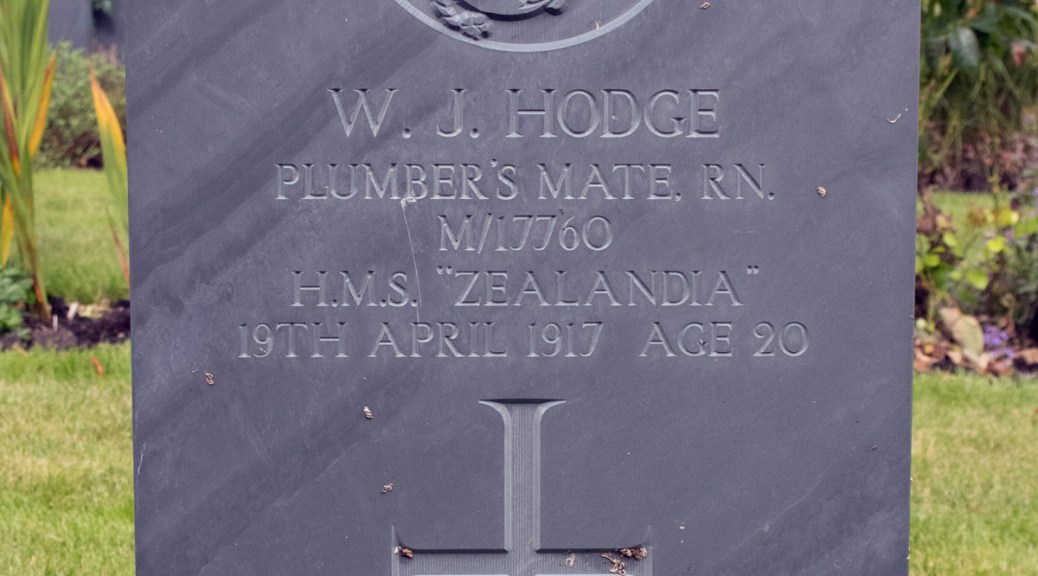
William James Hodge was born on 23rd November 1896 in Portsmouth, Hampshire. The oldest of seven children, six of whom were boys, his parents were James and Edith Hodge. James was a carpenter and labourer and, when he finished his schooling, William initially found work as a grocer’s errand boy.

William went on to find work as a plumber’s mate and, when war was declared, he saw an opportunity to put his stills to good use. The Royal Navy offered career prospects and, on 14th December 1915, he enlisted. His service papers show that he was 5ft 6ins (1.67m) tall, with black hair, brown eyes and a dark complexion.

Initial training took place not far from home at the Portsmouth shore based HMS Victory and HMS Fisgard. In November 1916, however, Plumber’s Mate Hodge was given his first sea-faring assignment, on board the battleship HMS Zealandia. She would remain his home for the next six months.

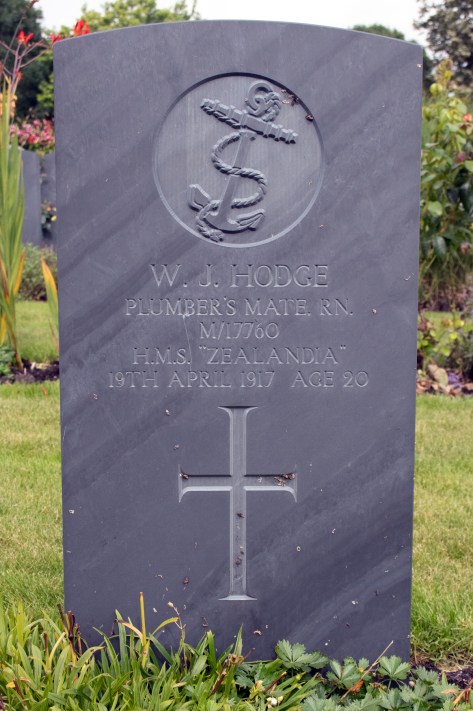
In the spring of 1917, William came down with tuberculosis. He was admitted to the Royal Naval Hospital in Chatham, Kent, but the condition would prove too severe. He passed away on 19th April 1917, aged just 20 years old.

The body of William James Hodge was laid to rest in the naval section of Woodlands Cemetery, Gillingham, Kent.


Sergeant Charles Chown

Sergeant Charles Chown

Charles Allen Chown was born in the Sussex village of Lyminster, at the start of 1882. The tenth of eleven children, his parents were Samuel and Mary Chown. Samuel was a general labourer, and when he passed away in 1898, Charles and his siblings rallied to support his now widowed mother.

The 1901 census found Mary, Charles and his brother Jesse living at 32 Lennox Road, Worthing, West Sussex. Jesse was employed as a brickmaker, while Charles had found work as a solicitor’s clerk. The family had two boarders, Helen and Rosie Bulbeck, and Charles’ niece, Minnie, was also staying with them.

Away from work, Charles was a music lover, and joined the local operatic society. In 1904 he appeared in a local version of Iolanthe, his “piece of portraiture being described as one of the successes of the occasion, for his facial play was good, and the drolleries of the character were displayed in an each and natural manner.” [Worthing Gazette: Wednesday 12th September 1917] In the following year’s Mikado, he took the role of the Lord High Executioner, and he was noted as being a “born comedian, with the most mobile countenance and a singularly dry form of humour…” [Worthing Gazette: Wednesday 12th September 1917]

By the time of the 1911 census, Charles had moved on with work, and moved out of home. Taking a room at 7 Tarring Road, Worthing, his landlords were Harold and Rose Ward. Still employed as a clerk, he was now employed by one of the estate agents in the town, although it is clear that his passion was elsewhere. When he joined up in the autumn of 1914, he gave his trade as musician.

Charles enlisted on 7th October 1914 in Ashton-under-Lyme, Lancashire. What took him north is unclear, although a theatre tour is a possibility. His service records note that he was 5ft 8.5ins (1.74m) tall and weighed 138lbs (62.6kg). He had dark brown hair, brown eyes and a sallow complexion.

Initially assigned to the Manchester Regiment, Private Chown was soon transferred to the 8th (Service) Battalion of the East Lancashire Regiment. He was obviously dedicated to his job: by the end of October 1914 he had been promoted to Lance Corporal, and within six weeks he rose to Sergeant.

In July 1915, Charles’ unit was dispatched to France. That autumn, they remained based near Tilques, in Northern France, but Sergeant Chown’s health was beginning to suffer. After just three months overseas, he was medically evacuated to Britain to receive treatment for pleurisy, and was hospitalised in Chatham, Kent.

When he recovered, Sergeant Chown was reassigned to the 10th Battalion of the East Lancashire Regiment, before being transferred to the 47th Training Reserve Battalion in September 1916. That winter, however, his health received a setback, and he contracted tuberculosis. He would spend the first half of the following year in hospitals in Aldershot in Hampshire, Sutton Veny in Wiltshire and, from May 1917, the 3rd Southern General Hospital in Oxford.

Sergeant Chown’s health would continue to deteriorate, and he was formally discharged from the army on 6th July 1917. He returned to Worthing, and his mother’s home, 2 Montague Place. Charles would eventually succumb to his medical condition, and he passed away on 31st August 1917, at the age of 35 years old.

The body of Charles Allen Chown was laid to rest in the family plot in Broadwater Cemetery, Worthing.


Trooper Ernest Mitchell

Trooper Ernest Mitchell

Ernest Henry Mitchell was born in the autumn of 1889 in Worthing, West Sussex. The second of five children, he was the eldest son of Frederick and Rhoda Mitchell. Frederick was a baker and confectioner, and the family lived in and around the town centre. The 1891 census found them at 29 West Buildings; ten years later they were living at 7 Clifton Road; the 1911 census recorded the family at 62 Chapel Road.

By this point, FW Mitchell’s was a well known bakery, and would remain so through to the 1960s. The Chapel Road shop was bombed during the Second World War, and the family moved the business to North Road.

The 1911 census showed what the bakery has become. Frederick and Rhoda were running the business, while their three sons – Ernest, Reginald and Frederick Jr – were also involved. Their eldest daughter, Rhoda Jr, was an elementary school teacher, while their youngest child, Edgar, was still at school. The Chapel Road property was a bustling affair: the Mitchells employed four live-in servants: Emily Lyon, Annie Dannage, and Mabel Swan as shop assistants, and Edith Blunden as a domestic.


FW Mitchell’s bakery, Worthing

Away from work, Ernest showed other talents. “He was possessed of musical inclinations, and was at one time a member of the Choir of the Congregational Church, as well as of the Choral Society.” [Worthing Gazette: Wednesday 31st October 1917]

In January 1913, Ernest married Constance Banwell. She was the eldest daughter of nurseryman Henry Banwell and his wife, Ellen, and lived on Christchurch Road, not far from the Mitchells’ shop.

When war broke out, Ernest stepped up to serve his country. His service records show that, while he enlisted on 9th December 1915, he was not formally mobilised until March 1917. As a Trooper, he was assigned to the Household Battalion, and, after a brief period of training, he soon found himself in the thick of things.

The Household Battalion fought at Arras in the spring of 1917, but it was at Passchendaele that Ernest’s war was to come to an end. Wounded in the leg on 6th October – just three months after arriving in France – he was medically evacuated to Britain for treatment. Admitted to No. 2 War Hospital in Birmingham, he initially recuperated, but pneumonia took over and Trooper Mitchell succumbed. He passed away on 26th October 1917, at the age of 28 years old.

The body was removed from Birmingham, arriving in Worthing at midnight on Monday; and the internment took place at the Cemetery yesterday afternoon [20th October]. Among those who attended the ceremony were two soldier brothers of the deceased – RA Mitchell, who is in the Royal Flying Corps; and FE Mitchell, of the Middlesex Regiment. Still another brother is serving his Country in a Military capacity. This is Fred Mitchell, formally Organist of the Congregational Church, who is in the Army Service Corps, and was unable to be present yesterday, for he is now in Hospital in Wiltshire.

[Worthing Gazette: Wednesday 31th October 1917]

Ultimately, Ernest Henry Mitchell would be the only one of his siblings to pay the ultimate price while serving his country. He was laid to rest in the family plot in Broadwater Cemetery, on the then outskirts of the home town.


Ernest’s headstone also pays tribute to Alan Frederick Gill, who died in April 1925. This was his sister Rhoda’s child, who died at just four-and-a-half years old.


Able Seaman William Watts

Able Seaman William Watts

William Watts was born on 24th October 1872 in the Devon village of Stockfleming. Details of his early life are unclear, but his later marriage record gives his father’s name as Richard.

The first confirmation of William’s life was his military service records. He left his job as a farmer’s lad and joined the Royal Navy on 3rd January 1888 and, being just 15 years old at the time, he was given the rank of Boy 2nd Class.

William was sent to HMS Impregnable, the navy’s training base in Devonport, Devon, for his initial induction. He remained there for the next eighteen months, and was promoted Boy 1st Class during that time. In October 1889, he was given his first posting, on board the sloop HMS Pylades. She would be his home for more than three years, during which time he came of age.

Now formally inducted into the Royal Navy, William was given the rank of Ordinary Seaman. His service papers show that he was 5ft 1ins (1.55m) tall, with dark hair, hazel eyes and a fair complexion.

Over the twelve years of his initial contract Ordinary Seaman Watts made a career for himself. By the end of that time, he had served on five further ships, returning to HMS Vivid, the Royal Naval Dockyard in Devonport, in between voyages. He was proving his mettle as well, and was promoted to Able Seaman on 1st November 1893.

When, in March 1901, his contract came up for renewal, William immediately re-enlisted. His service record shows that he had grown to 5ft 4ins (1.65m) tall, and now sported a tattoo of a star on his left wrist. He spent another thirteen years in the Royal Navy, but transferred to the Coastguard, serving in Weymouth in Dorset, and Brixham and Dartmouth in Devon.

On 15th September 1903, William married Olief Lawrence. The daughter of a labourer from Fontwell Magna, Dorset, the couple married in her local parish church. They would settle in Brixham, and have one son, William, who was born in October 1907.

When war broke out, William was called up on to play his part. Pensioned off just two months previously, he now returned to sea, joining the battleship HMS Goliath as an Able Seaman. His health was failing him by this point, however, and on 18th December 1914, he was invalided out of naval service.

At this point, William’s trail goes cold. It is clear that he and Olief moved to Marldon, to the west of Paignton, and he took up the role of landlord of the Ship Inn (now Ye Olde Smokey House). His health still seemed to be impacted, however, and it would eventually get the better of him. He died on 16th June 1917, at the age of 44 years of age.

The body of William Watts was laid to rest in the graveyard of St John the Baptist Church in Marldon, the village which he had come to call home.


Private Harry Carr

Private Harry Carr

Harry James Carr was born on 17th October 1893 in Warminster, Wiltshire. The youngest of four children, his parents were Joseph and Annie Carr. Joseph was a plasterer and tiles, and also a sexton for the local church: the 1901 and 1911 census returns found the family living at 22 Church Street, towards the west of the town centre.

When Harry completed his schooling, he found work as a plasterer alongside his father. War was coming, and he stepped up to play his part. Full service records have been lost to time, but he would have enlisted no later than the summer of 1916, joining the 1st Battalion of the Wiltshire Regiment. Private Carr’s unit became entrenched on the Western Front, fighting at the Somme during that year.

Harry was wounded during the Battle of Ancre Heights. The details of his injuries are unclear, but they were bad enough for him to be medically evacuated for treatment. Admitted to the Graylingwell Hospital in Chichester, West Sussex, he would remain there for the next four months. Ultimately, his wounds were too severe: Private Carr passed away on 17th February 1917, aged just 23 years old.

The funeral took place at the Minster on Thursday of Pte. Harry James… The deceased was the youngest son of Mr and Mrs J Carr, the respected sexton and sextoness for many years at the Minster Church.

[Wiltshire Times and Trowbridge Advertiser: Saturday 24th February 1917]

Harry James Carr was laid to rest in the graveyard of St Denys’ Church, in his home town of Warminster.


Private Thomas Osborne

Private Thomas Osborne

Thomas Ernest Osborne was born in the spring of 1884 in the New South Wales town of Cardiff. One of twelve children, his parents were Bartholomew and Hannah Osborne.

Little information is available about Thomas’ early life, but he found employment as a miner when he completed his schooling. In 1903 he married Florence McLean: they settled in Wollongong, to the south of Sydney, and had six children.

When war broke out, Thomas stepped up to play his part, and he enlisted in the Australian Imperial Force on 12th June 1916. His service records show that he was 5ft 7.5ins (1.71m) tall, and weighed 168lbs (76.2kg). He had brown hair, brown eyes and a fair complexion. He was also noted has having two vaccination marks on his left arm, and an inch-long scar on his lower lip.

Private Osborne boarded the A40 Ceramic troop ship on 3rd October 1916. It took nearly two months to make the trip from Sydney to Britain, and his unit – the 45th Battalion of the Australian Infantry – finally disembarked in Plymouth, Devon, on 21st November. From here, he marched into the ANZAC base in Codford, Wiltshire.

The voyage from Australia took its toll on a significant number of troops, and Thomas’ health was also impacted. He was admitted to the military hospital in Sutton Veny – just a few miles from base – suffering from pneumonia. The condition was to prove fatal: Private Osborne died on 10th December 1916, at the age of 33 years old.

The body of Thomas Ernest Osborne was laid to rest in the newly extended graveyard of St Mary’s Church, Codford.


Thomas’ effects were sent to his widow, although she was still chasing their return some nine months after his passing. They consisted of “diary, pocket book (leather), wristlet watch and strap, pipe, writing tablet, soap dish, jack knife, pencil, letters, postcards, photos, Testament, money belt, 2 keys, small penknife, ring.”

Florence married again on 16th February 1918, to a Victor Johnson. Thomas’ papers show that communications about her late husband continued, however. On 27th July 1921, an urgent missive was sent to Florence regarding the erection of a permanent headstone for his grave. There is no evidence of any response, and it seems likely that the now Mrs Johnson was unable to cover the cost. Thomas’ grave marker was eventually erected by his army colleagues.


Thomas’ youngest sibling, Reuben, also fought in the First World War. Eleven years younger than his brother, Private R Osborne was attached to the 35th Battalion of the Australian Infantry. By the spring of 1917 his unit was firmly entrenched on the Western Front. Rueben was killed on 7th June, and is commemorated on the Menin Gate at Ypres.


Seaman Christopher Coutts

Seaman Christopher Coutts

Christopher Coutts was born in Lerwick, Shetland, on 2nd August 1894, and was the only child to Robina Coutts. There is little information about his early life, but by the time war broke out, he was working as a shop assistant.

Given the location of his island home, it makes sense that Christopher also had a knowledge of the sea and seafaring. This was put to use during the war, and he was assigned to the Royal Naval Reserve as a Seaman. Initially based in Shetland, by the summer of 1916, he had been transferred to HMS Acteon, the torpedo school based in Sheerness, Kent.

Information has been received here that Christopher Coutts, RNR, has died in Hospital at Haslar. He had been in failing health for some time, and the end was not unexpected. Prior to the outbreak of war, deceased was employed as a shop assistant with Mr Brown, Freefield. After war broke out, he joined the RNR (Shetland Section), and after undergoing a period of training in Lerwick proceeded south to one of the naval depots, where he contracted the illness to which he has now succumbed. Deceased was a bright and promising young man, and much sympathy is extended to his sorrowing mother and other relatives.

Shetland Times: Saturday 12th May 1917

Given the location of HMS Acteon and the subsequent place of his burial, it is likely that Seaman Coutts died at the Royal Naval Hospital in Chatham, Kent, rather than Haslar Hospital, which is in Gosport, Hampshire. He died on 8th May 1917, at the age of 22 years old.

Christopher Coutts was laid to rest in the naval section of Woodlands Cemetery, Gillingham, Kent.


Seaman Christopher Coutts
(from findagrave.com)

Leading Mechanic Charles Harris

Leading Mechanic Charles Harris

Charles William Harris was born in Wingham, near Canterbury, Kent, on 19th July 1879. The fourth of eleven children, his parents were Charles and Kate Harris. Charles Sr was a carpenter and builder, and his son was to follow in his stead.

By the time of the 1901 census, however, Charles Jr had stepped out on his own. He had moved to London, and was boarding with the Hurley family, in rooms at 408 Bethnal Green Road, Middlesex.

On 1th June 1902, Charles Jr, now a plumber, married Esther Danton. An engine driver’s daughter from Kent, she was four years her new husband’s senior. The couple set up home at 5 Leatherdale Street in Mile End, and had two children: daughter Lilian was born in 1905, with son George following three years later.

When war broke out, Charles was called upon to play his part. He enlisted in the Royal Naval Air Service as an Air Mechanic, and was quickly promoted to Leading Mechanic. His service records show that, when he joined up on 15th June 1916, he was 5ft 7.5ins (1.71m) tall, with light brown hair, blue eyes and a fresh complexion.

Leading Mechanic Harris would be based out of HMS President, the umbrella name for the Royal Navy’s London bases. He spent time working at Wormwood Scrubs, and, in February 1917, was moved to Kingsnorth, Kent.

What happened next is summed up in a simple statement on Charles’ service papers: “26th May 1917 Accidentally killed by explosion of gas holder.” There is no further information, and nothing in the media about the incident. Leading Mechanic Harris was 37 years of age.

The body of Charles William Harris was taken to the Woodlands Cemetery, Gillingham, Kent. He was laid to rest in the naval section of the burial ground.


Tragedy was to strike again just two years later, when Charles and Esther’s daughter also passed away:

Much sympathy and respect were shown at Holy Trinity Church, Springfield, when the funeral of Lily Harris, the fourteen-year-old daughter of Mrs and the late Mr CW Harris took place. Deceased’s father, who was chauffeur to the Bishop of Chelmsford, lost his life in the war while serving with the RNAS, and this fact added to the regret felt by the parishioners at the further sad loss sustained by his widow, who is now left with only one little boy. The funeral procession included a large number of the scholars of the Springfield Day and Sunday Schools, with Mr R Coward of the day school, and practically every child carried a floral tribute. There was also a large attendance of neighbours and friends, including children, assembled at the church. The Bishop of Chelmsford officiated… [and] gave a touching address to the church, speaking particularly to the children; and his lordship also performed the last sad rites at the graveside.

[Essex Newsman: Saturday 29th November 1919]

There is no evidence of any connection between Charles and the Bishop of Chelmsford: as far as the records show, he was never a chauffeur, working as a builder, plumber and gas fitter before enlisting.