Alexander Cursiter Shurie was born in Orkney, in 1886. The youngest of seven children, his parents were farmers James and Maria Shurie. The family were born and raised in West Grenigoe, a small hamlet between Orphir and Scapa, on the Orkney mainland.
There is little information about Alexander’s young life. James died in 1902, and it is likely that his son helped with the running of the farm. When war broke out, he did not enlist immediate and, while his service records have been lost to time, it seems likely that he did not join up until the autumn of 1916.
Private Shurie’s unit – the 6th Battalion or the Seaforth HIghlanders – served on the Western Front during the conflict, but there is nothing to show that Alexander spent any time overseas himself. By March 1917, he had fallen ill, and was admitted to the Norwich War Hospital in Norfolk. His condition is unclear, but it would prove fatal: he passed away on 18th March 1917, at the age of 31.
The body of Alexander Cursiter Shurie was taken back to Orkney for burial. He was laid to rest in the family plot in the graveyard of St Magnus’ Cathedral, Kirkwall.
James – or Jim – Mackay was born in Kirkwall, Orkney, in 1897, and was the youngest of six children to John and Margaret Mackay. John was a stone mason, and the family lived in a small cottage at 14 Victoria Road, close to the town centre.
Little information survives about Jim’s life, and the family do not appear on the 1911 census. He would have been too young to enlist when war broke out, but at some point during the conflict, he enlisted in the army, joining the Seaforth Highlanders as a Private. His unit – the 3rd (Reserve) Battalion – was a depot unit, and was based at Cromarty, to the north of Inverness, for the duration.
In the closing weeks of the war, Jim fell ill, and was admitted to the military hospital in Cromarty, suffering from pneumonia. The condition would prove fatal, and he passed away on 11th November 1918, the day the Armistice was signed. He was just 21 years of age.
The body of James Mackay was taken back to Orkney for burial. He was laid to rest in the graveyard of St Magnus’ Cathedral, a short walk from where his family still lived.
Private James Cooper, a native of Kirkwall, died in the Red Cross Hospital at Netley last Thursday from a wound received at the Dardanelles. Private Cooper, who was 35 years of age, was a son of Mrs Cooper, School Place, Kirkwall (with whom much sympathy is felt), and of the late Capt. Charles Cooper. After being employed for some tim in a shop in Kirkwall, he decided to follow his father’s vacation [sic] and went to see for some years, during which time he served in the Naval Reserve. He was in New Zealand when the war began, and at once enlisted in the 6th Hamaki Coy. With the New Zealand contingent he went to Egypt and took part in the fighting with the Turks near the Suez Canal. In April the contingent was sent from Egypt to the Dardanelles, and towards the end of that month Private Cooper received a gunshot wound in the left arm. With other wounded he was sent to the base hospital at Alexandria, and thence, after a few weeks, was sent home to the hospital at Netley. In all his letters home he wrote cheerfully and made light of his wound, but the nurse wrote that the wound was a serious one. At Netley the arm was amputated. Private Cooper gradually sank and died last Thursday.
[Orkney Herald: Wednesday 30th June 1915]
James Cooper was born on 9th October 1879 in Kirkwall, Orkney. He was one of seven children – and the youngest of three sons – to Charles and Jane Cooper. With her husband being away at sea a lot of the time, Jane was used to raising her family on her own.
In August 1905, tragedy struck the family:
At an early hour on Friday morning last, the town of Stromness was thrown into a stat of alarm by the report that a sad burning fatality had taken place on board the barquentine Brazilian on Ness patent slip. To accurately describe how the accident took place is impossible, but from careful enquiries we learn that on Thursday evening Captain Charles Cooper, belonging to Kirkwall, accompanied by an acquaintance, left the town and went on board the vessel, where they lit a fire and make a cup of coffee, after which friend left him. At that time the fire was very low, and no danger apprehended. At an early hour of the morning, the vessel was observed to e on fire, and an alarm given. In a short time the fire hose from the town was on the scene, and two two streams playing on the burning vessel. The fire was fortunately confined to the cabin and companion way, where the rescue party discovered the body of Capt. Cooper terribly burned and disfigured, to such an extent that it was quite unrecognisable… There can be no doubt but that death was caused by suffocation, but what led to the fire is not known. It is supposed, however, that after the friend left the vessel, Capt. Cooper had taken the paraffin oil flask to put some oil on the nearly burnt-out fire, when possibly an explosion took place, and the cabin got suddenly full of smoke.
[Orkney Herald: Wednesday 16th August 1905]
Charles was 64 when he died. Jane brought his body across the island, and he was buried in the family plot in the churchyard of St Magnus’ Cathedral.
By this point, James was serving in the Royal Navy. The exact details are unclear, but he seems to have bought his way out, after completing six years. He travelled to Australia, and worked as a cook for a while, before moving on to New Zealand, setting up home in the town of Thames, on the country’s North Island.
When war was declared, he was quick to step up, and, joined the Auckland Regiment of the New Zealand Expeditionary Force. His service papers show that he was 5ft 7ins (1.7m) tall and weighed 159lbs (72.1kg). He had brown hair, grey eyes and a medium complexion. He had a tattoo of a naval coat of arms on his right forearm, and one of a full length woman on the back of his left forearm.
Private Cooper’s unit left New Zealand on 16th October 1914, heading for Egypt. As the newspaper report stated, he moved from there to Gallipoli, before being medically evacuated to Egypt, and then to Netley Hospital, Hampshire.
After his passing, the body of James Cooper was taken back to Orkney for burial. He was laid to rest in the family plot at St Magnus’ Cathedral, reunited with his father after ten years.
Albert Edward Thorne was born on 30th April 1874. The fourth of eight children, his parents were George and Rosanna Thorne. George was born in Nether Compton, Dorset, and this is where the family were raised. He worked as a stone mason, the 1884 census confirming he employed six men and two boys.
When Albert completed his schooling, he found work as a domestic gardener. This was not something he wanted to do long-term, however, and, on 30th May 1892, he enlisted in the Royal Marine Light Infantry. His service records show that he was 5ft 6ins (1.68m) tall, with dark brown hair and blue eyes. He was also noted as having a mole on the right of this abdomen and a scar on the right of his waist.
Private Thorne was sent to the Royal Marine depot in Walmer, Kent, for his training, and he remained there until the end of November. He transferred to Plymouth, Devon, and, over the next three years, split his time between there and Devonport.
On 26th December 1895, Albert married Rhoda Mills, the daughter of a local labourer, in Plymouth Register Office. The couple would have three children: Albert Jr, Arthur and Vera.
Private Thorne was a career marine, and remained in the service, based between Plymouth and Portsmouth, Hampshire, until the spring of 1914. Having completed 22 years, he was stood down to reserve status, although this was not to be for long, as storm clouds were brewing over Europe.
In August 1914, Albert was mobilised once more, and was assigned to the cruiser HMS Gibraltar. A depot ship, she would support other ships in and around the Orkney and Shetland Isles. The voyage north seems to have taken its toll, however, and Private Thorne was evacuated to the hospital ship Rohilla, suffering from appendicitis, which resulted in peritonitis. The conditions would prove fatal, and he passed away on 30th August 1914, at the age of 40 years old.
The Rohilla docked at Kirkwall on the Orkney mainland. Hundreds of miles from home, is seems that Rhoda may not have been able to afford to bring her husband’s body back to Devon. Instead, the body of Albert Edward Thorne was laid to rest in the graveyard of St Magnus’ Cathedral, Kirkwall.
Rhoda remained in Plymouth, in the rooms at 64 Durnford Street that she knew as home. The 1921 census found her living there with eldest son Albert – now a construction manager at the Royal Naval Dockyard in Devonport – and daughter Vera. The family had a boarder, Irish-born merchant seaman William Arnold, whose sister, Margaret Fitzgerald, was also visiting.
John Harcus Brass was born in Kirkwall on the Orkney mainland in May 1900. He was the oldest child to Thomas and Margaret Brass. Thomas was a grocer, and the family lived at 3 Union Street, to the south of the town centre.
There is little information about John’s early life. Better known as Jackie, he was too young to enlist when war broke out, but joined up as soon as he came of age. He was assigned to the Seaforth Highlanders and, as a Private, was attached to the 4th Battalion.
Jackie was sent south for training, and was billeted in Glencorse, to the south of Edinburgh. Sadly, Private Brass’ war was not to be a lengthy one. He was admitted to the 2nd Scottish General Hospital in Edinburgh, suffering from influenza. The condition was to get the better of him, and he passed away on 30th October 1918. He was just 18 years of age.
The body of John Harcus Brass was taken back to Orkney for burial. He was laid to rest in the graveyard of St Magnus’ Cathedral, in his home town of Kirkwall.
George Brent was born in the autumn of 1887 in Bratton, Wiltshire, and was the only child to George and Naomi Brent. Census records humbly record George Sr was a wool carder, although he actually ran Luccombe Mill, the family living in the substantial Luccombe House.
George had been widowed in the 1870s, and was thirty-four years older than his second wife, Naomi. When he died in 1900, she was left to raise her teenaged son. She was not on her own, however, the 1901 census recording her as living on her own means, and with servant Eliza Whately to support her.
Education was important to Naomi, and by the time of the 1911 census, George was working as a draughtsman and designer for an engineering company. War was on the horizon, however, and he would step up to serve his country.
George enlisted in the Army Ordnance Corps, and served in the Balkans from October 1915. Full details of his time in the army have been lost, but he rose through the ranks and, by the summer of 1918, he was a Staff Serjeant.
At some point love blossomed and, George married a woman called Edith. Sadly, her life is destined to remain a mystery: she is noted as being George’s widow on his probate record and his beneficiary in the Army Register of Soldiers’ Effects.
Staff Serjeant Brent’s health seems to have suffered after three years in the eastern Mediterranean. He was admitted to the military hospital in Mansfield, Nottinghamshire, although his condition is unclear. He passed away on 3rd September 1918, at the age of 30 years old.
The body of George Brent was taken back to Wiltshire for burial. He was laid to rest in Bratton Baptist Chapelyard, not far from Luccombe House.
George left an estate of £978 16s 6d (approx. £58,000 in today’s money) to his widow. Naomi must have taken some comfort in Edith’s presence: the 1921 census found them living in Luccombe House.
The census sheds some light on Edith’s background, noting that she was born in Grangemouth, Stirlingshire. Interestingly, she and Naomi have two visitors: widow Helen Harrower (aged 65) and Helen Georgina Harrower (aged 32). The younger Helen was also born in Grangemouth, and it appears that the visitors were Edith’s mother and sister.
Edward Kent was born in the Berkshire village of Little Coxwell on 8th December 1887. One of fourteen children, his parents were John and Agness Kent. John was a mason’s labourer, and by the time of the 1901 census, the family had relocated to Fisherton de la Mare in Wiltshire.
Edward found work as a general labourer when he completed his schooling, but when war broke out, he was called upon to serve his country. Conscripted in the spring of 1916, he enlisted in the Royal Marine Light Infantry as a Private. His service papers show that he was 5ft 6.5ins (1.69m) tall, with brown hair, brown eyes and a fresh complexion. He was also noted as having a scar on the back of his neck.
Private Kent was sent to Deal, Kent, for his training, but by September 1916, he had moved to Portsmouth, Hampshire. Change was afoot, however, and in November Edward was assigned to the 3rd Battalion and sent to the Aegean, where he would remain for the rest of the conflict.
Edward returned to Portsmouth in January 1919, and was admitted to the Haslar Hospital, suffering from pneumonia. The condition would prove fatal, however, and he passed away on 2nd February 1919: he was 31 years of age.
The body of Edward Kent was taken back to Wiltshire for burial. He was laid to rest in the graveyard of St Nicholas’ Church, Fisherton de la Mere.
Jesse Doughty was born in the Wiltshire village of Bapton in the autumn of 1896. One of ten children, his parents were shepherd George Doughty, and his wife, Fanny.
George died in 1902, and Jesse’s mother was left to raise the children. His older brother William took the role of head of the family, however, and, by the time of the 1911 census, the Doughtys were living in a six-roomed cottage, with six wages coming in. Jesse, the second youngest of the siblings, had finished school by this point, and was working as a shepherd boy.
When war broke out, Jesse stepped up to serve his country, although full details of his time in the army have been lost to time. It seems that he initially joined the Machine Gun Corps, but transferred to the Labour Corps of the Wiltshire Regiment.
By the autumn of 1918, Private Doughty was based in Fovant, Hampshire. While there, he fell ill, and was admitted to a military hospital with pneumonia. The condition would prove fatal, and he passed away on 16th December, at the age of 22 years old.
The body of Jesse Doughty was taken back to Wiltshire for burial, and he was laid to rest in the graveyard of St Nicholas’ Church, Fisherton de la Mare, a short walk from where his family were still living in Bapton.
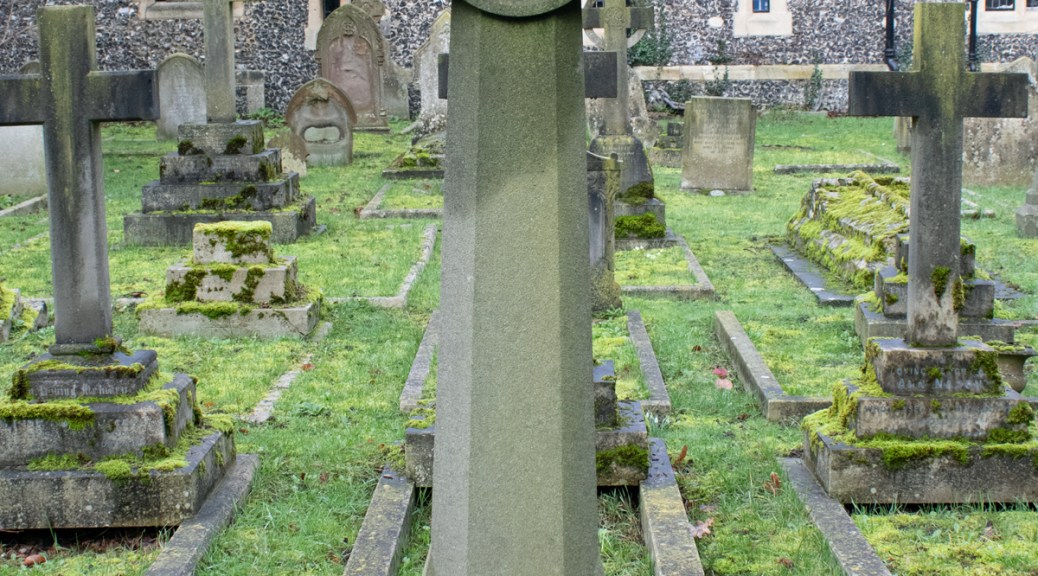
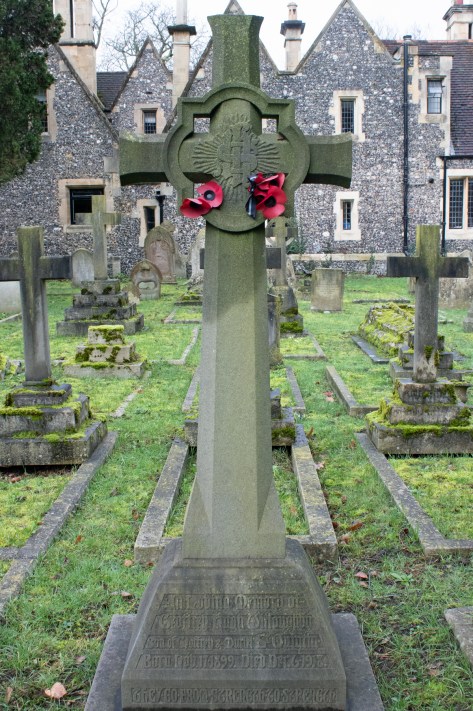
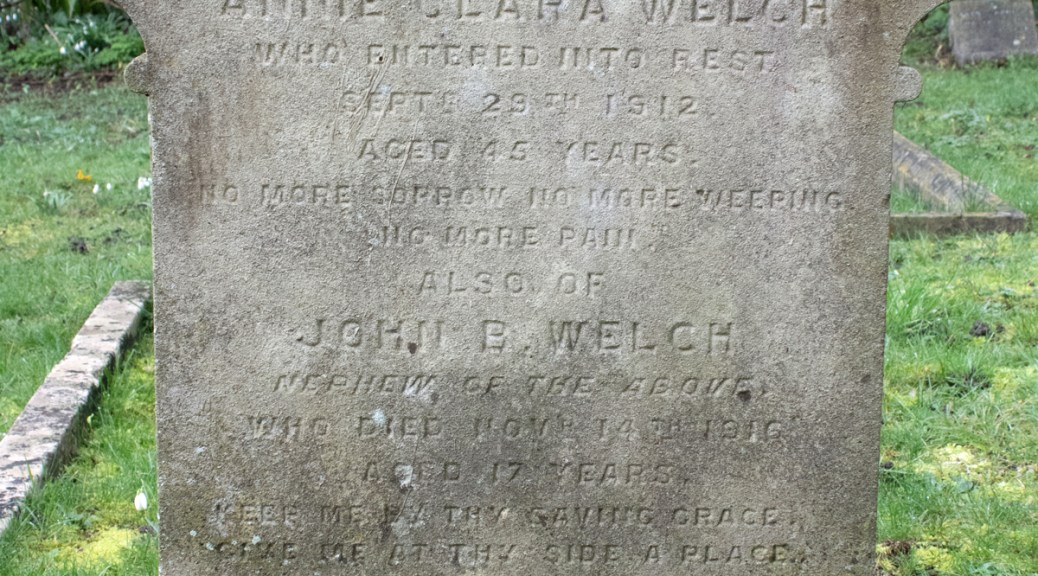
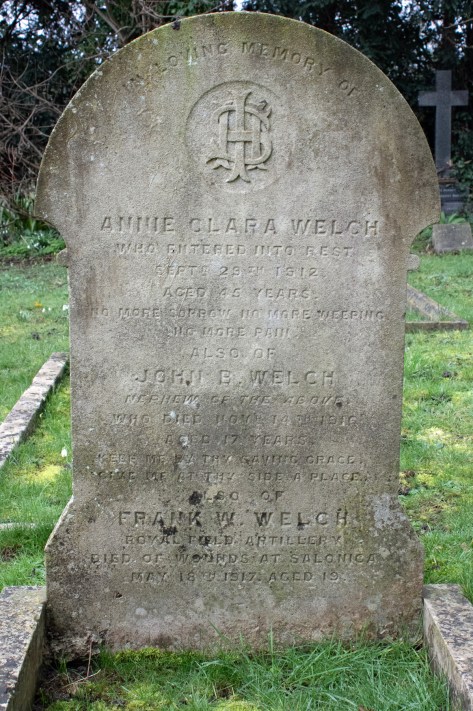
In the picturesque cemetery of St Mary’s Church, Mortehoe, Devon, is a headstone commemorating Walter Stuart Thompson. The stone notes that he died on the 16th April 1920, and that he was in his 29th year. He is recorded as being the youngest son of the late Reverend Walter Thompson from West Didsbury, Lancashire. His mother is also noted as being buried with him.
A baptism record for Christ Church, Didsbury, confirms that Walter was christened on 22nd November 1891, and gives his parents’ names as Walter and Mary Elizabeth Thompson. The family do not appear in any census records but, given that the Commonwealth War Graves Commission records note that Walter was a Lieutenant in the 2nd King Edward’s Own Gurkha Rifles, it is possible that they emigrated in the years following his birth.
During the First World War, Lieutenant Thompson’s regiment fought on the Western Front, in Egypt and in India. As his service records no longer exist, it is unclear when or how Walter served, but it is clear that he survived the conflict, and returned to Britain at the end of the war.
What the connection was to Devon is again unclear, although it seems possible that Walter was sent there for health reasons. His passing does not appear in any contemporary newspapers, so is unlikely to have been anything out of the ordinary.
The life of Walter Stuart Thompson, therefore, is destined to remain a mystery, buried with him in the tranquil cemetery on the north Devon coast.
Charles William Newman was born in Worthing, West Sussex, on 16th April 1880. The younger of two children, he was the only son of John and Eliza Newman. John worked as a plasterer, and the family boarded with Mary Ann Brooker, initially on Stanhope Road, then at Campion Terrace, off Worthing High Street.
By the time of the 1901 census, John and Eliza were living in a place of their own, a terrace house at 14 Lennox Road. Charles had completed his schooling by this point, and was employed as a house painter. Eliza was working as a dressmaker, and the Newmans had a lodger, hawker Harry Fielder.
On 11th October 1903, Charles married Ellen Stilwell. Eight years her new husband’s senior, she was a shepherd’s daughter. The couple married in St Botolph’s Church, to the west of Worthing town centre. The couple would not go on to have any children, and the 1911 census found them living at 24 Lanfranc Road, a small terraced cottage, near West Worthing station.
Charles was still employed as a house painter, but had also taken up work as a member of the ground staff at Worthing Sports Ground. When war broke out, however, he stepped up to serve his country, enlisting in the Royal Field Artillery in the early months of the conflict.
When information last reached us concerning certain local members of the Home Counties Brigade of the Royal Field Artillery, they were at Slough, but recently they were transferred to Westerham, in Kent, where a fatal accident occurred to one of their number, Driver Charles William Newman… who was killed by a runaway horse.
His widow was one of the witnesses examined at the Inquest, and the evidence revealed the fact that the horse was attached to a water van which Newman himself was driving.
Newman… was expected to go home on short leave on Friday, the day of the accident, to see his wife.
[Worthing Gazette: Wednesday 9th June 1915]
Driver Charles William Newman was 35 years old when he died, on 4th June 1915. His body was taken back to Sussex for burial, and he was laid to rest in Broadwater Cemetery, a short walk from where Ellen was still living.