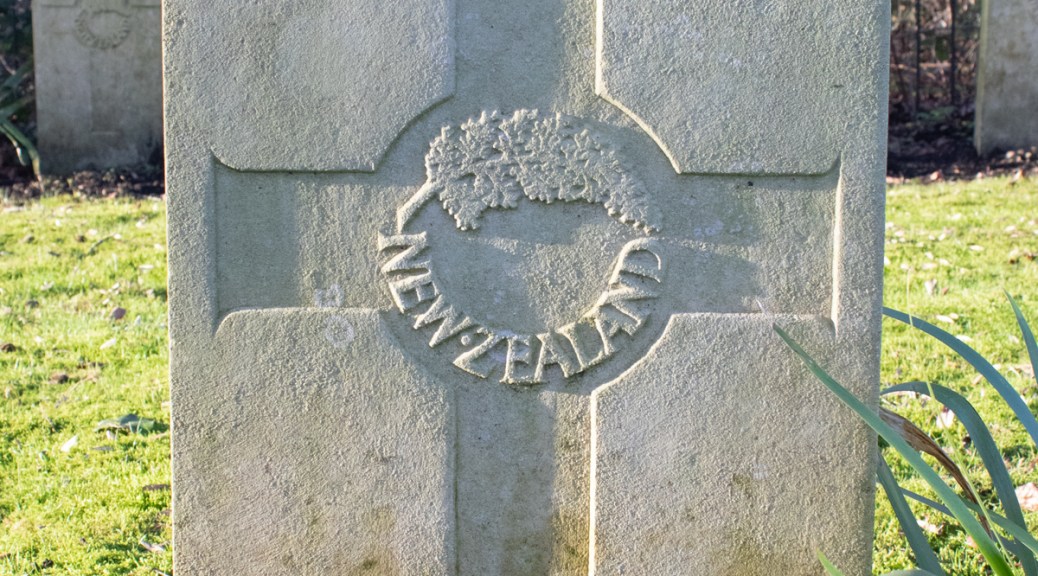
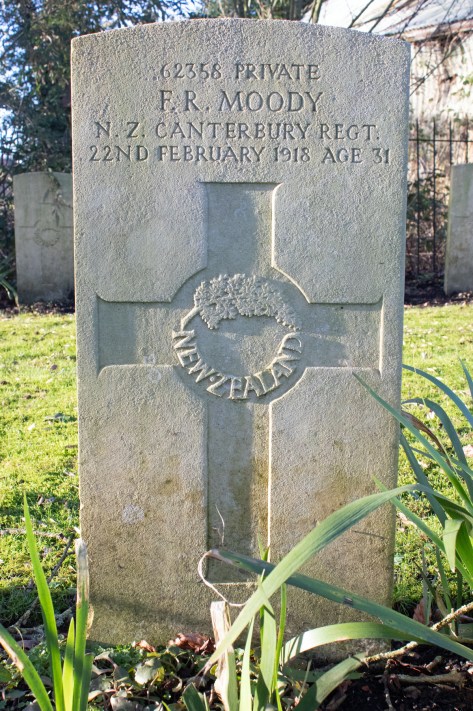
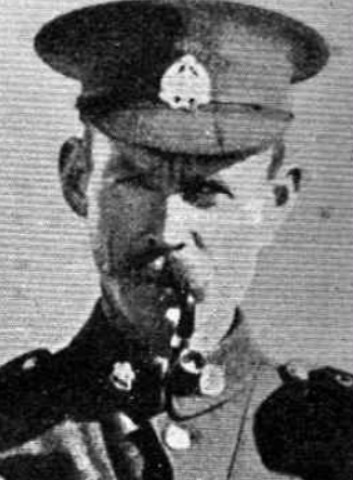
Francis Robert Moody was born on 8th September 1876, in the town of Kihikihi, on New Zealand’s North Island. There is little information about his early life, but his parents were Hampshire-born Francis Moody and his Irish wife, Mary.
When he completed his schooling, Francis Jr found work as a carter. When war broke out, however, he was called upon to play his part, enlisting in the New Zealand Canterbury Regiment on 18th June 1917. His service papers show that he was 5ft 10ins (1.77m) tall, and weighed 140lbs (63.5kg). A Roman Catholic by birth, he had brown hair, blue eyes and a medium complexion.
Private Moody’s unit left New Zealand on 13th October 1917, making the two-month voyage to Britain on board the HT Corinthic. Francis disembarked in Liverpool, Lancashire, before being marched into camp in Sling, Wiltshire.
Over the next month, Private Moody received further training, but by this point, and following the lengthy journey, his health was beginning to suffer. He was admitted to the No. 3 New Zealand General Hospital in Codford, Wiltshire, on 30th January 1918, suffering from bronchitis.
Francis’ health continued to deteriorate, and he developed tuberculosis. The condition would prove fatal, and he passed away on 22nd February 1918, at the age of 41.
Thousands of miles from home, Francis Robert Moody was laid to rest alongside his colleagues in the graveyard extension of St Mary’s Church, Codford.
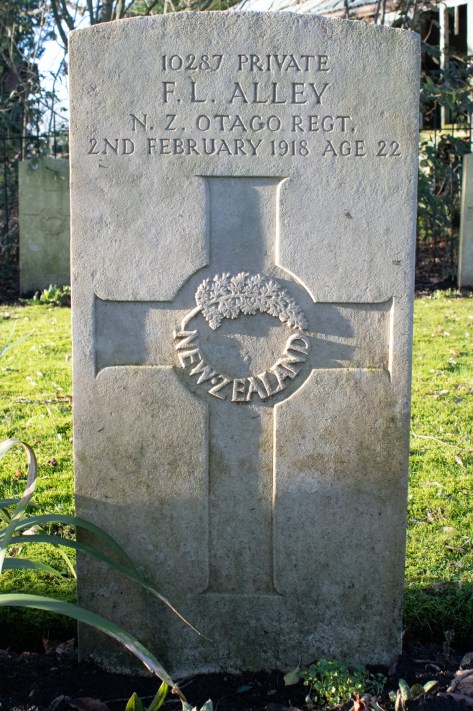
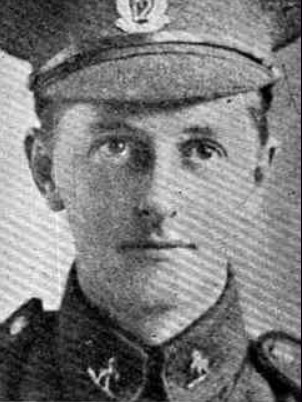
Francis Lignori Alley was born in Hikutaia, on New Zealand’s North Island, on 18th February 1896. There is little information about his early life, but it is clear that he was one of six children to John and Elizabeth Alley.
By the time he had completed his schooling, the Alley family had moved to the port town of Gisborne. Francis found work as a warehouseman in for Macky Logan Caldwell Ltd. When war broke out, however, he was called upon to play his part.
On 11th January 1916, Francis enlisted in the New Zealand Otago Regiment. His service records show that he was 5ft 8.5ins (1.74m) tall, and weighed just 90lbs (40.8kg). A practicing Roman Catholic, he had brown hair, grey eyes and a fair complexion. His papers also noted an operation scar in his groin.
Private Alley’s unit left New Zealand in the spring of 1916. After a month’s stop in Suez, they arrived in Southampton, Hampshire, on 7th August, and were marched to their camp in Sling, Wiltshire. Within a matter of days, however, Francis found himself on the Western Front, and would remain there for the next month.
On 9th June 1917, during the Battle of Messines, Francis was wounded. Initially treated on site, he was medically evacuated to Rouen, then Britain for treatment to gun shot wounds to his face and eye. He spent the next few months being treated and recuperating, hit service papers stating that he re-joined his unit in Étaples on 8th August. That autumn, he was given leave, but while back in Britain, he fell ill, and was admitted to the venereal section of the No. 3 New Zealand General Hospital in Codford, Wiltshire.
Private Alley was discharged on 7th November 1917, and remained at the camp in Codford. On Boxing Day, he was admitted back to hospital again, suffering from septicaemia: the condition was to prove fatal, and he passed away on 2nd February 1918. He was just 21 years old.
The body of Francis Lignori Alley was laid to rest in the graveyard extension of St Mary’s Church, Codford, not far from the camp he had been based at.
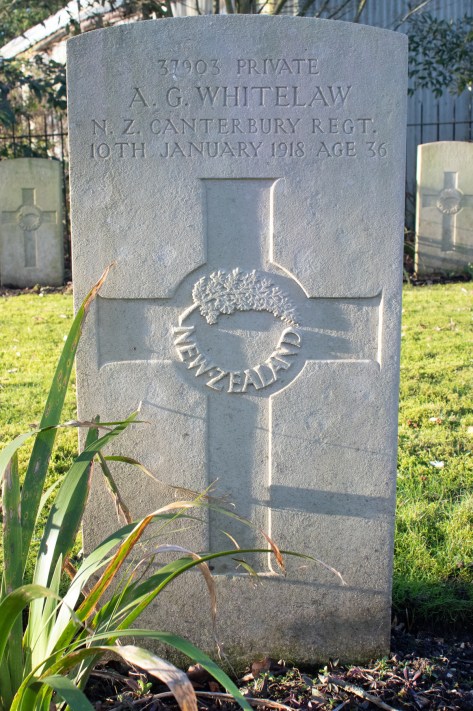
Alexander George Whitelaw was born in 1879 in the town of Ashburton on New Zealand’s South Island. One of ten children, his parents were Scottish immigrants Peter and Agnes Whitelaw.
There is little information about Alexander’s early life: his father died in 1912, with his mother passing just two years later. By the autumn of 1916, he was working as a general labourer, but the world was at war, and he stepped up to play his part.
Alexander enlisted on the 4th October 1916, knocking five years off his date of birth to ensure he was accepted. His papers also show other discrepancies, as he noted both of his parents being having been born in New Zealand. As a Private, he was assigned to the New Zealand Canterbury Regiment, his service papers showing the man he had become. A Presbyterian, he stood 5ft 11ins (1.8m) tall, and weighed 154lbs (69.9kg). He had cark hair and a dark complexion. His eyes were blue, but he suffered some colour blindness, confusing reds and blues.
Private Whitelaw’s unit – the New Zealand Canterbury Regiment – left home on the 19th January 1917, and embarked for Europe. His movements from this point on aren’t entirely clear, although by the start of 1918, he had been medically evacuated to the No. 3 New Zealand General Hospital in Codford, Wiltshire, suffering from pleurisy. The condition was to get the better of Alexander: he passed away on 10th January 1918, at the age of 38 years old.
Thousands of miles from his family home, the body of Alexander George Whitelaw was instead laid to rest in the extension to St Mary’s Churchyard, Codford.
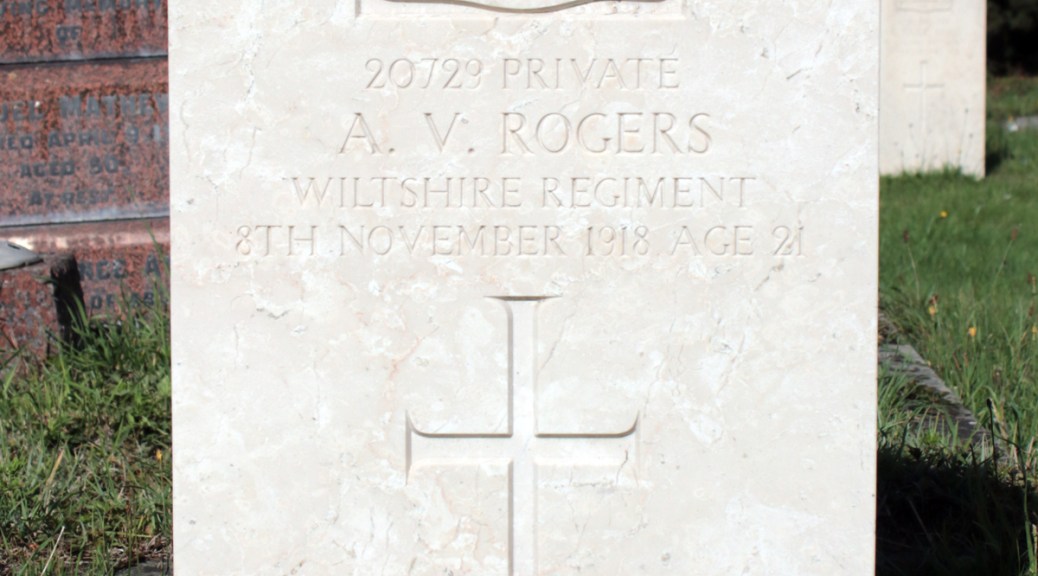
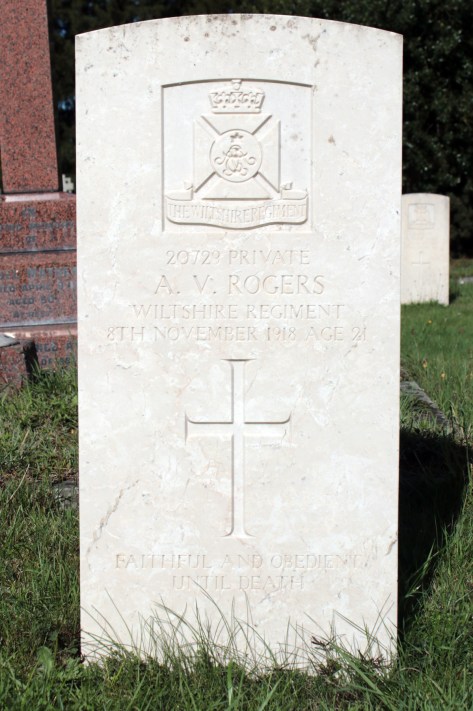
Albert Victor Rogers was born in Trowbridge, Wiltshire, on 2nd June 1897. The middle of three children, he was the older son to Edward and Elizabeth Rogers. A Liverpudlian, Edward worked as a carter for a flour mill, and the family lived in Lower Westwood, to the west of Trowbridge itself.
By 1911, the Rogers family had relocated to the centre of Trowbridge, and were living in a small cottage at 3 Church Street. Edward was now employed as a mason’s labourer, while Albert’s sister, Amy, had taken a job as a wool and worsted piecer for a local cloth mill. Albert, just thirteen years of age, was likely in his last year at school.
Albert’s military records are limited. They note that, as a Private, he was attached to Wiltshire Regiment Depot, and the he died in a military hospital on 8th November 1918. He was just 21 years of age. Details of his passing and funeral do not appear in any local contemporary newspapers, so it is unclear how he passed.
The body of Albert Victor Rogers was laid to rest in the sweeping grounds of Trowbridge Cemetery, not far from where his family still lived.
By the time of the 1921 census Edward had also died. The document recorded Elizabeth living in a cottage at 85 Mortimer Street, Trowbridge, and that she was employed as a waste picker for Salter & Co, a wool manufacturer.
The four-roomed property was a busy place, which Elizabeth shared with her surviving son, Leslie, brother Arthur Hobbs, and niece Gladys Rogers. Amy had also died by this point, and so Elizabeth had opened her home to her three grandchildren Leonard, Doris and Victor.
[My thanks go to Rob Clarke for his invaluable information about Albert’s life and family.]
Harry Frank Parsons was born on the 23rd January 1894 in Angmering, West Sussex. The third of four children, he was the only son to Henry and Annie Parsons. Henry was a garden labourer, who died when his son was just four years old: by the time of the 1901 census, Annie had lost her husband and two of her daughters. She was living with her surviving children in a cottage close to Worthing town centre.
When he completed his schooling, Harry found work with a local fruit nursery. The 1911 census found him and his mum living at 19 Eldon Road, Worthing: his was the only wage coming in.
War broke out in the summer of 1914, and Harry was quick to step up and play his part. He enlisted in the Royal Sussex Regiment on 11th September and, as a Private, was assigned to the 11th Battalion. His service record shows that he was 5ft 6ins (1.67m) tall, and weighed 129lbs (58.5kg). He was noted as being a Wesleyan, with dark brown hair, blue eyes and a fresh complexion.
Private Parsons spent the next twelve months on home soil, but in the summer of 1915, he developed tuberculosis. The contagious condition led to his discharge from the army, and he was formally stood down on 14th September 1915, having serves for a year and four days.
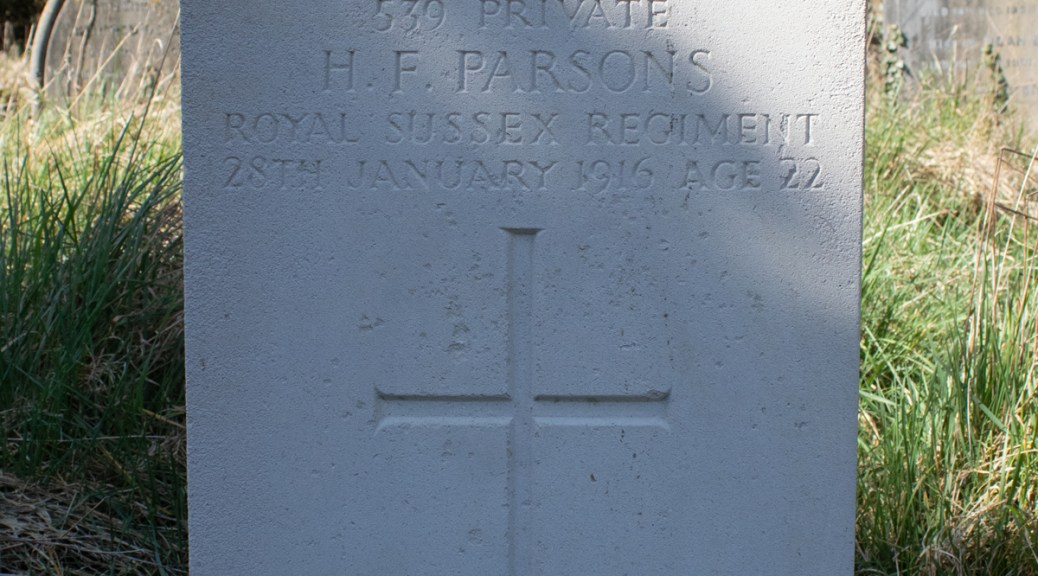
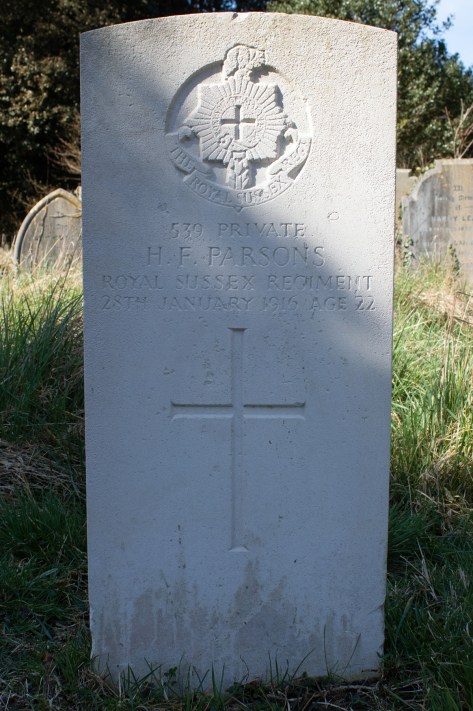
At this point, Harry’s trail goes cold. It is likely that he returned home, but his lung condition lingered. He passed away on 28th January 1916, five days after his 22nd birthday.
The body of Harry Frank Parsons was laid to rest in Broadwater Cemetery, to the north of Worthing town centre.
Private Harry Parsons (from ancestry.co.uk)
Annie had now lost three of her children. Her remaining child, daughter Edith, had married a month after her brother’s passing. She would go on to have two children with husband William Hoad, although their oldest, son William Jr, would die when just five years old.
Edith also passed away before her time, dying of tuberculosis and pleurisy in 1941. Annie, who had now outlived her husband and all of her children, lived until the spring of 1949.
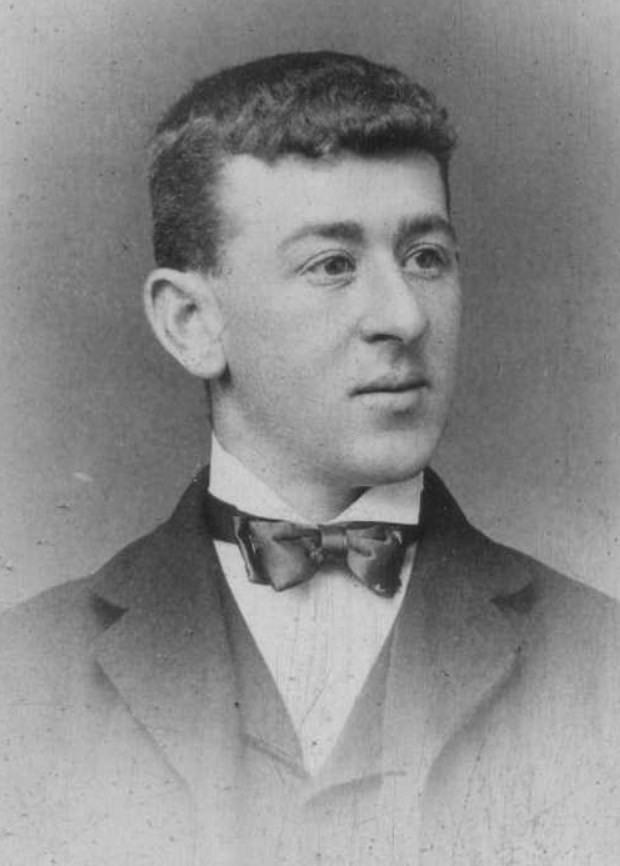
Eric William Fullilove was born in the Kent town of Deal on 25th April 1897. The middle of three children, his parents were Harry and Sarah Fullilove. Harry was a Sergeant in the Royal Marine Light Infantry, and by the turn of the century, the family had rooms at 16 Victoria Street, not far from the seafront.
Harry retired from military service, and the family moved to West Sussex. The 1911 census found the family living in a house on West Street in Worthing. Harry was now working as a bath attendant for the borough council, while Eric was being paid for being an errand boy when he wasn’t at school. The family had four visitors, Henry and Stanley Parsloe from Devon, and Florence and Margaret Gill from London.
Eric sought adventure in his life, and, on the day after his fourteenth birthday, he enlisted in the Royal Marine Light Infantry as a Bugler. His service papers show that he was just 5ft (1.52m) tall, with brown hair, brown eyes and a fair complexion.
Bugler Fullilove was assigned to the newly commissioned HMS Princess Royal, and would remain attached to her for the next four years. n the spring of 1915, he moved ashore, and was based in barracks in Portsmouth, Hampshire. While there, he came of age, and formally inducted into the Royal Marines. Now a Private, his papers show that he had grown 8.5ins (22cm).
Over the next five years, Eric served on two different vessels, returning to his Hampshire base in between assignments. His annual reviews noted a very good character, and a satisfactory/superior ability. Private Fullilove survived the conflict, but his health seems to have been impacted, and he was invalided out of the service on 1st April 1920.
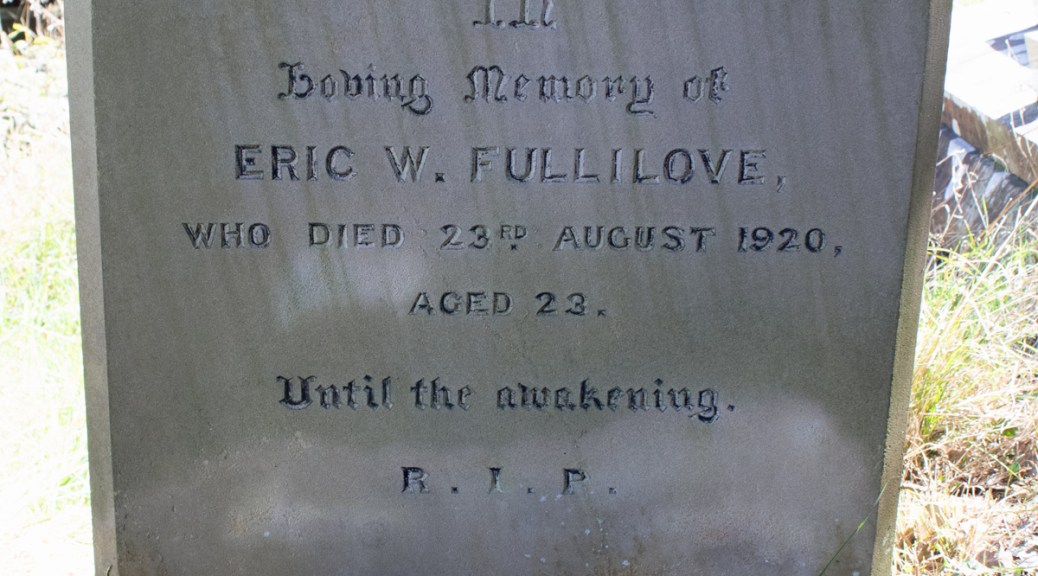
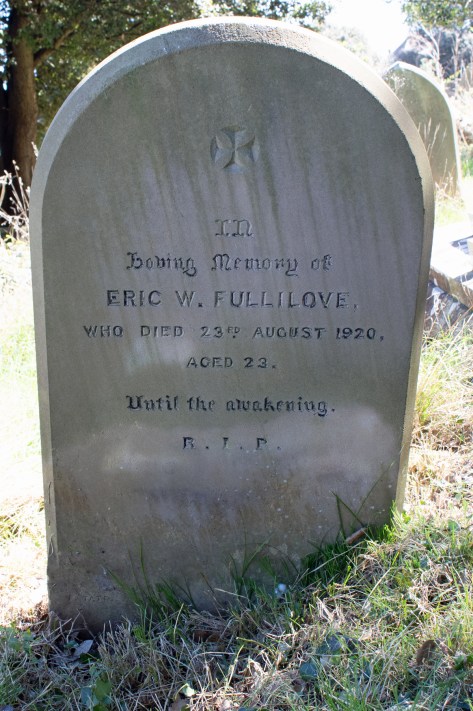
Eric William Fullilove returned home, and his trail goes cold. He passed away on 23rd August 1920, through causes unconfirmed: he was 23 years of age. He was laid to rest in Broadwater Cemetery, to the north of Worthing, West Sussex.
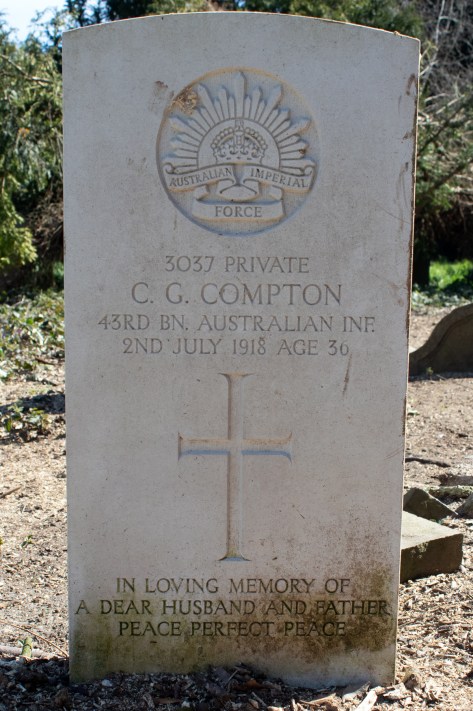
Charles George Compton was born in the Broadwater area of Worthing, West Sussex in 1882. One of five children, his parents were Charles and Eliza Compton. Charles Sr was a shoe maker, but when he finished his schooling, his son found work as a bricklayer.
There is little detailed information about Charles’ early life, but in 1901 he married a woman called Lilian. They went on to have three children, and, by the time of the 1911 census, they had set up home at 47 Newland Road, Worthing.
Charles sought to make a better life for his family, and, on 31st January 1913, he boarded the SS Osterley, bound for Australia. He set up home at 1 Orange Lane, in Norwood, a suburb of Adelaide, and, at some point soon afterwards, Lilian and the children joined him.
War was declared in the summer of 1914, and the Empire was called on to play its part. On 28th March 1917, Charles enlisted, becoming a Private in the Australian Infantry. His service papers show that he was 5ft 6ins (1.68m) tall, and weighed 154lbs (69.9kg). He was noted as having brown hair, hazel eyes and a medium complexion. He had two tattoos: one on his left forearm and another on his left hand.
After a few months’ training, Private Compton’s unit boarded the HMAT A30 from Adelaide, to make the journey back to Britain. His unit – the 10th Training Battalion – disembarked in Plymouth on 25th August 1917, and made its way to Larkhill Camp on the edge of Salisbury Plain, Wiltshire.
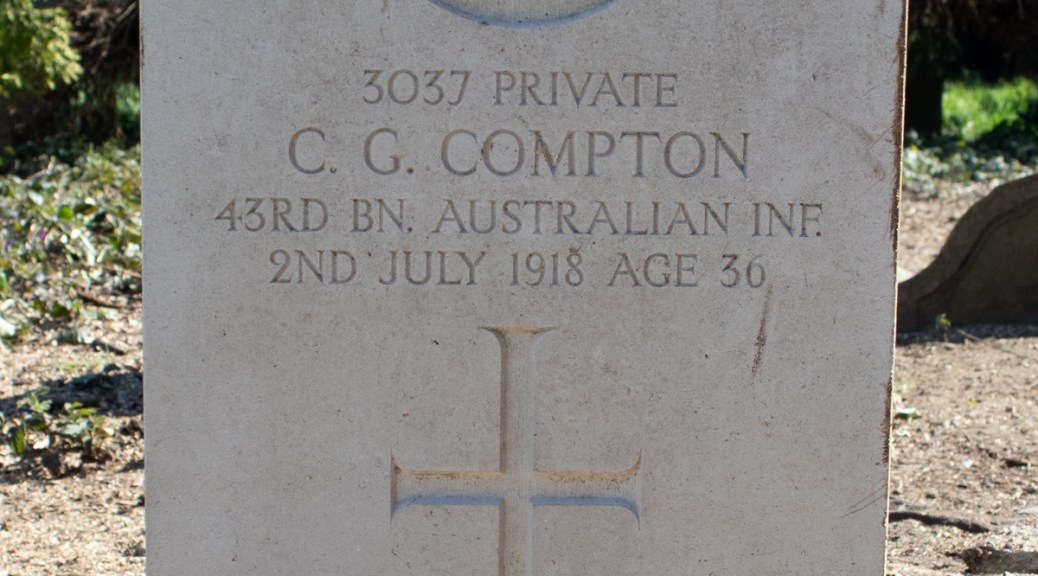
Over the next few months, Private Compton undertook further training, and would be transferred to the 43rd Battalion of the Australian Infantry. On 30th May 1918 he was admitted to Hurdcott Hospital, near Fovant, Wiltshire, suffering from influenza. The condition would eventually prove fatal: Charles passed away on 2nd July, at the age of 36 years old.
There was another Military funeral locally on Saturday.
The deceased soldier in this case was Private Charles George Compton, and the place of interment was the Cemetery at Broadwater. Private Compton, a member of an old Worthing family… was a member of the Australian Force…
The deceased worked for the Corporation before leaving Worthing for Australia, where his wife and two children are now living.
[Worthing Gazette: Wednesday 10th July 1918]
Charles George Compton was laid to rest in Broadwater Cemetery, not far from where his family were still living.
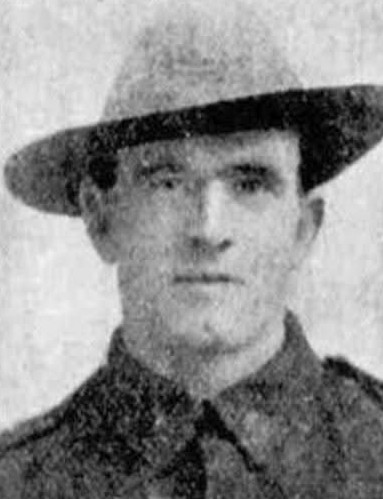
Private Charles Compton (from findagrave.com)
Lilian was now thousands of miles from home and family. Grieving the loss of her husband, the communication from the Army on his passing would provide her with some comfort:
Thanking you for all your kindness in sending my husband things on to me. You don’t know how greatefull I feel when I received letters saying how kind the nurses all were to him through his illness. All I wishes I could have been their, but it was not to be. I now close thanking you all.
[Letter to battalion: 14th January 1919]
Lilian would move to Lincoln Street, Adelaide: her new home she would name Worthing after her home town.
Frank Roland Holloway was born in Bristol, Gloucestershire, early in 1896. One of five children, he was the only son to Frederick and Emily Holloway. Frederick was a general labourer, and by the turn of the century, the family had moved to Hilperton, Wiltshire.
When Frank completed his schooling he found work in a local cloth mill. The 1911 census record the family living on Marsh Road, Hilperton, with four – albeit meagre – wages coming into the household. Frederick was employed by the Anglo Swiss Milk Company as a labourer, while his daughter, Frank’s older sister Edith, was also working in the factory’s tin shop. Emily was helping other people with their laundry, bringing in a few extra pennies.
War broke out in the summer of 1914, and Frank would step up to play his part. His service papers show that he was employed as a rubber worker by this point, and that he was a volunteer with the local militia. He formally enlisted on the 20th February 1915, and was assigned to the 8th Battalion of the Wiltshire Regiment as a Private.
Private Holloway remained with his unit for four months, before being discharged from military service, having contracted tuberculosis. Interestingly, his service papers include a statement from Frederick about his son’s health:
I am making an application on behalf of my son. He had been ill now for over 12 months. He served 2 years 175 days in 4th Wilts and 129 days in 8th Wilts. He had not any illness for some years and had been in good health and passed several military doctors for active service, but having left Salisbury Plain he came to Trowbridge where they slept in damp straw also under [a] bad roof in [an] old disused factory. He was a lad in good health and is now suffering with consumption.
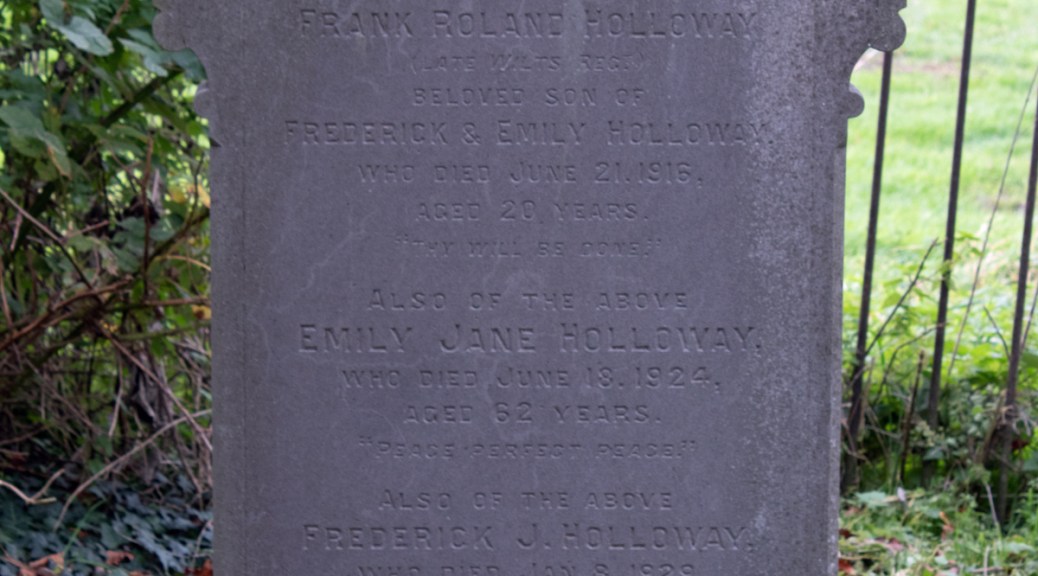
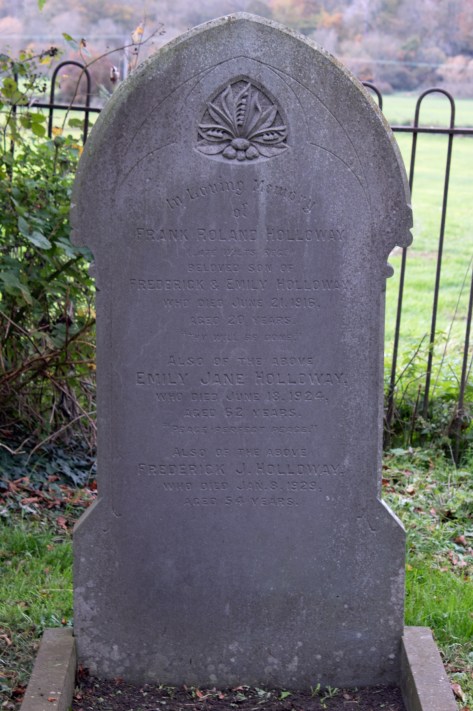
Sadly, any response to Frederick’s request for compensation would come too late. Frank passed away on 21st June 1916: he was just 20 years of age.
The body of Frank Roland Holloway was laid to rest in St Paul’s Churchyard, in village of Staverton, the parish church for his home in Hilperton.
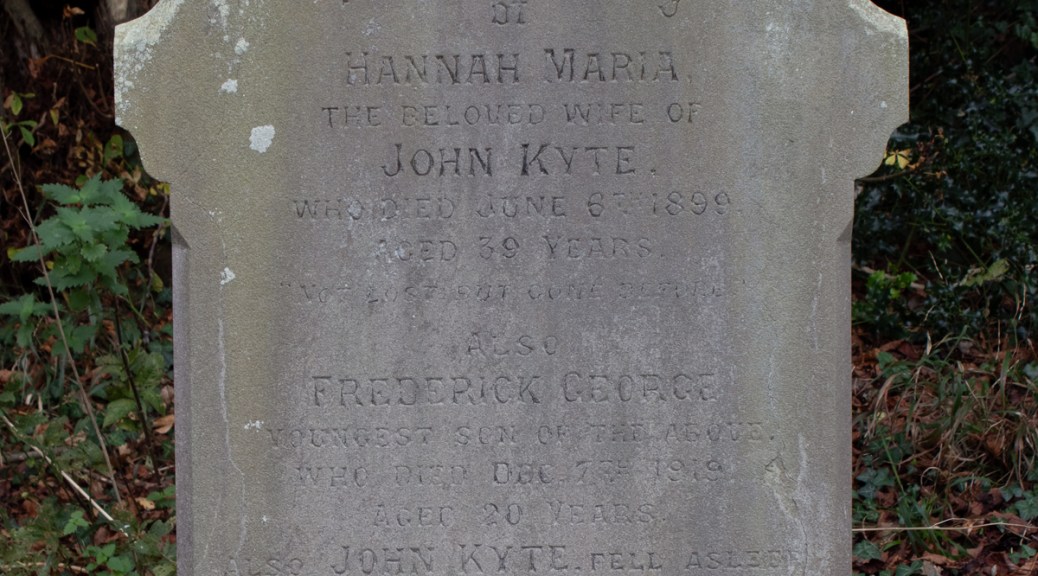
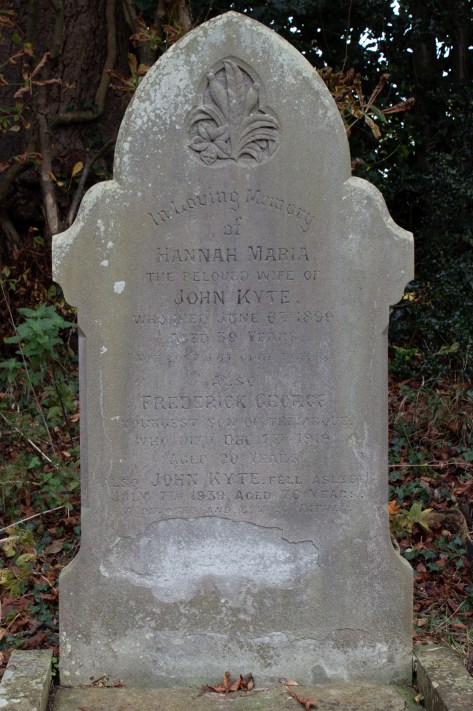
Frederick George Kyte was born on 23rd January 1899. The youngest of five children, his parents were Wiltshire-born market gardener John Kyte, and his wife, Esther. Frederick’s mother had been born in Chelsea, Middlesex, but it was in John’s home county where the family lived, on 16 Wine Street, Bradford on Avon.
Education was important to John and Esther. The 1911 census found his older brothers working as clerks, one to a rubber works, the other to a solicitor.
In his spare time, Frederick was a chorister and the local parish church, and was ‘an enthusiastic member of the Church Lads’ Brigade’ [Wiltshire Times and Trowbridge Advertiser: Saturday 13th December 1919] When he completed his schooling, he also found work as a clerk, and was employed by a local insurance broker.
On 13th January 1915, Frederick joined the Wiltshire Regiment, and, as a Bugler, was attached to the 8th Battalion. He was only 15 years of age, but remained with the unit for the next two years, until he was invalided out of the army for medical reasons.
After some time he partially recovered, and resumed his occupation as an insurance agent, but took to his bed some three months ago.
[Wiltshire Times and Trowbridge Advertiser: Saturday 13th December 1919]
The lung condition Frederick had contracted would be the one to which he would ultimately succumb. He passed away in the family home on 7th December 1919, aged just 20 years old.
The body of Frederick George Kyte was laid to rest in the family plot in Bradford on Avon cemetery.
The newspaper report provides some further information about Frederick’s brothers. Both also served in the army, and both rose to the rank of Serjeant.
The eldest [Edward] is now with HM Forces in Palestine, whilst the younger, Herbert, who was mentioned in despatches and awarded the Military Medal for good work during the retreat, is demobilised.
[Wiltshire Times and Trowbridge Advertiser: Saturday 13th December 1919]
Thomas Morris was born on 12th November 1880 in Bradford on Avon, Wiltshire. One of thirteen children, his parents were Henry and Eliza Morris. Henry was a chimney sweep, and this is a trade that Thomas would also go into, unsurprisingly, from a very young age. The family lived to the north of the town centre, initially at 57 Newtown, before moving round the corner to 5 Wine Street.
By the turn of the century, love was beckoning for Thomas. On 29th March 1903, he wed Annie Britten, a labourer’s daughter, who also lived on Wine Street. The marriage certificate noted that Thomas had changed jobs, and was employed as a labourer.
The 1911 census return shows the family home that had been set up. Henry and Eliza were still at Wine Street, although now at No. 44. Thomas and Annie were also living there, crammed into the four-roomed cottage with their four children as well. Henry was still working as a chimney sweep, while Thomas had found employment as maltster’s labourer.
Annie would go on to have six children in all, and when war broke out, she was left to raise the family with the help of her father-in-law (Eliza having passed in May 1914). Thomas enlisted in the Wiltshire Regiment early on in the conflict and, according to later reports, had seen a lot of service on the Western Front. He survived the conflict, however, and returned to a base in the garrison town of Trowbridge, Wiltshire.
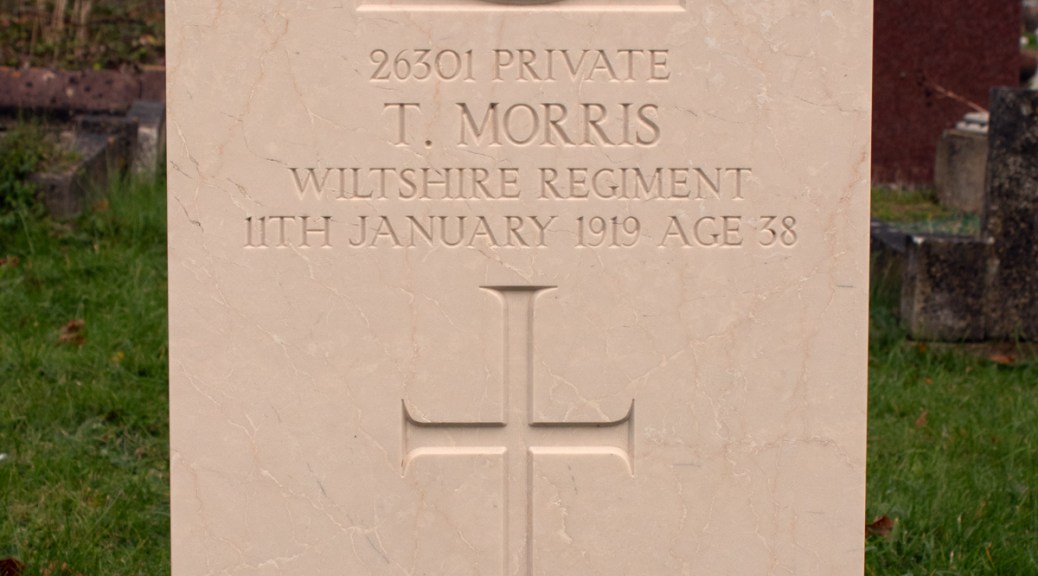
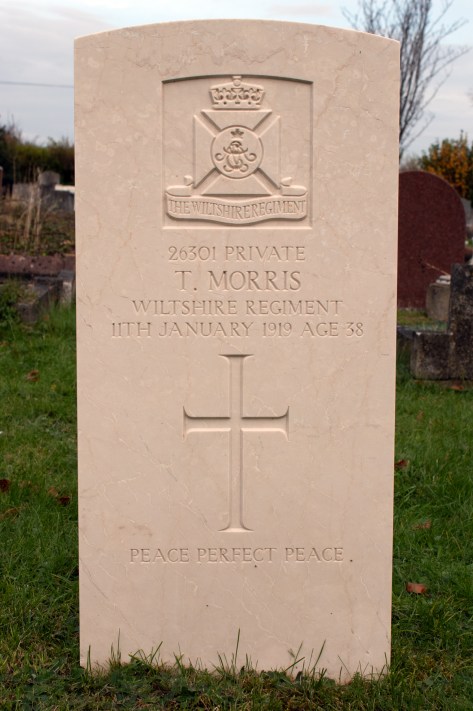
At the start of 1919, Private Morris came home on leave, but while there, he fell ill. He was admitted to the military hospital in Sutton Veny, also in Wiltshire, but succumbed to the influenza he had contracted. He passed away on 11th January 1919, aged the age of 38 years old.
The body of Thomas Morris was taken back to Bradford on Avon to be buried. He was laid to rest in the town’s cemetery.
Annie was now a widow with children to raise. Henry had also passed away in 1918, and so she remarried, wedding William Bishop in December 1919. The couple went on to have a child of their own, Phyllis, in March 1921.
Annie would live a peaceful life, passing away in Trowbridge in 1943, at the age of 60.