Tag Archives: Ireland

Leading Stoker Daniel Johnson

Leading Stoker Daniel Johnson

Daniel Johnson was born in Dingle, County Kerry, Ireland, on Christmas Day 1883, one of nine children to John and Ellen Johnson. John was a general labourer in the town, but while he initially followed suit, his son was destined to see the world.

On 3rd April 1903, Daniel joined the Royal Navy as a Stoker 2nd Class. His service records show that he was 5ft 7ins (1.70m) tall, with auburn hair, grey eyes and a sallow complexion.

Stoker Johnson was initially sent to HMS Vivid – the Royal Naval Dockyard in Devonport – for training. He was given his first posting in December, and was assigned to the battleship HMS Empress of India. She was to be his home for the next fifteen months.

In February 1905, Daniel was moved to another battleship, HMS Hannibal. Over the next eight years, he would go on to serve on six further vessels. His conduct was noted as Very Good throughout his time in the Royal Navy, and this was matched with the promotions he received. In July 1906, while on board HMS Suffolk, he was given the rank of Stoker 1st Class, and four year later, while serving on HMS Commonwealth, he was promoted to Leading Stoker.

In between voyages, Daniel’s base was HMS Vivid, but in February 1913, he was assigned to HMS Victory – the Royal Naval Dockyard in Portsmouth, Hampshire. He had been serving for ten years by this point, and his records hint at the man he had become. His height was now 5ft 10ins (1.78m), his hair recorded as dark brown and his complexion was noted as being fresh.

On 16th April 1913, Daniel seems to have been assigned to the Northern Irish Inniscrone Battalion, remaining with them for some fifteen months. Based at Inniscrone (now Enniscrone, Co. Sligo), this posting seems to have been with the Coastguard, patrolling the western coast of Ireland.

August 1914 saw Leading Stoker Johnson return to the Royal Navy. He was assigned to the battleship HMS Bulwark, which patrolled the English Channel when he first came on board. By that autumn, however, she had moved to North Kent, guarding the waters around the Isle of Sheppey against potential German invasion.

Daniel was on board Bulwark when, on the morning of 26th November 1914, an explosion ripped through the ship, tearing it apart and sinking it. In all 741 souls were lost, Leading Stoker Johnson among them. He was just 30 years of age.

The majority of those who died in the explosion aboard HMS Bulwark were buried in a mass grave in Woodland Cemetery, Gillingham, Kent. Daniel’s body, however, was not recovered until 24th January 1915, some two months after the explosion.

The sixteenth inquest on the victims of the Bulwark disaster was held at Chatham Naval Hospital on Monday. A body clothed in the dress of a patty officer was identified as that of Thomas Henry Treacher, who was a gun-layer. Two stokers were identified by marks on their clothing as Daniel Johnson, of Blackfields, Co. Kerry. and Edward Henry Buckingham of Nunhead, London, and an able seaman’s body proved to be that of John Griffin, of Kilrush, Co. Clare. The jury returned a verdict of accidental death in each case. Twenty-five bodies have now been recovered.

Westerham Herald: Saturday 30th January 1915

Daniel Johnson was laid to rest in a marked grave in Woodlands Cemetery, not far from his fellow servicemen.


Interestingly, the Coastguard station at Enniscrone would feature in history again a few years after Daniel’s death. Based next to the town’s pier, it was manned by up to five guards and was home to them and their families.

The coastguard station at Enniscrone, County Sligo, was raided on Thursday night, and arms and ammunition taken. The streets of Enniscrone were cleared by the Volunteers prior to the raid. One coastguard is stated to have fired several shots at the attackers, but he was eventually overpowered, and the garrison were then marched out. The arms and ammunition were removed to a waiting motor car, and the furniture and personal belongings of the coastguards taken from the building, which was then set fire to and destroyed.

Belfast News-Letter: Saturday 28th August 1920

Able Seaman John Griffin

Able Seaman John Griffin

John Griffin was born on 26th November 1885, one of six children to John and Mary Griffin. John Sr was a shoemaker from Limerick, Ireland, but it was in neighbouring County Clare, in the coastal town of Kilrush, that he and Mary raised their family.

John Jr’s siblings found labouring work when they left school, but he was after bigger and better things. In July 1901 he enlisted in the Royal Navy, set for a life at sea. As he was only fifteen years old at this point, he was not formally enrolled in service, but given the rank of Boy 2nd Class. He was initially posted to the training ship HMS Black Prince, which was based in Queenstown – now Cobh – County Cork.

Boy Griffin spent nine months on board the Black Prince, rising to the rank of Boy 1st Class in the process. In May 1902 he was given his first posting, aboard the battleship HMS Minotaur. After six months he transferred to the frigate HMS Agincourt, before moving again – to HMS Russell – on 18th February 1903.

It was while John was assigned to this battleship that he came of age. On his eighteenth birthday, he was formally enlisted into the Royal Navy for a period of 12 years’ service. He was given the rank of Ordinary Seaman and his records give an indication of the man he had become. They note that he was 5ft 4.5ins (1.64m) tall, with dark brown hair, brown eyes and a fresh complexion.

In April 1904, Ordinary Seaman Griffin was transferred to the battleship HMS Queen. He spent two years on board, gaining a further promotion – to Able Seaman – in September 1905.

Over the next nine years, John served on seven further vessels and, when not at sea, was based primarily at HMS Vivid, the Royal Naval Dockyard in Plymouth/Devonport, Devon. In July 1914, with Europe on the brink of war, he was given another transfer, to the battleship HMS Bulwark. Boarding in Portsmouth, Hampshire, the ship sailed to the North Kent coast, off Sheerness.

Able Seaman Griffin was on board Bulwark when, on the morning of 26th November 1914, an explosion ripped through the ship, tearing it apart and sinking it. In all 741 souls were lost, John among them. He should have been celebrating his 29th birthday.

The majority of those who died in the explosion aboard HMS Bulwark were buried in a mass grave in Woodland Cemetery, Gillingham, Kent. John’s body, however, was not recovered until 24th January 1915, some two months after the explosion.

The sixteenth inquest on the victims of the Bulwark disaster was held at Chatham Naval Hospital on Monday. A body clothed in the dress of a patty officer was identified as that of Thomas Henry Treacher, who was a gun-layer. Two stokers were identified by marks on their clothing as Daniel Johnson, of Blackfields, Co. Kerry. and Edward Henry Buckingham of Nunhead, London, and an able seaman’s body proved to be that of John Griffin, of Kilrush, Co. Clare. The jury returned a verdict of accidental death in each case. Twenty-five bodies have now been recovered.

Westerham Herald: Saturday 30th January 1915

John Griffin was laid to rest in a marked grave in Woodlands Cemetery, not far from his fellow servicemen.


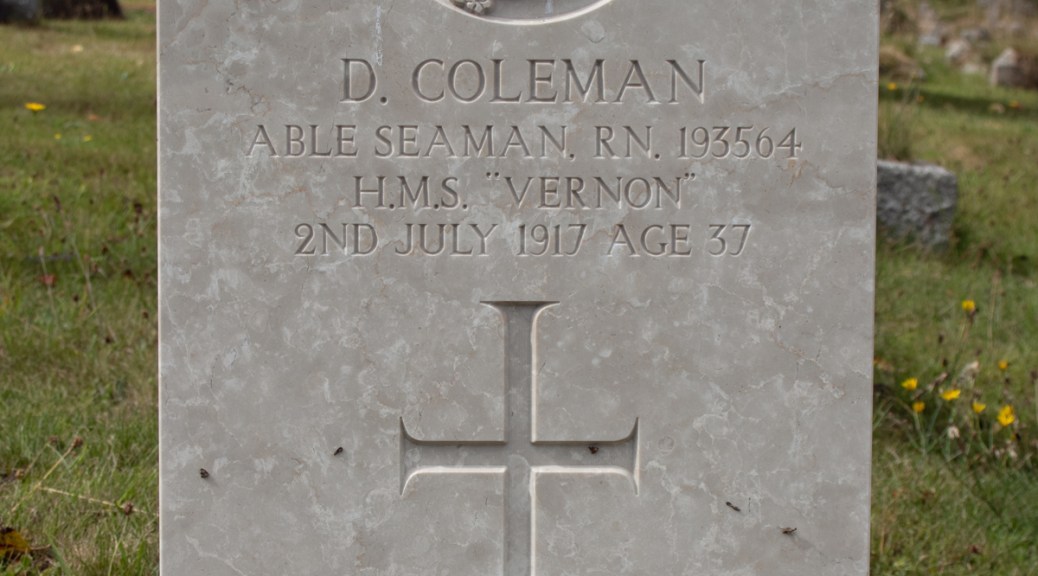
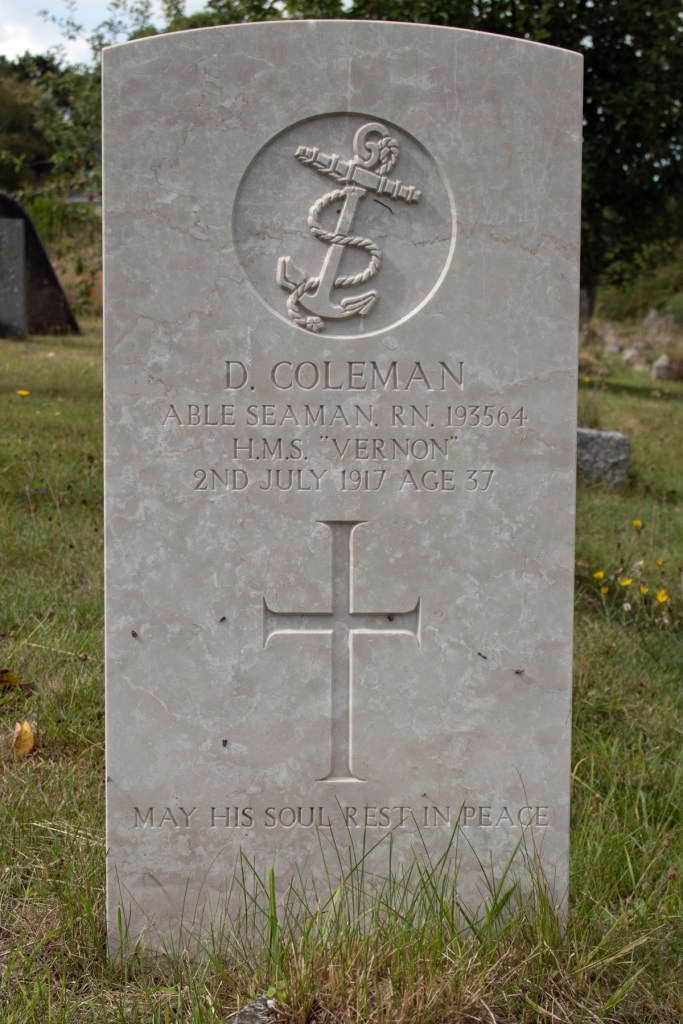
Able Seaman David Coleman

Able Seaman David Coleman

David Coleman was born in the spring of 1880, one of nine children to Jeremiah and Mary Coleman. Jeremiah was a farmer from County Cork, Ireland, and it was in his home village of Killbrittain that the family were raised.

When David left school, he found work as a labourer and mechanic and, in the spring of 1896, he left Ireland for England in search of a bigger and better life for himself.

Things may not have gone quite to plan, however, and, on 17th March 1897, he enlisted in the Royal Navy. He was too young to enrol for full service at this point, however, and so he took on the rank of Boy 2nd Class. He was initially assigned to the training ship HMS Northampton and quickly made Boy 1st Class.

Over the next year, David served on two vessels – HMS Calliope and HMS Doris. When he turned eighteen, he was officially enrolled in the Royal Navy, and given the rank of Ordinary Seaman.

David remained on HMS Doris for nearly four years, and seemed to impress his superiors. By the end of his time on board, he had been promoted again, reaching the rank of Able Seaman.

Over the next nine years, Able Seaman Coleman served on ten different ships, each time returning to HMS Vivid, the Royal Naval Dockyard in Devonport. In March 1910, with his contract complete, he was stood down to reserve status.

The same year, he married Florence Tompkins, who had been born in Newton Abbot, Devon. The couple set up home in Totnes and went on to have three children. David found work as an electrician for the local electric light works.

War was coming to Europe by this point and, in August 1914, Able Seaman Coleman was called back to duty. He served for two years on board the battleship HMS Caesar and, having previously been assigned to HMS Defiance, returned there again. In May 1916, he was assigned to HMS Vernon, one of the shore-based establishments in Portsmouth, Hampshire.

It was while he was in Portsmouth that he fell ill, and was admitted to the town’s Haslar Hospital. Details of his condition are unclear, but he was to succumb to it, passing away on 2nd July 1917, at the age of 37 years old.

David Coleman was brought back to Devon for burial: he was laid to rest in the town’s cemetery, not far from the family home.


Tragedy was to strike the Coleman family again when, early in 1918, both of David and Florence’s younger children – David, aged 5, and Mary, age 2 – passed away. Causes of death are again unclear, but it seems likely to have been one of the lung conditions that would ravage Europe as the war entered its final stage.


Stoker Alexander Maguire

Stoker Alexander Maguire

Alexander Maguire was born on 28th March 1880 in Glenarm, County Antrim, Northern Ireland. Little is known about his early life, apart from his parents’ names – James and Ellen.

Glenarm is a coastal village, and it is likely that Alexander would have had experience of seafaring from an early age. This seems to have spurred him into building a career and, on 16th December 1903, he enlisted in the Royal Naval Reserve as a Stoker.

With war getting closer, Stoker Maguire was called into formal service, and was assigned to the steamer SS Rathlin Head. He sailed the Atlantic in March 1914, and disembarked an New Orleans. It seems, however, that he missed his passage back home, although at this point, his whereabouts become a bit hazy.

Alexander was back in Britain by 13th January 1915, as his service papers record him in Liverpool. He then travelled to HMS Pembroke, the Royal Naval Dockyard in Chatham, Kent. This looks to have been his last move, however, as he passed away just two days later. The cause of death is simply recorded as ‘disease’: he was 34 years of age.

Alexander Maguire was laid to rest in the Roman Catholic section of Woodlands Cemetery in Gillingham, Kent, not far from the dockyard to which he had been assigned.


Major George Hannan

Major George Hannan

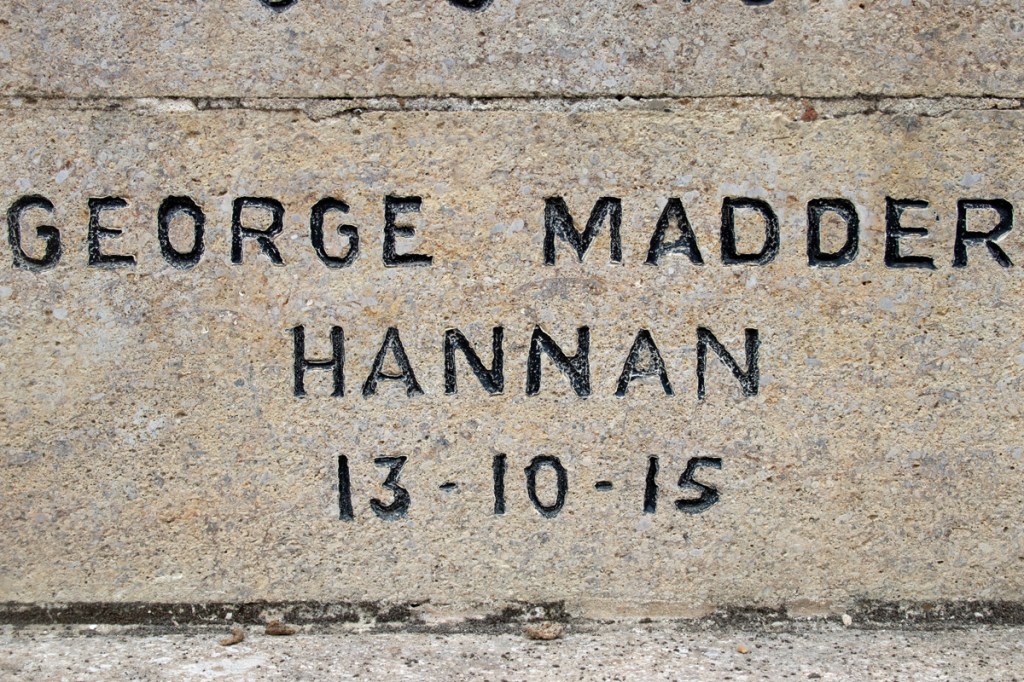
George Madder Hannan was born in Dublin in 1861, the son of banker Benjamin Hannan. There is little concrete information about his early life, but what can be pieced together produces the story of a well-travelled man.

On 22nd January 1896, George was initiated into the Lodge of Otago, a freemason’s collective in Dunedin, New Zealand. He is listed as being a Master Mariner.

George’s marriage certificate records that he wed Mary Carlisle on 27th October 1898. The wedding took place at St Jude’s Church in Kensington, London, and the groom was listed as a Gentleman. Mary was the daughter of a paper manufacturer, and had been born in Lancashire.

The next document for George is the 1911 census. This notes that he ad Mary were still living in Kensington, along with their only child – daughter Grace, who had been born in 1900 – and two servants. This time he is listed as being an army major, a special reserve officer.

Moving forward a few years, the next record for George is the notice of his funeral, in October 1915:

We regret to announce the death of Major Madder-Hannan, which occurred at May Bank on Wednesday morning. Major Madder-Hannan, who had only resided in the village [of Bearsted, Kent] for the past few months, held his commission in the 9th Service Battalion Cameronians. He had been an invalid since taking up his residence here.

Kent Messenger & Gravesend Telegraph: Saturday 16th October 1915

Sadly, no documentation remains about George’s time with the Cameronians. He passed away, presumably through illness, on 13th October 1915, at the age of 54 years of age.

Unusually, given the main family home was in Kensington, George Madder Hannan was buried in the village where he died. He was laid to rest in Holy Cross Churchyard, Bearsted.


Captain Roden Chatterton

Captain Roden Chatterton

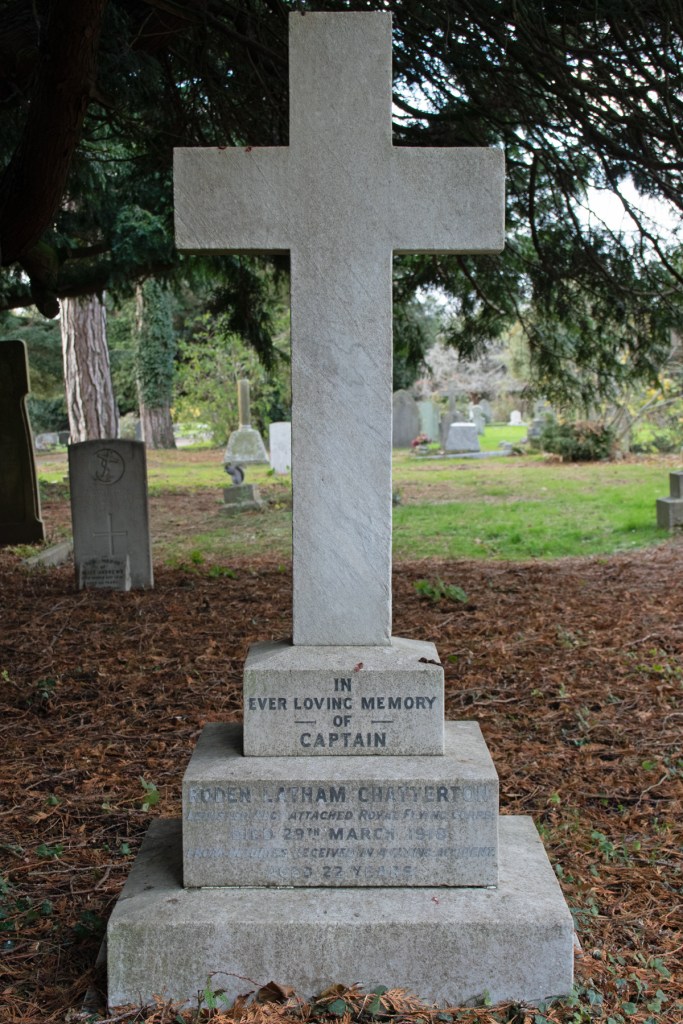
Roden Latham Chatterton was born on 13th July 1895, in Budin, Bengal, India. He was the only child to George and Ella Chatterton. George was a Lieutenant Colonel in the army, and had married Ella in India, where he was based.

The family had returned to England by the time of the 1911 census, but then moved permanently to Ireland. When war broke out, Roden joined up, enlisting in the 1st Battalion of the Leinster Regiment with the rank of Lieutenant. Full details of Roden’s military service are not available, but he arrived in France in January 1915 and, stayed there for the best part of two years.

In December 1917, the now Captain Chatterton transferred to the Royal Flying Corps. Based in Kent, he learnt to fly, and was close to gaining his wings, when an accident befell him in March 1918.

About 5:30pm on March 27th, [Captain Chatterton] was about 1.500 feet up, was trying to land near an aerodrome, and the wind was very rough. He shut off the engine and tried a left hand turn when the machine stalled and came down in a spin nose down and crashed to the ground. Several [people] went to his assistance. He was in great pain and made no remarks. He had been strapped in, but the belt had broken. The wind was from the south south-west. He came own into the wind and was trying to turn head into it when the machine got into a spin. It was not an ideal day for flying. Another machine… was flying with the deceased, and that landed all right. There was no collision in the air. When [he] turned he had not got the nose down far enough to keep up the engine speed and, in the witness’ opinion it was through an error of judgment on his part that the machine crashed. Had there been more space he would have got out of the spin. There was nothing wrong with the machine, but it was a type that was very difficult to handle in rough weather.

Whitstable Times and Herne Bay Herald: Saturday 6th April 1918

Captain Chatterton was taken to the Lees Court Military Hospital south of Faversham for treatment, but died of his injuries on 29th March 1918. He was 22 years of age.

Roden Latham Chatterton was laid to rest in a quiet corner of the Borough Cemetery in Faversham.


Ordinary Seaman William Nolan

Ordinary Seaman William Nolan

William John Nolan was born in County Kildare, Ireland, on the 8th October 1892, one of ten children to agricultural labourer Thomas Nolan and his wife, Anna.

There is little documentation connected to his early life, but when he left school, William found work as a porter, and it was this that he was doing up until war broke out in 1914.

William was conscripted on 1st March 1915, joining the Royal Navy as an Ordinary Seaman. His service records show that he stood 5ft 5.5ins (1.66m) tall, had brown hair, brown eyes and a fresh complexion. He was also noted as having tattoos on his forearms, and a scar on his right one.

Ordinary Seaman Nolan was sent to HMS Pembroke, the Naval Dockyard in Chatham, Kent, for training. Within a month, he was given his first posting, on board the armoured cruiser HMS Lancaster. He spent fifteen weeks aboard and, over the next two years, he served on four more ships, returning to his base in Chatham after each voyage.

William came back to HMS Pembroke in July 1917: the base was particularly busy and cramped that summer, so much so that additional temporary accommodation was set up in the barracks’ Drill Hall. This is where Ordinary Seaman Nolan was billeted.

On the night of the 3rd September 1917, Chatham was bombarded by a German air raid, and the Drill Hall received a direct hit. Tragically, Ordinary Seamen Nolan was amongst those killed. He was just 24 years old.

William John Nolan’s body was laid to rest in the Woodlands Cemetery in Gillingham, alongside the other victims of the Chatham Air Raid.


Seaman James Anderson

Seaman James Anderson

James Anderson was born on 9th April 1892 in Galway, Ireland. He was one of eleven children to labourer Thomas Anderson and his wife, Mary. Thomas was a labourer and fisherman, and it was into the sea-faring life that James entered into when he finished school. The 1901 census notes that the family were Roman Catholic, and that, while not all of them were able to read and/or write, those that could – James included – could do so in both English and Irish.

James was set on using his knowledge of boats to build a career for himself and, on 9th December 1911, he enrolled in the Royal Naval Reserve. His service records show that he was 5ft 3.5ins (1.61m) tall, had a fresh complexion and blue eyes.

Over the next few years, Seaman Anderson served on a number of different vessels, plying the seas around Ireland, to and from Liverpool. He was on board the Cressy when war was declared, and within a couple of weeks, he had been stationed at HMS Pembroke, the Royal Naval Dockyard in Chatham, Kent.

There is little information about James’ life during the war, although, as he appears to have been permanently based at HMS Pembroke, it is likely that his skills were being put to training new recruits, rather than serving at sea.

As the war progressed, Chatham Dockyard became busier. In the summer of 1917, the base became so overcrowded that temporary accommodation was set up in the barracks’ Drill Hall: this is where Seaman Anderson found himself billeted.

On the 3rd September 1917, the first night air raid carried out by the German Air Force bombarded the town, and scored a direct hit on the Drill Hall; Seaman Anderson was among those killed that night. He was just 25 years of age.

James Anderson was laid to rest, along with the other victims of the Chatham Air Raid, in the Woodlands Cemetery, Gillingham.


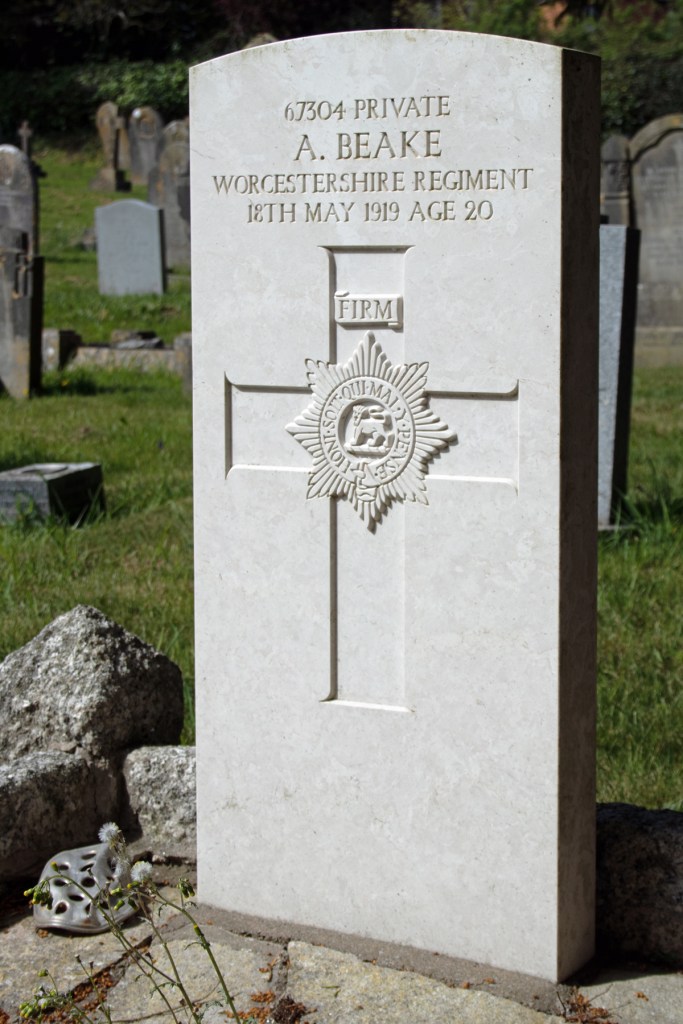
Private Alfred Beake

Private Alfred Beake

Alfred Beake was born in December 1898 and was one of nine children to Alfred and Charlotte Beake. Alfred Sr was a baker from Westonzoyland in Somerset, but it was in Chard that he and Charlotte had set up home and raised their family.

There is little documented about Alfred’s life. He played his part in the First World War, and had joined the Worcestershire Regiment by November 1918. His troop – the 5th (Reserve) Battalion – was a territorial force, and he would have split his time between Harwich, Essex, and Plymouth, Devon.

Private Beake survived the war and, by the spring of 1919 had been moved to Dublin. It was here on 18th May that he met with colleagues Private Simpson and Swindlehurst in the centre of the city. The trio caught a tram to the coastal town of Howth for a day out, where tragedy struck.

The Dublin Evening Telegraph reported on what happened next:

Private Sydney Simpson, Royal Engineers, stated… when they got to Howth, they walked along the Cliff Walk for about a mile, when they saw some seagulls down the cliff. [Beake and Swindlehurst] went out of witness’s sight for a while, when he heard a shout from Swindlehurst for help. On hurrying back, he saw Swindlehurst looking towards the sea, and he said the deceased had slipped down. The cliff was so steep that, although they tried to get down, they could not do so. Witness sent for help. None of the party had taken any drink.

Private Swindlehurst… said that he and deceased climbed down the grassy slope to get some seagulls’ eggs, but that the deceased suddenly slipped down. There was no horseplay going on at the time when the accident took place.

Captain Wynne, Royal Army Medical Corps, who made a post mortem examination, described the terrible injuries which the deceased had sustained. Death must have been instantaneous.

Dublin Evening Telegraph: Wednesday 21st May 1919

Private Beake had suffered a fractured skull from the fall. He was just 20 years of age.

Alfred Beake’s body was brought back to Somerset for burial. He was laid to rest in the family plot in Chard Cemetery.


Alfred’s oldest brother, Walter George Beake, had also served in the First World War.

Private Beake fought with the 7th Battalion of the Somerset Light Infantry, and was involved in some of the key skirmishes of the Somme. But it was at Ypres that he was buried alive during an attack, and the resulting shell shock left him totally incapacitated.

Walter was discharged from the army on medical grounds in September 1916. He returned home to try and piece his life together again. He never married, and passed away in December 1978, at the age of 87 years old.


Major Stafford Douglas

Major Stafford Douglas

Stafford Edmund Douglas was born on 4th January 1863, the second of four children to Stephen and Mary Douglas. Stafford came from a military family, his father having been a Captain in the Royal Navy. This led to a lot of travelling and, having been born in Donaghadee, County Down, he then moved to South Wales.

By the 1880s, when Stephen and Mary had set up home in Portsmouth, Stafford had started to carve out a career for himself, and was a Lieutenant in the Argyll and Sutherland Highlanders, based at Edinburgh Castle.

Over the coming years, Lieutenant Douglas, who stood 5ft 8.5ins (1.74m) tall and also spoke French, travelled the world, serving in South Africa, Ceylon (Sri Lanka) and Hong Kong. By 1894 he had made Captain, and he finally retired in 1903, after nineteen years’ service.

On 29th April that year, at the age of 40, Stafford married Mary Louisa Harris. She was the daughter of an army colonel, and the couple wed in St George’s Church, Hanover Square, London. The couple set up home in Exeter, Devon, and went on to have two children – Violet and Stafford Jr.

At this point, Stafford’s trail goes cold. When war broke out in 1914, he was called back into duty, working as a Railway Transport Officer in Norwich. He continued in this role until 1919, before being stood down and returning home.

Stafford Edmund Douglas passed away on 15th February 1920, at the age of 57 years old, although no cause of death is immediately apparent. He was laid to rest in the Milton Road Cemetery in Weston-super-Mare, presumably where his family were, by this time, residing.